You know you've thought this, too. A co-worker starts skipping out on your lunch group a couple times a week, then altogether. They rush out the door at the end of the day with some mention of "running." Or they show up at work in the morning with a red face and maybe even a tiny bead of sweat on their brow, then proceed to drink four glasses of water before you even down that first cup o' joe.
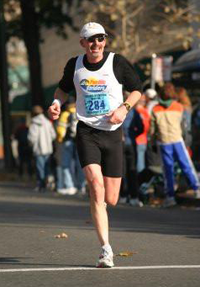
Then, after a few months of this, they show up one Monday morning moving a little slower than usual, and announce that they "ran a half-marathon over the weekend"!
What? A half marathon? What is that? You? You ran over 13 miles? In one day? I don't believe you!
So the mystery begins. Do people really do this? Or are they actually just sitting home watching football and eating hot dogs all day on Sunday?
It turns out that they are probably telling the truth. The half marathon is quickly becoming one of the most popular distances in the sport of running. Back in the 80s, it was marathons (26.2 miles) or 10ks (6.2 miles). Throughout the past 20 years or so, there didn't seem to be any running race distance that was notably more popular than any other. But now it seems like everyone wants to do a half marathon. What is going on?
Here's what I think is happening. People have figured out that, in most cases, a person can complete a 5k or 10k race (or even a 12k, like Bay to Breakers) with little or no training. Indeed, they can simply walk most of the way, which would only take a few hours at most: "Ta da! I finished a 10k!"
Certainly, if you make the effort to finish one of these events, whether walking or running, you are to be commended for making the effort to exercise. But many dedicated runners started thinking "Wait a minute. I'm a 'runner,' so I should be able to do something harder than that." The first thing that comes to mind is a marathon, but there's a problem. Training for a marathon is an enormous endeavor. But more importantly, when you run a marathon, you are then pretty much out of action for at least a few weeks, other than maybe limping around the block.
So people started trying half marathons. It turns out that it's the ideal long distance for anyone who considers himself/herself a runner. You can't really do one without some significant perseverance and dedication, i.e., training. But the best part is that you feel pretty much back to normal after only a few days or a week. Even my son got into the act this past summer, only a couple weeks before his 18th birthday (he ran the Giants Half Marathon in a blazing sub-1:33, beating the 2nd fastest 17-year-old by over 15 minutes).
So how do you train for a half marathon? One way to look at it is that you train the same way as you would for a 5k, 10k, or 12k, only more. That is, you have to train your body to run longer distances, but the pattern of training is about the same. If you want to run one "fast," then there is more to it - there are speed and strength elements that you have to add to your training regimen. A running coach like me would be able to help you outline a training program for either just finishing or trying to run a faster race.
You also have to choose a half marathon that's a good fit for you. There are huge ones, tiny ones, trail half marathons, women-only events, and so on. We are fortunate here in the Bay Area to have a great selection of races to choose from.
So what are you waiting for?