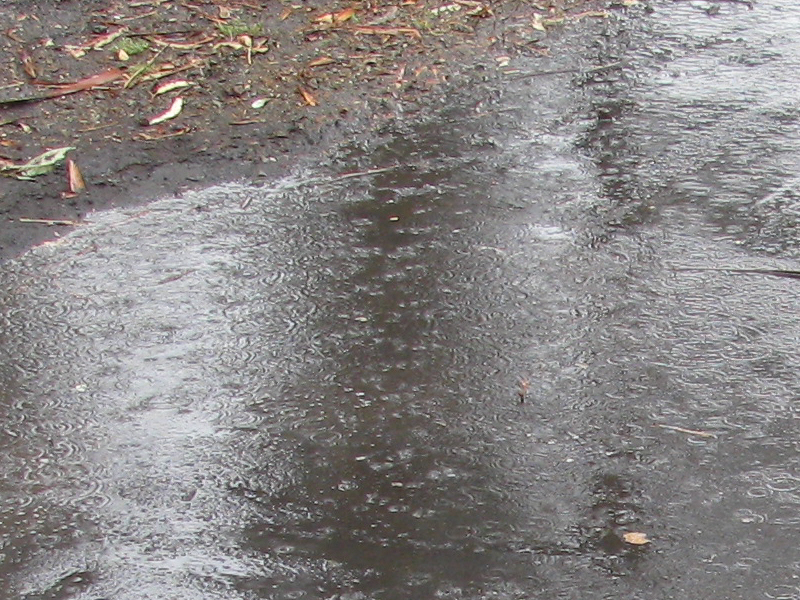
We've been hearing all week about the awful weather people are having in most of the rest of the country - I definitely sympathize with them. Meanwhile, we are getting very concerned with our lack of rain. I have confidence that we'll start getting some rain pretty soon, so it's worth thinking about running in the rain so that we're ready for it when it comes along. Here is a recap of appropriate clothing for running in the rain.
After the Run
That's right. What you have to put on after your run is way more important than what you wear while running. That's because you will generate heat while you run, so you aren't going to get too cold during the run itself (at least not around here). But if you're wet from the rain, you will get cold very quickly once you finish. Always have a pair of sweatpants to put on, as well as a dry shirt and a sweatshirt, and maybe even a hat. If you know you'll be getting out of the rain before too long, then those items don't have to be waterproof (or -resistant), just dry. A good way to keep your clothes dry (if you're going to stash them somewhere outdoors while you run) is to put them in a plastic bag. Even a basic plastic bag from a shopping trip will work. A large zip-loc bag is best, but probably not necessary.
During the Run
Like I wrote above, you probably won't get too cold during a run in the rain. The joke I always tell my clients is, "If you start getting cold, run faster!" They laugh nervously, then speed up. Seriously, though, it is good to wear a shirt made of man-made fabric. You can get a fancy "technical fabric" shirt, or even a cheap polyester-based shirt - I've seen these for as little as $5-10. The advantage of these artificial fabric shirts is that they hold less water than cotton, so will keep you a little warmer. The other advantage, primarily for men, is that they will cause less nipple-chafing than a cotton shirt. This is generally less of an issue for women because sports bras fit relatively tightly, so minimize the friction between fabric and skin. But nipple-chafing is a common and painful issue for men, so try to avoid it with this kind of fabric (although you can also put a little vaseline or even regular lip balm on them to help, too).
The other accessories I will wear in the rain are a hat and gloves. I wear a hat anyway to keep the sun off of my face, but in the rain, it can keep the rain off of it. Rain won't harm your face like the sun will, but it can be annoying. For gloves, I usually just wear a simple pair of lightweight cotton or polyester gloves - it seems I only need a little extra warmth, so even when cotton gloves get wet, my fingers don't get too cold.
What about something warm for your legs? Unless it's very cold - say down around 50° or colder - I find that I don't really need to wear running tights. It seems to be just fine to have dry sweats to put on afterward. But if your legs get cold, some lightweight running tights can do the job. People living in colder climates might need more than one pair to cover more variation in temperatures.
The Next Day
Whenever you get home, you need to start thinking about tomorrow right away. Why? Because it might rain again tomorrow! Unless you have two (or more) of everything, you need to get it all dried out for the next day. The good thing is that all this man-made fabric I've been writing about dries pretty fast (but may not be appropriate for your clothes drier). Unless your stuff got really muddy or sweaty, you can probably just hang up your shirt, gloves, hat, and tights (if you wore them), and they'll be dry by morning. Just be sure to wring out any excess water first.
To dry your shoes, take out the insole, then stuff them with newspaper. Before you go to bed, pull that newspaper out. If the shoes are still wet, stuff some fresh newspaper in them, and they should be dry by morning.
What's your favorite tip for running in the rain?
Marty Beene, Owner of Be The Runner, holds certifications from USA Track & Field (Level 2 Endurance Coach) and from the National Academy of Sports Medicine (Personal Trainer, Fitness Nutrition and Senior Fitness Specialist).