Schools
Mac High Students Defy All Stereotypes
At MacGregor High School, a small environment helps high school students succeed.
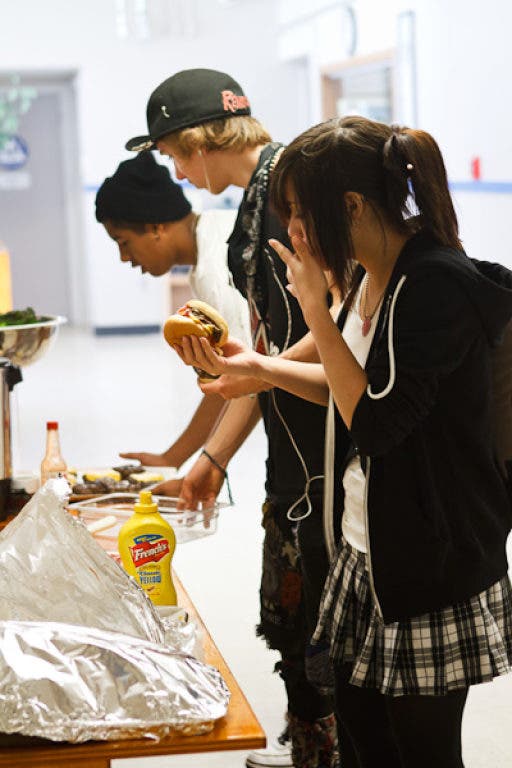


An unseasonably warm spring day, burgers on the grill, a gathering of students: What a perfect setting for getting to know this often-misunderstood school. Every Friday, Principal Alexia Ritchie treats the whole school to lunch prepared by the zero period Culinary Arts class – provided that attendance and behavior rules have been followed.
MacGregor students are well aware of the stereotypes surrounding their school.
“People think we’re rowdy,” said junior Stuart Swanson, a decidedly non-rowdy looking young man with short blond hair and a clean white T-shirt.
Find out what's happening in Albanyfor free with the latest updates from Patch.
Kaili James, a senior, stood across from Stuart chopping onions for the vegetarian empanadas being catered for the middle school wrestling team.
“People despise Mac High," she added. "They think we don’t learn anything, that we do drugs, steal and get in trouble with the police.”
Find out what's happening in Albanyfor free with the latest updates from Patch.
Instead Kaili has been working so hard at MacGregor that she will be eligible to graduate early.
“The environment here is less stressful [than at ]," she said. "I know the students and teachers better, which makes it easier for me to concentrate and do my work.”
The reasons for attending MacGregor, a continuation school of 65 students, are as varied as the students. Most are here because of credit deficiencies which threaten their ability to graduate on time. Students may have fallen behind due to home-related stress, their own or a parent’s illness, learning or behavior issues that interfered with classes, missed school or the challenges of navigating a large high school.
Principal Alexia Ritchie has been with the school since 2001. She chose to have her office right next to the kitchen – home of the popular culinary arts classes – to be near the action. She sees MacGregor as a microcosm of what is going on at Albany High.
“Most of the kids here work hard, want to be respected and want to learn to respect others in their community,” she explained, as we observed the students getting the burgers ready for the grill. “Students like the structure at MacGregor, but they also appreciate their independence.”
She adds that teachers expect the kids to take responsibility for their own education. “The teachers are not here to police or nag them,” she said.
Diane Peterson, a petite blonde with lots of energy, serves as the part-time guidance counselor at MacGregor. She said she loves being there because, while she may see some students enter the school with few goals and aspirations, she is there to “see the light bulb go on with these kids, and before I know it they are taking community college classes and are preparing for productive lives after high school.”
Ritchie expanded on this point. “The smaller setting diminishes incidents of bullying or acting out in class. There is no tolerance for drug or alcohol use, and I find that no one is impressed by these types of misbehavior at MacGregor,” she said.
Ritchie was able to choose the central location for her office because the district last fall. MacGregor moved to the corner of Brighton and San Gabriel avenues, a return to its roots, since the school held its first classes in this building in 1981.
Virginia Behm became MacGregor’s first principal after recognizing the need for an alternative high school. As director of student activities, she saw students slipping through the cracks at Albany High.
Behm, who went on to serve as Albany High principal and deputy superintendent of Albany schools before her retirement, said the original purpose of MacGregor was to provide “a small environment with supportive adults, where students could blossom.”
This philosophy and the accompanying success have continued. Teachers at MacGregor develop individualized curricula to support students in completing enough credits to graduate on time, allowing the school to boast a 95 percent graduation rate. The school's five teachers, who combine to provide 2.6 FTE (full time equivalent positions), each have a graduate degree in the discipline in which they teach.
Ritchie explained, “It is our mission to provide alternative ways to a high school diploma that can work for all of our students.”
After finishing his cheeseburger out on the blacktop, junior Gerson Diaz commented that the teachers “don’t treat you like ‘bad’ kids; they just treat you like humans.”
Chelsea DePianto, a sophomore with long brown hair, explained, “You get more one-on-one time with your teachers, and you get the help you need.”
Junior Athos Costa added, “We can build real relationships with the teachers. They care about their students.”
Although there isn’t much landscaping on the playground of the former primary school, Ritchie’s eyes glow when she talks about plans for raised beds, built and maintained by students, that will contain a kitchen garden. The new garden will be a mere 10 feet from the school's professional-grade kitchen.
In addition to being the place where students learn about cooking, restaurant management and catering, the kitchen has become a focal point for the greater Albany community. MacGregor students hosted a Thanksgiving dinner for the adult school and the Transition Special Ed program (for ages 18-22), which share their campus.
Elementary and middle school classes often join MacGregor students in the kitchen for cooking-related field trips. The teenagers who work with the younger students demonstrate their pride in giving back to their community in a positive way. And the second graders, who watch attentively as the MacGregor students use knives to prepare the filling for potstickers, are clearly impressed by their interactions with these teens.
Students appreciate the community they are building at MacGregor. Several students said the school feels like a family, with support coming from both the staff and other students. While they may miss seeing Albany High friends at lunch, they can keep up with them through participation in Albany High extracurriculars, such as music or sports.
As part of the Western Association of Schools and Colleges accreditation process, Ritchie surveyed alumni last spring to find out what they are doing after MacGregor High.
Of the 80 alumni she found, 43 percent are enrolled in a two- or four-year college, including local community colleges, nursing school, art school, UC Berkeley, Berklee College of Music and the University of Texas, Austin (Ph.D.).
Eleven percent are attending vocational institutions (beauty school, auto repair school or the San Francisco Culinary Academy).
Another 36 percent are employed in industries such as business, service, food, healthcare and construction; 10 percent are in the military.
(Those questioned included both recent graduates and those from the more distant past.)
Current students said they have a good idea of what they want to do after graduation. Their aspirations include attending community college; studying film, beauty or culinary arts; and working as a firefighter or in bio-tech.
They can have these dreams because, as Tashi Dorjee, a senior from Tibet with spiky hair and a winning smile, said, “MacGregor High gives us a chance for a new beginning.”
Senior Nadia Deetz, dressed in a summer top to celebrate the warm day, sums it up: “Students here just need credits. They may have slacked off, but now they are trying to fix it and to make their lives better.”
Student Kaili James added that “MacGregor students are working hard to turn things around and to graduate.”
Manuel Ramirez, a senior in a green shirt and neat dark hair, agreed. “Being at MacGregor allows you to earn credits faster, and it gives you a chance to shine,” he said.
Everybody makes mistakes ...! If there's something in this article you think should be corrected, or if something else is amiss, give editor Emilie Raguso a call at 510-459-8325 or shoot her an e-mail at emilier@patch.com.