Arts & Entertainment
Poetry at Albany Library: Words of Witness Tackle Terrorism, Healing
An Albany Library reading demonstrates the power of poetry In overcoming the impacts of violence.


"Unlike an aerial attack, a poem does not come at one unexpectedly. One has to read or listen, one has to be willing to accept the trauma," wrote Carolyn Forché in the introduction to her landmark 1993 anthology of war poetry, Against Forgetting: 20th Century Poetry of Witness.
Not surprisingly, Forché’s anthology was invoked at least one or two times at the Albany Library last Tuesday evening. It was in a similar spirit of willing witness that almost 30 people gathered to hear readers Susan Griffin and Anita Barrows, for the event was an anticipatory homage to the forthcoming volume Transforming Terror: Remembering the Soul of the World. Griffin is one of the editors (along with Karin Lofthus Carrington) and Barrows one of the contributors.
Due to hit shelves in May, the collection includes essays, prayers and meditations as well as poems by a broad range of contributors, with the goal of exploring "how we might transform the conditions that produce terrorist acts and bring true healing to the victims of these acts."
The focus of the evening, however, was on the poetry—along with art, as the readers stood in front of a projection of the book's cover image, a painting by Claudia Bernardi, whose work reflects her experience of the Argentinian genocide.
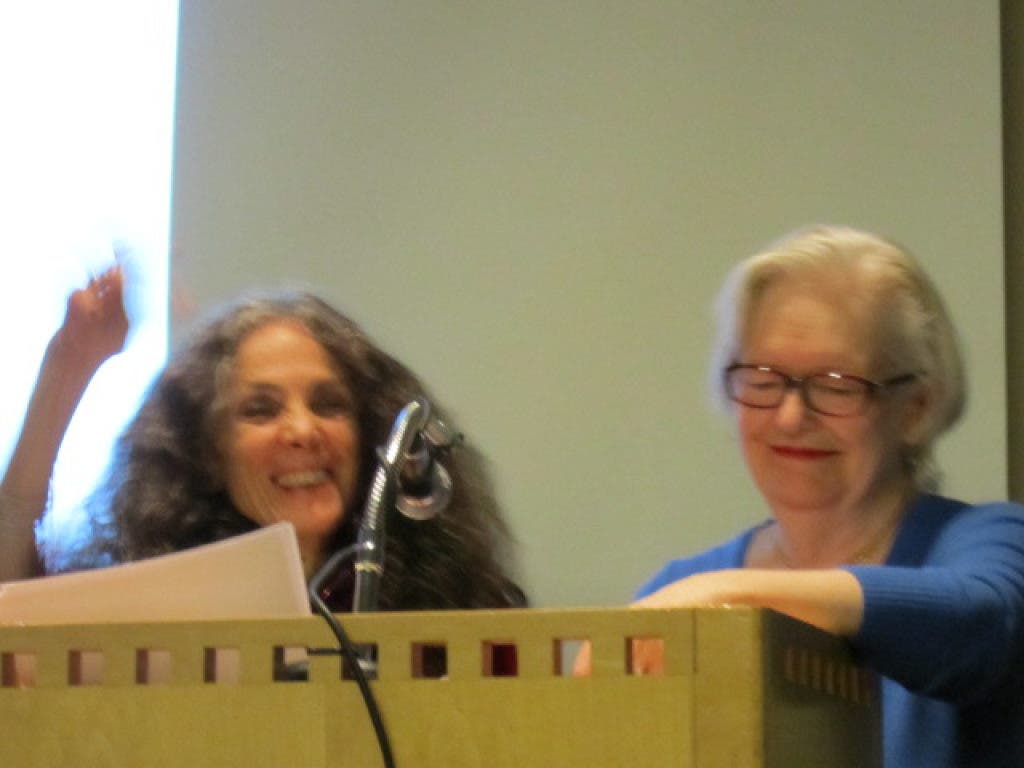
Taking the podium together, Griffin and Barrows immediately (and unintentionally) diffused the weighty topic of the evening by losing most of their notes. Griffin spent a few moments searching while Barrows waved to her infant grandson, burbling in the audience, and dedicated her reading to him.
"Well," declared Griffin after a minute of searching, "let’s wing it—it’s fun!"
Thus began, on an upbeat note, a tour of many of the poems in the anthology, with Barrows and Griffin switching off, reading poems from around the world and across the centuries.
Find out what's happening in Albanyfor free with the latest updates from Patch.
There were voices from prisons and concentration camps; there was Spanish Civil War hero Federico Garcia Lorca, Sufi poet Hafiz, Palestinian poet Mahmoud Darwish, Chilean poet Ariel Dorfman, local legend Alice Walker and a poem called "Prayer" by Forché herself.
Griffin paused at one point to explain that the poems in the book are in an "emotional order," focusing consecutively on terrorism, trauma, denial, "the dark," justice, gender, compassion and, finally, an “activist chapter.”
The reading was informal and interactive, as audience members at several points asked the readers to repeat names of authors or titles of poems, and occasionally corrected pronunciations of poets’ names.
As Barrows and Griffin prepared to shift from Transforming Terror’s poems to reading their own work, listeners were encouraged to stand up and take a "stretch break."
The transition was nearly seamless, since the themes of war and terror were present in both poets’ works.
Find out what's happening in Albanyfor free with the latest updates from Patch.
Barrows began, reading Poem in Time of War, 2006, a piece in several sections, about the Israeli invasion of Lebanon. In the final section, she overhears her 6-year-old granddaughter talking with a friend. "Are there still wars going on?" one child asks in surprise. "There are always wars going on," the other answers.
Griffin read from a series of poems inspired by the story of painter Claudia Bernardi, which have since been turned into a play. One poem was from the points of view of four different soldiers involved in the killings in Argentina; another, called Map, was about Bernardi’s process of drawing and documenting piles of bodies afterwards.
The poem Quiet was so powerful, yet short, that it caught the audience off guard, and Griffin was asked to read it again: “The quiet was not calm, but consuming/As if time were hungry for every moment of our future lives."
In the pause after the poem, I was briefly able to sense how silence might not relax, but devour -- how, after trauma, time itself could chew up one’s future.
This is witnessing, once removed. Without undergoing these experiences ourselves, the words are as close as we can get. And witnessing —understanding violence and its effects—is an important step toward Griffin’s goal of "moving the world beyond violence as the first, and often only, response to violence."
Transforming Terror, appearing almost two decades after Against Forgetting—and at the close of our first decade in the post 9/11 world -- couldn’t come at a more relevant time. As Forché wrote back in the 20th century, "The resistance to terror is what makes the world habitable."
Everybody makes mistakes ... ! If there's something in this article you think should be corrected, or if something else is amiss, give editor Emilie Raguso a call at 510-459-8325 or shoot her an e-mail at emilier@patch.com.