Arts & Entertainment
Touching Up History, One Galloping Horse at a Time
Albany artist Lise Liepman returns carousel animals to their past ornate glory.
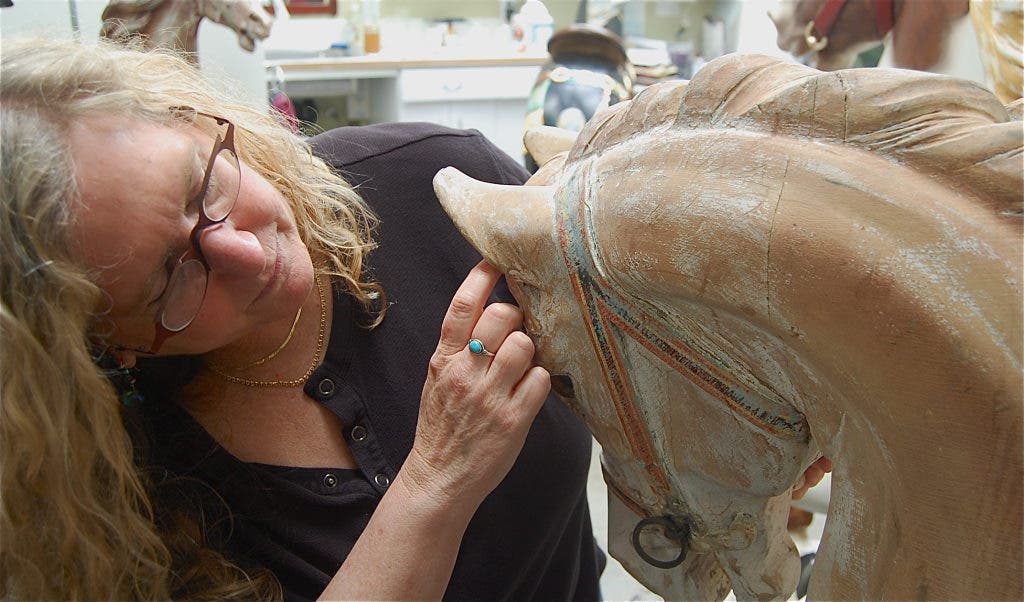


Every few months three new horses take up temporary residence in an otherwise typical neighborhood in Albany. But none of the neighbors mind. In fact, they may not even notice as the animals are brought around back to a small one-room building that used to be a garage.
The horses stay just long enough for Lise Liepman to restore them to the glory they knew when they were carved almost 100 years ago. Liepman is one of the foremost carousel animal painters in the country and for the last 30 years has been refinishing the works of master craftsmen who created animals to delight children around the turn of the 20th century.
Local residents have probably seen her work as they rode the carousel at the San Francisco Zoo. One of her first jobs was as an apprentice at the restoration of the Tilden Park merry-go-round which celebrated its centennial on August 13. She’s quick to point out that she was just learning at the time and very little of the original work from that restoration is even visible since the horses have all been redone.
Find out what's happening in Albanyfor free with the latest updates from Patch.
Liepman also takes pains to point out that only half of the San Francisco Zoo animals are her work. “I worked on that with a friend who has since moved to Arizona,” she says, “We each did some.”
She has been at her craft for so long that she’s now beginning to get commissions to restore work she completed almost 20 years ago. That’s where the semi-regular horse delivery comes in.
Find out what's happening in Albanyfor free with the latest updates from Patch.
As she tells the story, “I restored part of this carousel for a collector in Southern California about 20 years ago, but the owners decided to sell it.”
“We just restored the outside row of 18, the first time, but the new owner now wants all 52 of them done.” she says.
Most look pretty good to an untrained eye, but as Liepman notes, “Silver and gold leaf don’t wear well and the silver tarnishes,” so they need work. The small garage-turned-studio can only hold a small herd and the horses, all about 5-6 feet long and 4-5 feet tall, have to be rotated in and out.
The building has six skylights which provide ample light and with the assistance of her cat, Samir, Liepman can be found painting, at some point, most every day.
Lise began her restoration career when she ‘almost’ graduated from UC Berkeley in the '70s. “I met a guy at a folk dance class who took me to his parents' art gallery - The Red Bug in Walnut Creek. He was probably trying to impress me that his parents were artists, but his mother and I had an instant connection when I saw her restored carousel horses.” Nothing lasting came of the relationship with the young man, but Lise and his mother became close fiends and she left Cal just a few credits short of graduation, to learn the restoration trade.
“I was a fine arts major,” she says, “So I knew something about art, but I learned more from his mother than I learned from almost all my college professors.”
Her tutor had learned the craft almost on her own, since her father owned an amusement park in Seattle. When he died he left it to her and her husband.
Eventually Liepman went back to Cal, graduating with a degree in American Folklore, Carousel Art and History.
Since she learned the trade she’s never looked back, restoring full carousels of horses and other wild animals, as well as individual pieces for collectors. She does about 20-25 a year, although the past year has been a bit slower, but she has about a two-year backlog now.
She estimates that each animal takes between 40-100 hours of work, over 2-3 months and at her hourly rate, she adds, “I’ll never be rich.”
“I can work on three or four animals at a time,” she points out, “ since paint and gold leaf have to dry, and varnish has a specific time frame for applying second or third coats.”
There used to be several local craftsmen who did the actual restoration of the wood, but now she works with a couple in Long Beach, Ed and Adriana Roth. “It makes the logistics tougher, but they do a great job.” They often meet in San Luis Obispo, where her mother lives. “My job is to bring out the character in the wood-working, that’s where the real art is,” she adds.
Most of the horses were originally carved in pieces from solid planks by artisans on the East Coast around the turn of the last century. They each had their own theme, many featuring cowboys or the Wild West. Some had regional characteristics like those of The Parker Flying Horse Company in Leavenworth, Kansas, which often had a ear of corn tucked behind the saddle.
As the horses aged they were not always lovingly restored, but maintenance workers simply got them fixed up and repainted as best they could. “If the carousel isn’t running, no one’s making money,” she points out, so speed was important.
Around the 1950’s and 60’s the horses became very popular and people bought whole carousels to restore and sometimes to sell in pieces. “That’s a bit of a political issue in the field,” she notes, and at one time there were even competing professional organizations founded on both sides: those who favored keeping carousels intact and those who believed that if there wasn’t enough money to save the whole carousel, then at least the individual pieces could be saved.
Liepman says there are a number of local collectors who she has worked for, but she admits the best part of the job is dealing with the people, “I really enjoy working with my customers,” she says. “Some have a definite idea of what they want and others it’s more of a collaborative effort.” In 33 years she says she’s only had one bad experience where she and an owner could not agree on a color scheme.
For anyone who’s just acquired an animal, she says it not really necessary, to match the original colors. “In most cases, you can’t match the colors, and there isn’t enough paint left to tell,” she says. So, she just advises people to pick colors they will enjoy. One Kensington couple who just had a horse restored, picked colors that matched the room where the horse will be displayed.
“It doesn’t hurt the value at all,” she says. Some of the more unique and larger pieces can fetch up to $100,000, but most are valued between $3,000 and $20,000.
After 33 years, does she have any regrets, “Are you kidding me?" she asks, “look at where I work - surrounded by great art. I wouldn’t change a thing.”
Everybody makes mistakes ... ! If there's something in this article you think should be corrected, or if something else is amiss, call editor Emilie Raguso at 510-459-8325 or email her at emilier@patch.com.