Sports
Why Don't You Compete? (Part I)
What's keeping you from balancing fitness with work and family life? An Albany triathlete offers some tips.
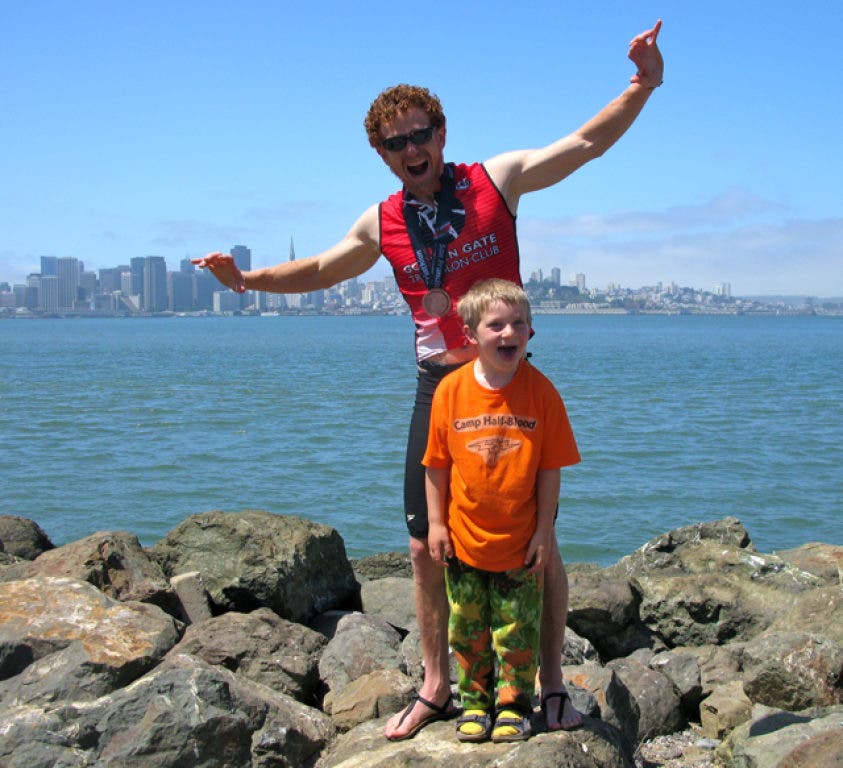
Last time in this spot, I presented some key motivations for why I compete. In this and my next few articles, I want to explore some of the roadblocks we all face (including myself) in our attempt to balance our working and family lives with our physical fitness needs. Not a day goes by without some new report about the physical, mental, or emotional benefits of exercise. Everyone would benefit from having a fitness program that they can stick to long-term. Yet, despite best intentions, this eludes many of us. Why?
As someone who has been competing in triathlons for the past 10 years and still maintaining a day job plus family life (wonderful wife + 2 boisterous boys), I've apparently managed to integrate a long-term fitness program into my lifestyle. As I walk through some of the main reasons we often give for not exercising, I'm offering up myself as an example to describe the attitudes and approaches that have enabled me to fashion a fitness routine I can stick with. My strategies won't work for everyone but may provide some useful insights. And as a resident of Albany since 1998, I will also highlight local resources and features relevant to helping (or hindering) the attainment of a fit lifestyle.
I don't have time!
Find out what's happening in Albanyfor free with the latest updates from Patch.
This is probably the single most common reason for why we shortchange our committment to personal fitness. Our jobs, commute time and friend-family time fill up our days, leaving us with little free time at the end of the day and needing to maximize our sleep in the morning. Most of us classify fitness as an extra activity or reward that is permitted only if we do all of our "essential" assigned tasks.
My attitude (which I've written more about here) is that attention to physical fitness is an essential task – part of the basic maintenance that our bodies need to avoid breaking down – and is an essential ingredient for self-reliance. It's the best preventative maintenance act you can do to help you avoid the serious health consequences that can rob you of your health, job, or life if you neglect such maintenance for too long.
Find out what's happening in Albanyfor free with the latest updates from Patch.
My main solution: bicycle commute to work. I've been a dedicated, weather-be-damned bike commuter since I was a grad student (starting 1987) and I believe this has contributed the most to the success of my fitness. The Albany-Berkeley area is quite bicycle friendly and there are lots of bicycle routes in the area, ranging from dead-flat to ultra-hilly.
Even though my commute route is just 3 to 5 easy-to-moderate-pace, no-hill miles each way, it guarantees some minimal amount of daily conditioning that is infinitely better than zero exercise time. And the large number of short rides contribute substantially to fitness. I have direct proof of this because in the month leading up to my last triathlon event (Treasure Island Sprint on July 11), the only bike training I did was my short commute to and from work. Yet the bike portion of the race was the strongest part for me (I was 26th out of about 300 competitors in the 20 km bike leg).
Another great way to find time during the day is to work out during lunch break and then grab a quick bite afterwards or eat at your desk. This is a key window for me since my evenings and weekends are largely devoted to family time. This often requires a flexible job situation for times when the workout goes a little long (in which case I can put in extra time later). Quite often, I find the exercise break helps clear my mind and helps me think through difficult job tasks. It's also an opportunity to connect with co-workers who join me in the exercise outing and discuss work or non-work issues. So there are many intangible side benefits to working out on-the-job.
The routine exercise that you integrate into your daily schedule, such as my bike commuting, can have a major impact on weight management, which we all struggle with. I weigh the same as I did in graduate school when I started bike commuting in 1987, and here's why: I once did a "stick of butter" calculation to estimate much energy I burn during my standard bike commute. My five days a week of 6 to 7 miles a day roundtrip burns (and this is a conservative estimate) about 200 calories a day, which adds up to 4,000 calories a month – equivalent to about five whole sticks of butter a month that I'm burning. That's an extra 60 sticks of butter a year that I get "for free" simply for putting in a little bit of easy cycling each day going to and from work. And compared with car commuting, being on the bike lets me enjoy the outdoors, save money on gasoline and reduce greenhouse gases to boot. Quadruple win. (Here a good calories burned calculator for various activities.)
In future articles I'll continue looking at some other factors that limit our ability to keep fit, and examine fitness resources in Albany. Bear in mind: Should I inspire you to start up a new exercise program or make some dramatic change in your fitness lifestyle, first get clearance with your doctor before starting anything new. Best of luck!