Community Corner
Albizia Julibrissin or the Persian Silk Tree
This tree has a joyful and friendly vibe.
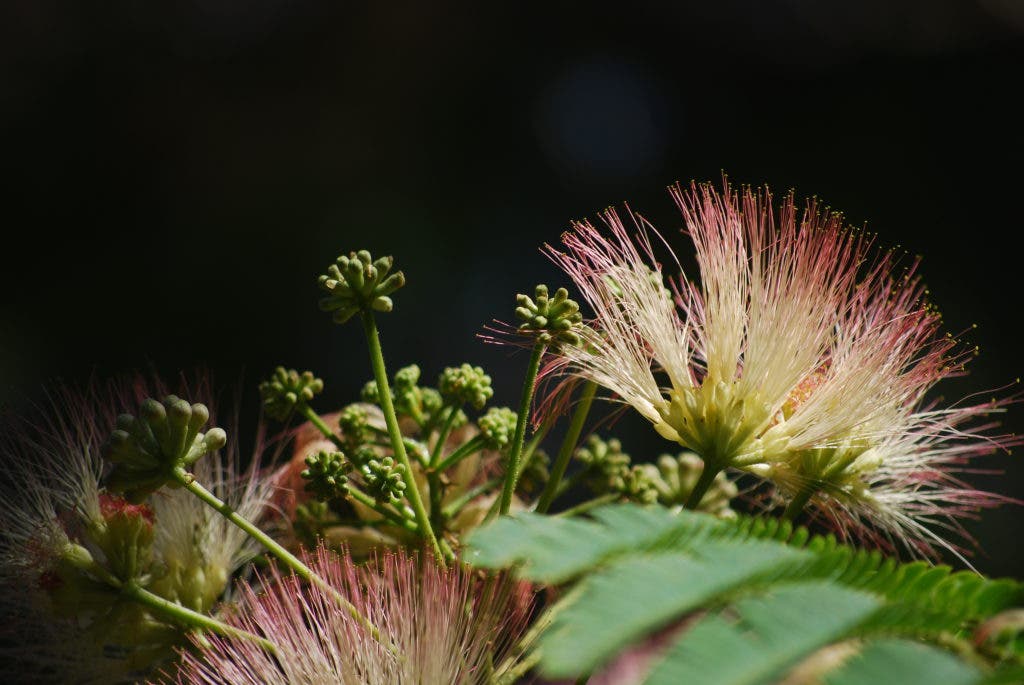

This August a delicate, pink flowering tree has caught my attention on the avenues in Burlingame. Every time I see one of these delicate, fragrant trees I get a peaceful and joyful feeling.
On my walk through this weekend I found another one, splendidly blooming, sharing its fragrance and beauty with everyone around.
Walking is a favorite past time because my pace can be adjusted for the many beautiful distractions in nature. When I look up into the trees, I hold my gaze there for a few minutes. Sometimes I follow my gaze with my third eye, the camera, to focus in on details or capture a moment of beauty.
Out and about there are “people-watchers,” and I am certain that I am the subject of some. Often children and adults have approached me to ask what I am looking at. Other times I notice people around me are looking up in the same direction I was just focused on.
I am a “tree-watcher,” and continually find fascination in their color, structure or personality. Trees educate and amaze me as they grow and change through the seasons and years.
This tree is officially named Albizia julibrissin, after an Italian nobleman Filippo degli Albizzii of the famous Florentine family Albizzi. He transported it from Asia to Europe in the late 1700s, and soon afterwards French botanist André Michaux planted it in his formal garden in Charleston, South Carolina.
Around the world people have created different common names that refer to its “silky” flowers or “sleeping” leaves that fold up and close at night. In the United States it is most often referred to as a silk tree or mimosa, but those names also refer to other plant species.
The umbrella-like shape of the tree provides room for all the flowers to spread their clusters of silky stamens skyward. A blur of soft pink colors the tree in layers, supported on willowy branches with feather-like leaflets. The opposing leaves hug close together to create a cool shady spot to relax under.
Its primary use is as a mid-sized shade tree adding color and texture to the landscape.
There are acclaimed medicinal uses as described in Traditional Chinese Medicine and Ayurvedic traditions. Flowers are said to improve memory, induce sleep or provide a sedative effect promoting calmness.
Interestingly, I find my personal experience in just viewing the Albizia julibrissin tree calming and restorative, leaving me feeling happy.
Find out what's happening in Burlingame-Hillsboroughfor free with the latest updates from Patch.
DISCLAIMER: Consult with your own health care provider. This information is intended for educational purposes only. Do not self-administer.