Neighbor News
The Only Ingredient You Need to Watch Out For
Europe now requires companies to name about 80 chemicals covered by it. American labels still say just one word.

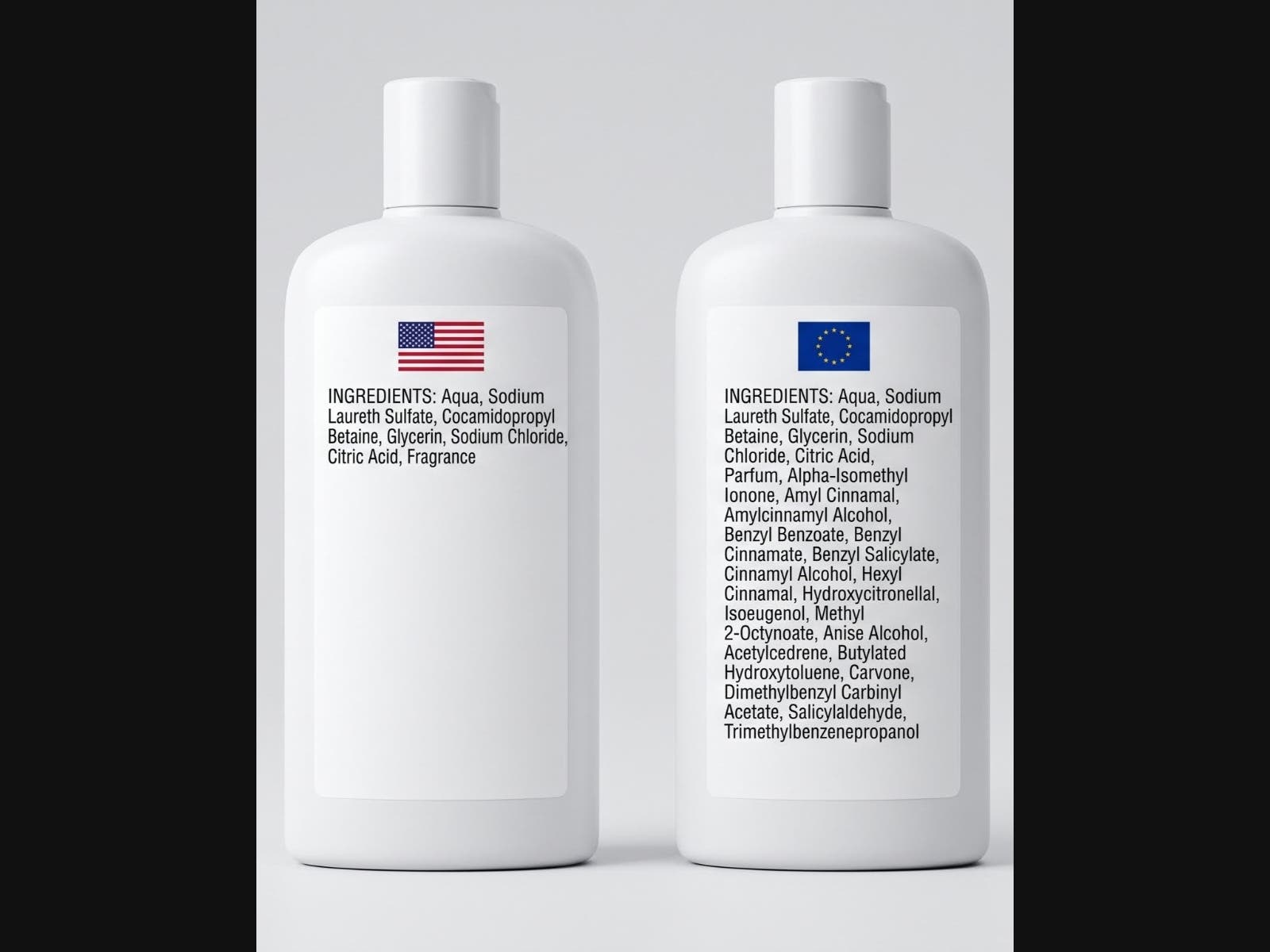
The same bottle of shampoo, from the same company, now carries a different ingredient list in Rome than it does in Castro Valley. As of last week, European labels on cosmetics, spanning shampoo, deodorant, lotion, soap and perfume, must name around 80 specific fragrance chemicals individually. American labels say just one word – "fragrance".
I noticed because I work in therapeutics discovery, and think about how small molecules bind to protein receptors on cells in the context of diseases and their treatment. What I did not expect was that a labeling rule would turn out to rest on chemistry rather than on smell. Nobel Prizes have been awarded for two aspects of how our bodies detect these compounds: the receptors that enable smell in 2004, and the detection of temperature and chemical irritation in 2021. What surprised me is that fragrance molecules engage both!
The reason is that "fragrance" is not one chemical compound. It is an umbrella term, drawn from an industry palette of nearly four thousand catalogued in the International Fragrance Association's Transparency List. Manufacturers are not required to disclose which ones they used, a provision originally motivated by trade secret concerns. The Code of Federal Regulations puts it plainly: the label "shall bear a declaration of the name of each ingredient in descending order of predominance, except that fragrance or flavor may be listed as fragrance or flavor."
Find out what's happening in Castro Valleyfor free with the latest updates from Patch.
To sell in the European Union, that is no longer enough: around 80 substances must now be listed explicitly when present above a threshold. Canada's equivalent law arrived the same week. Which raises the obvious objection: why should governments interfere with something as harmless as smelling nice?
I went to the regulation itself. Commission Regulation (EU) 2023/1545 concluded there is "a potential risk to human health arising from the use of the additional fragrance allergens identified by the SCCS." The Commission estimates that 1 to 9 percent of the EU population is allergic to at least one. The stated aim of the Canadian law was to enable consumers "to identify ingredients that they may be allergic to, sensitive to, or wish to avoid."
Find out what's happening in Castro Valleyfor free with the latest updates from Patch.
So this is not a debate about sneezing.
When certain fragrance molecules reach the skin, they are reactive enough to form permanent bonds with proteins already there. Immune cells then recognize the altered protein as foreign and mount a response, leading to allergic contact dermatitis (which often persists for years or decades).
Asthma is a second and separate problem, working by a completely different route: direct irritation of airway sensory nerves, immediate rather than delayed, and requiring no prior exposure. The California Department of Public Health lists fragrance ingredients in personal care and cleaning products among asthma triggers, and runs a Work-Related Asthma Prevention Program.
A third group of people report a broader chemical sensitivity that researchers are still characterizing, sometimes termed Multiple Chemical Sensitivity or Toxicant Induced Loss of Tolerance.
Strikingly, an internal Centers for Disease Control and Prevention policy from 2009 prohibits scented products throughout CDC interior space, explicitly naming candles, diffusers, plug-in air fresheners, potpourri, and even urinal blocks. It asks employees to arrive as fragrance-free as possible, and states that some fragranced products "may be detrimental to the health of workers with chemical sensitivities, allergies, asthma, and chronic headaches/migraines."
Here, California's Cosmetic Fragrance and Flavor Ingredient Right to Know Act requires companies to report hazardous fragrance ingredients to a state database, though nothing appears on the packaging. A 2022 federal law directed the FDA to propose allergen labelling by June 2024; no rule has been issued. A bill introduced in Congress last July would require full disclosure on labels and websites.
You should not be alarmed unless you have kids, or your exposure arithmetic merits it.
Multiple pediatric practices now run fragrance-free policies, given the American Academy of Pediatrics (AAP) lists fragrances among asthma triggers and advises considering unscented products. The AAP further advises parents to choose fragrance-free lotions, noting that phthalates are often a component of "fragrance." The FDA's own guidance acknowledges that a consumer may not be able to tell from the ingredient label whether phthalates are present. If fragrance is deemed inappropriate in a federal office building full of adults, it is worth asking what we do about classrooms and locker rooms.
Now to the arithmetic: sensitization risk depends on the total dose across everything you use, not on any single product; and mixtures of allergens, if anything, have been shown to produce a stronger response rather than a weaker one. So count yours tomorrow morning: the deodorant, antiperspirant, perfume and body spray; the detergent and dryer sheets; the shampoo, conditioner and gel; the hand and body soaps, the moisturizer and the lip balm; the counter spray, the floor cleaner and the toilet bowl cleaner; and finally the scented candles and car fresheners. Most people are surprised by the total.
You chose the scent. Did you choose everything that came with it?
There is a reasonable precedent for how this might eventually get addressed. Rather than banning sugar, they put calorie and nutrient information on the box, and people recalibrated their eating habits. The first step to managing an exposure is knowing what you were exposed to.
That information may take years to reach an American label, and perhaps, a few ingredients may get banned if the clinical evidence warrants such a measure. In the meantime, the fragrance-free version of almost everything on that list is already on the shelf, at the same price.
The author is a computational drug discovery researcher in Castro Valley.