Neighbor News
Prevention Team is Working in Your City
Prevention Team working hard implementing 8-Step Framework



Helpline Youth Counseling –
Eight-Step Alcohol Retail Framework: July 2014 - Present
The issue of youth underage drinking through retail access is a county-wide problem in Los Angeles. In the city of Norwalk, it is no different. Things, however, are changing.
Find out what's happening in Cerritos-Artesiafor free with the latest updates from Patch.
Since July 2014, Helpline Youth Counseling has been actively working with 20 local alcohol retailers in the city of Norwalk. How are they doing this? These retailers have voluntarily partnered together with Helpline Youth Counseling in implementing the Retail 8-Step Framework and coming up with solutions to help minimize the issue of underage drinking.
The Retail Framework is an 8-step process that allows the agency, community members and alcohol retailers to work together to reduce access of alcohol for youth at the retail level. Step 1 includes identifying the 20 retailers and then completing Pseudo Decoy Buy activity. This activity was conducted to document which of the selected 20 retailers would sell alcohol to one of the pseudo decoys (21 year old volunteers), which would have been a potential sales-to-minor infraction. This task aims to highlight responsible retailers and possible troublesome retailers.
Find out what's happening in Cerritos-Artesiafor free with the latest updates from Patch.
After Pseudo Buy activity, Helpline introduced themselves and the Retail Framework strategy to the retailers during the Sticker Shocker campaign, Step 2. The campaign targets “shoulder tap” or “Hey Mister” buying strategies youth use to get adults to buy alcohol for them. The sticker resembles a stop sign and includes a warning for adults of the penalties for supplying alcohol to youth. After a brief introduction and explanation of why the retailers are important in this goal, the coalition members placed the warning stickers on the retailers’ refrigerators containing alcohol. Most of the retailers that were selected agreed to participate, some refused, and others stated that they would apply the stickers themselves at a later time, which most retailers did.
Step 3, Knock and Talks are designed to assess retailers and neighboring business/ residents views regarding alcohol-related problems such as youth access and intoxicated patrons. The data collected can generate an overview of what impact retailers may have in their immediate local community.
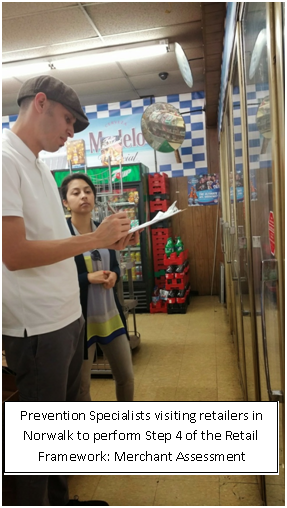
Merchant store assessments were conducted in Step 4 with permission from the retailer. Helpline assessed the stores on how alcohol products were placed, advertised, how the alcohol was promoted throughout the stores, and if the stores were up-to-date with local and state ordinances. Although it was a bit of a challenge for the retailers who allowed the agency into their stores to this extent, the retailers were helpful and open to new ideas to make alcohol less accessible.
In Steps 5 & 6, a free Responsible Beverage Service Training facilitated by Helpline was offered to all off-sale retailers of Norwalk. This training was used to educate, inform, and refresh the retailer with the Licensee Education on Alcohol and Drugs (LEAD) approved materials and city regulations related to their business. Dhaka Liquor and Pioneer Liquor participated in Step 5, RBS training, this past December. About a month later, Helpline started Step 6 a post RBS merchant assessment – same as Step 4- to analyze if any changes have been implemented since the first assessment.
The final steps, Steps 7 & 8, will be completed in the coming months.
Step 7 is a self-reporting tool. This tool is used to collect data from the retailers about behavior of youth attempting to buy alcohol from our partnering retailers.
Step 8 will be a Merchant Committed contract. It will simply be a written understanding that the retailers commit to stay in compliance with city and state codes and implement policies within their stores for all employees.
Overall, the Retail 8-Step Framework experience allowed Helpline Youth Counseling and its volunteers to meet and work closely with the local city retailers and begin a relationship that will hopefully bring about positive change toward alcohol prevention among youth and an overall healthier Norwalk.
For more information, or if you would like to get involved, please contact:
Helpline Youth Counseling
Substance Abuse Prevention Control
Steve Moua Smoua@hycinc.org
Maurina Cintron mcintron@hycinc.org
Joel Reynoza jreynoza@hycinc.org
562.864.3722
Stats
Pre-RBS Training Survey Findings
Three stages have been completed: The Pseudo-Decoy, testing whether the stores would sell to a potentially under-aged purchaser; the Knock and Talk, asking questions around youth alcohol purchasing; and the first Merchant Assessment, surveying the store and asking questions about alcohol marketing and alcohol and drug abuse more generally.
Findings from the Knock and Talk:
Of the 20 stores, 5 refused to participate and there was a language barrier preventing another store from participating in the Knock and Talk.
Asked whether there was a response to the Sticker Shock Stickers, only seven of the 14 gave a response. Six said that there had been no reactions, with two adding that since they worked mornings they did not really sell alcohol and that the night clerks would have a better idea. The seventh response did not answer the question, but merely stated that they were “Strict on alcohol sales”; this was one of the stores observed to sell alcohol without asking for ID or age.
Knock and Talks:
Below are the results from the 14 retailers who answered the Knock and Talk Neighboring Business/Residence Surveys:
· 35.7% or 5 out 14 retailers felt that youth attempted to buy alcohol at their stores at least once weekly.
· 35.7% or 5 out 14 retailers felt that youth attempted to buy alcohol at their stores at least once monthly
· 42.9% or 6 out 14 retailers felt that youth attempted to steal alcohol from stores at least once monthly.
· 50% or 7 out 14 retailers felt that drunk people attempted to buy alcohol at their stores at least once monthly.
For the Merchant Assessment, 17 of 20 stores began the survey and 16 completed it.
A drug pipe was found outside at one location, but otherwise drug paraphernalia was not seen or reported. No one was seen to be loitering or drinking outside the stores (although these surveys were all conducted in the mornings), and no old couches for hanging out were reported at any of the locations.
Eleven (68.9%) of the 16 businesses answering this question did have graffiti present on the building; one answer was left blank.
Only 1 of the 17 stores did not have surveillance cameras, 16 had written ID-check policies (one was left blank), and 12 (70.6%) had written policies on identifying and handling intoxicated patrons (one was left blank, and four, 23.5%, had no such policy).
Fifteen had banners advertising alcohol inside or outside the premises; two did not. Two (12.5%) of the stores had alcohol advertisements clearly targeting youth; fourteen (87.5%) did not (one blank). Five stores (29.4%) had alcohol or tobacco advertising right next to youth-oriented products.
None of the stores stock beer near an entry/exit, though eight (47.1%) do stock beer at the end of an aisle. Eight stores (47.1%) had the alcohol separated from the products that young people buy (sodas, chips, candy, juice), while nine (52.9%) did not. In eight of the stores (47.1%) youth had to walk through alcohol displays to get to those products.
In two of the stores (11.8%), alcoholic beverages were not separated from energy drinks and other non-alcoholic beverages. In the other 88.2% of the stores, they were.
Of the 11 stores that sold hard liquor, three (27.3%) did not keep it behind the counter or in a locked cabinet; the other eight (72.7%) did.