Health & Fitness
The Hole in Our Gospel Part 4
The fourth post responding to a series grappling with Rich Stearns' award winning book.
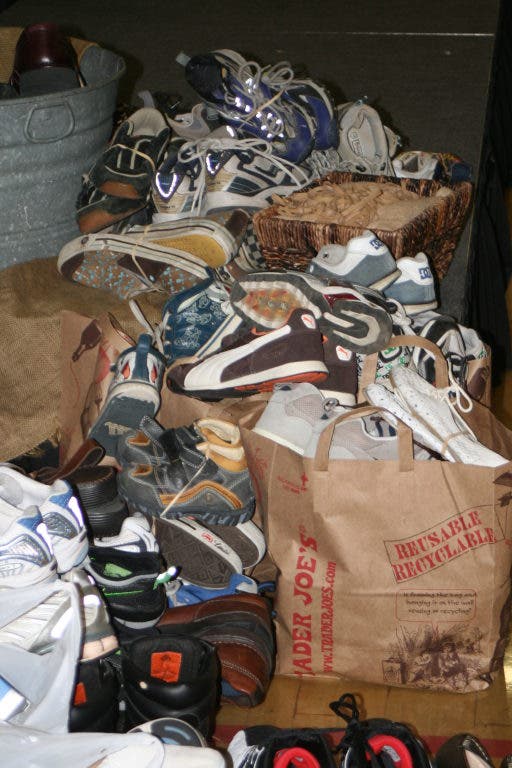


There is a Welsh Proverb quoted by Rich Stearns in The Hole in Our Gospel that says “Bad news goes about in clogs, good news in stockinged feet.”
During the fourth week in our series, we were invited to be the shoeless bearers of good news.
The challenge was to choose a pair of shoes to wear to church the following weekend and leave them there, going home in our socks or bare feet. The shoes were donated to an organization called “Soles 4 Souls” that gives relief to victims of abject suffering and also uses shoes to support micro-business efforts to eradicate poverty.
Find out what's happening in Danvillefor free with the latest updates from Patch.
I went home and looked at all the shoes I own and felt a little gluttonous. Instead of beating myself up or wallowing in guilt, I found several pairs of shoes that were still in good shape that I don’t use for running anymore. My husband combed through his shoes and my boys did the same.
All of us found several pairs that we kept just in case we needed them. We threw all of them in the wash and wore them to church the following weekend with several extras in a bag to give as well.
Find out what's happening in Danvillefor free with the latest updates from Patch.
I grew up with a philosophy that says “it’s better to have something and not need it than to need it and not have it.” It’s not a bad philosophy, in and of itself, especially for a mom with young kids (I think I kept a change of clothes in the
car for my boys until they were at least five).
However, our culture in general has much, much more than it needs. Does anyone really need three pairs of “back up shoes” just in case they need them? I decided I didn’t.
Somehow, the more I give away and lighten my load, the less encumbered I feel. Knowing that someone else who has next to nothing can use what I “might” need once in awhile makes it worth giving it up.
The weekend we were given the “Shoe Challenge” the sermon focused on the well- known “Parable of the Talents” from Matthew 25:14-30. It is about three servants who were entrusted with different quantities of talents from their master before he left on a journey.
Each received an amount proportionate with his abilities. A “talent” was a weight measure of money at the time this story was told by Jesus. One talent was the equivalent of about 20 years of a peasant’s salary. Over time, the word’s meaning has enlarged to include skills, abilities and resources.
The first servant was given five talents, which he “put to work” and gained five more. The second received two talents, which he also invested, gaining two more. The last servant received one talent, which he buried in the ground.
When the master returned, he praised the first two servants for investing wisely. The third servant was chastised for not even putting his talent in the bank to earn interest. The one talent he had was given to the servant who had earned the most.
The parable ends with the chilling words “For everyone who has will be given more, and he will have an abundance. Whoever does not have, even what he has will be taken from him. And throw that worthless servant outside, into the darkness, where there will be weeping and gnashing of teeth.”
Suffice it to say, it wasn’t exactly a “feel good” sermon. Still, it contained many
challenges worth pondering. Our pastor broke down the story in depth. Among the many strong points he made, a few key highlights stood out to me:
-We’re not entitled to our resources, we’re entrusted with them to use according to God’s purposes
-The mindset of “I earned it and I’m free to spend it the way I want!” assumes that we are owners of our resources instead of stewards of them
-Like the first two servants, we can expect rewards for our faithfulness
-We’ve been entrusted by God to understand and communicate the gospel
-We all receive different “talents” from God (they could be material or otherwise) and our job is to use them to bless others and honor Him, not to bury them and pretend they don’t exist
These are not easy concepts to digest! As our pastor succinctly stated “None of this makes any sense unless we’ve been gripped by the love of God.”
I started thinking about what the Parable of the Talents might look like in my life and realized I had a great example from earlier this year.
One morning last winter shortly after the tsunami decimated Japan, my younger son and I were sitting at the breakfast table before school. He was scouring the comics while I was scanning the headlines.
He glanced over at a large front page, color picture of the tsunami’s devastation. Wide-eyed, he said “Mom, what’s that story about?” I read the caption to him and gave him some background on what had happened.
We began talking about what it would be like to have our home and everything in it
washed away in an instant.
The more we talked, the more we both wished there was something we could do. But how could we help living thousands of miles away and worlds apart? I suggested we mull it over and pray about it.
Before long, the seed of an idea took root as we remembered some kids from his school that had raised money to help after the earthquake in Haiti the previous year. Together we brainstormed a plan to sell popcorn for $1 a bag to kids at lunch.
All the money would be used to send to an aid organization to help those suffering in Japan. We decided to invite a few other like-minded families to help us out and wrote up a brief plan.
A few days later, my son (in third grade at the time), sat down with the principal and his list and laid out the plan. She could not have been more affirming of his idea and quickly scheduled a date when the sale could take place.
Throughout the week preceeding the sale the four families participating made posters and announcements reminding the kids at school to bring money on that Friday.
We discovered that another family in the school had also been moved to help Japan and had initiated a coin drive to raise funds, which they planned to match. We decided to combine forces with them and they agreed to match whatever funds we raised as well.
The PTA generously allowed us the use of its popcorn machine and supplies. That Friday, each of the eight kids involved paired up and took “shifts” at lunch walking around to all the tables selling bags of popcorn. Halfway into the first lunch period, we realized that the demand far exceeded our supply.
Two of us quickly drove home and started popping every kernel of corn in our houses while the other two moms worked the hot machine and bagged popcorn for the kids at school. The outpouring of support (not to mention the excitement over the popcorn) was overwhelmingly positive.
By the end of the three lunch periods totaling 90 minutes, we had made $300. Combined with the roughly $1,200 in loose change and the matching funds, the school succeeded in sending $3,000 to an aid organization helping victims of the tsunami in Japan.
My son and I didn’t realize our popcorn sale would take on a life of its own. The only “talents” we invested were our idea, our planning, our connections with others and our ability to spread the word (and our popcorn when the PTA’s supply ran out). God used what we invested and multiplied it, teaching us a valuable lesson in the process and motivating us to look for other opportunities in the future.
The big message I take from the Parable of the Talents is that what we have has been given to us for a season to be used to honor God and bless others. We never considered for a second keeping any of the popcorn money for ourselves.
From the outset, we knew it would all go to Japan and that it wasn’t really “ours.” We were just the conduit through which it was passing to get where it needed to go. We were used in a small way to help fill a big need.
The process of translating this idea into our daily lives is just as simple but somehow it feels so much more challenging and complicated. I think praying for contentment and asking for eyes to see where God wants to use our resources is a good start.