Health & Fitness
Morality in Politics: Occupy This!
The Spare Changer Homeless Newsletter's editor compares the Occupy movement to the 1960s.
I spend too much time in cyber-space—I admit I prefer it this way—but from time to time I check in on “the real world” just to see what we have learned from the hard and often tragic lessons of history.
At my age, nothing seems “new” really, but checking in every so often reminds me that the leaders of today are making the same mistakes as our leaders of yesterday. And I fear it will be no different for our leaders of tomorrow.
Struggle, despair, poverty: these are universal problems, universal illnesses. Why do we continue to treat the symptoms, rather than spend our energies on the cures? Why do we tip-toe on the razor blade of socio-economic chaos, as we do today in America, and globally? Could it really be that there is more profit in treatment than in cure?
Find out what's happening in Davisfor free with the latest updates from Patch.
Why don’t we all pitch in and create that utopian society we all believed we would someday have? Why are so many people in America so… unhappy? Why have they tolerated this for so long?
History Books
Find out what's happening in Davisfor free with the latest updates from Patch.
One day history books will teach our children to believe that dissent will always have a place in American society, that the powers that be will always be forced to capitulate when the working—and unemployed masses-- rise up in dissent, protest, and demonstration.
They will teach—as objectively as winners of our present economic class war want to—that civil disobedience, angry protests driven by millions living in poverty, the crime of social injustice, even boredom, and often ignorance, are natural and logical consequences of unchecked greed and decades “right-of-center” largesse. If not active support of corporate growth by entities with no allegiance to our country or its people.
These history books will also observe that the first election of Barak Obama to the Presidency of the United States of America was the first Salvo of the Second Civil War, that the Occupy Wall Street Movement that spread like wildfire across the nation was the second salvo, even as mainstream media’s purposeful lack of coverage (and later misleading coverage) of thousands of citizens protesting in “occupations” of the “Wall Street’s” of our nation.
History will show that the third salvo will be the President listening to and acknowledging that dissent. Hearing and heeding these voices will mark the beginning of corporate capitulation. The banking industry must be separated from the securities industry. Greed will be replaced by charity and compassion for the less fortunate and they will together rise as the new currencies of progress, success and public approval. (This will have taken a lot of time though!)
It occurs to me that aside from the political “far right” and J. Edgar (and perhaps Jimmy Hoffa), everyone in the country loved John Fitzgerald (Jack) Kennedy; as much for what he left unaccomplished because of a bullet to the head as for his ideals and ideas as to how to move the country forward.
We were in the middle of the Cold War with the then Soviet Union and he endeavored to avert another depression in the mold of FDR’s New Deal. But like John Fields (my elementary school music teacher at Graham Elementary School), John Lennon (arguably the real genius in front of the cultural phenomenon that was The Beatles), John Wayne (“Hello, little sister…sit down, pilgrim!”), and even Steve Jobs, these dead heroes of mine pale to the man who stood by the side of JFK: his younger brother Bobby.
This was a man of men; a champion of the poor and the middle class; a staunch supporter of economic prosperity for every American and every American business through hard work, wise investments, and scientific progress and excellence. They were both men of cures, not of treatments. They were men of peace, not of war. And they, like Barak Obama, were men of change who embraced social, economic and therefore political dissent as a viable tool to return balance to our country and its people.
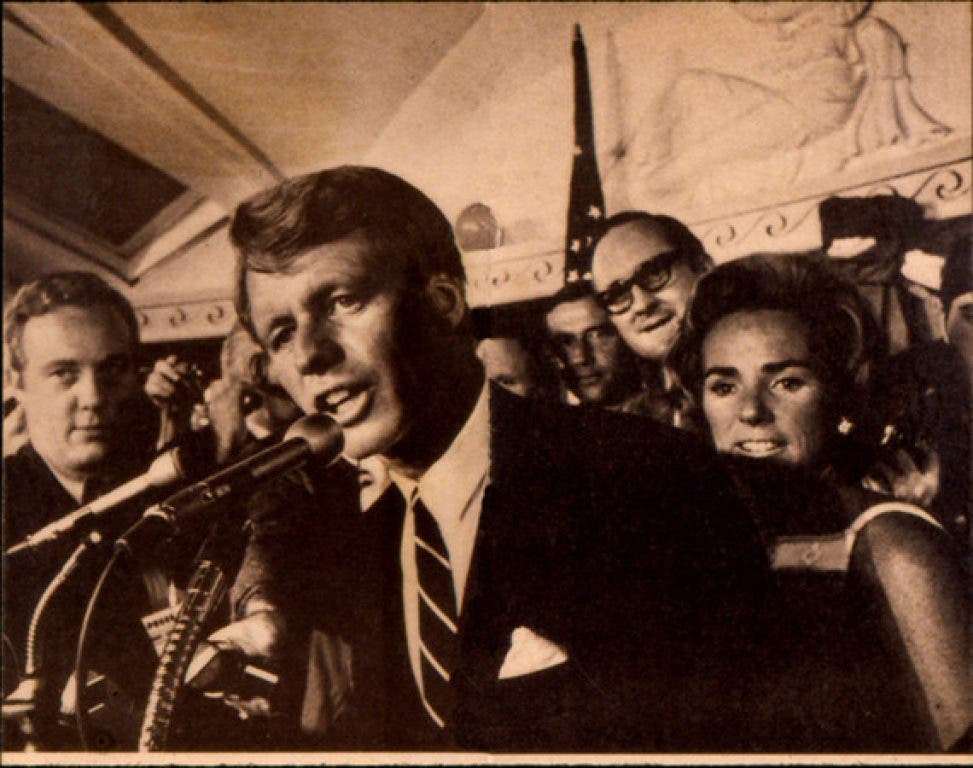
Robert F. Kennedy, in a 1966 address to students at UC Berkeley, brought home these sentiments that could have been expressed today. Said Bobby:
“It is not enough to allow dissent. We must demand it for there is much to dissent from …We dissent from the fact that millions are trapped in poverty while the nation grows rich …We dissent from the conditions and hatreds which deny a full life to our fellow citizens because of the color of their skin … We dissent from the monstrous absurdity of a world where nations stand poised to destroy one another, and men must kill their fellow men …We dissent from the sight of most of mankind living in poverty, threatened by hunger and doomed to early death after a life of unrelenting labor …We dissent from cities which blunt our senses and turn the ordinary acts of daily life into a painful struggle …We dissent from the willful, heedless destruction of natural pleasure and beauty …We dissent from all these structures -- of technology and of society itself -- which strip from the individual the dignity and warmth of sharing in the common tasks of his community and his country.”
Nearly a half century later, our country is at the same crossroads. Where homelessness was once a phenomenon of urban centralization and later re-gentrification, it is now commonplace in both rural and suburban America. Millions are “trapped in poverty,” particularly the homeless across our nation. We have learned to take for granted that they will remain that way…but contrary to the RFK America of 1966, our nation is not “growing rich,” but instead it is growing poorer; directly designed and implemented by the self-propagating greed of multi-national corporations that owe no allegiance to anything, to any one, nor even to any philosophy save perhaps for an allegiance to profit to secure and maintain power.
Our country functions at an economic deficit, one so bad even the traditionally liberal Democratic Party is forced to agree to budgets that reduce spending for needed services at the expense of those already dependent on them, and at the expense of those who will be: your children, your grandchildren, your great-grandchildren, and so on. While both Republican and Democratic political philosophies have converged to move to a “balanced” budget in government spending, the travesty in ethics materializes in how each camp proposes to do it.
One camp embraces the concept of shared sacrifice in the form of paying proportionate-share taxes, which means tax reform; reform that places “fair burden” on those that can afford it and still live comfortably. Reform that ends tax exemptions and loop-holes for wealthy corporations, that is, their CEO’s and large shareholders, to whom they owe their only allegiance, hiding behind a shield of “corporate responsibilities to our shareholders first” culture. Given the present economic crisis, this is: Just. Plain. Wrong.
When Bobby Kennedy spoke of “conditions and hatreds that deny a full life to our fellow citizens,” and when he spoke of “the monstrous absurdity of a world where nations stand poised to destroy one another,” he could have been speaking to us today, pointing to a looming civil war between the wealthy and the poor in a culturo-economic atmosphere that pits those who want to keep what they have earned against those who have no prospect but to remain trapped by the very mechanisms employed by those who want to keep what they have earned.
This is the root of the problem, the dilemma we as voters must clear our heads about and, sadly, since much of the one-percent’s wealth comes from making money on money handed down -- not from the sweat of their brow -- the working-professional class, the under-employed, the unemployed, those at risk of homelessness and the chronic homeless themselves are, in fact, at war (no matter who accuses whom first of waging this war. Our economy and our culture have evolved, paralleling the evolution of our technology, but our ethics, our basic sense of what is right and what is sinfully wrong, has not similarly evolved.
“This nation is poised … to destroy itself,” I think Bobby would surely say today.
--
This is the first installment in a two-part column. You can read more from Lawson on thesparechanger.net. Like Davis Patch on Facebook to have Part 2 delivered to your wall.