Neighbor News
Dublin Students Build AI Tool Designed to Help People With Aphasia
Emerald High students won 3rd place at an OpenAI hackathon with Wordless, an AI support tool designed for people living with aphasia.

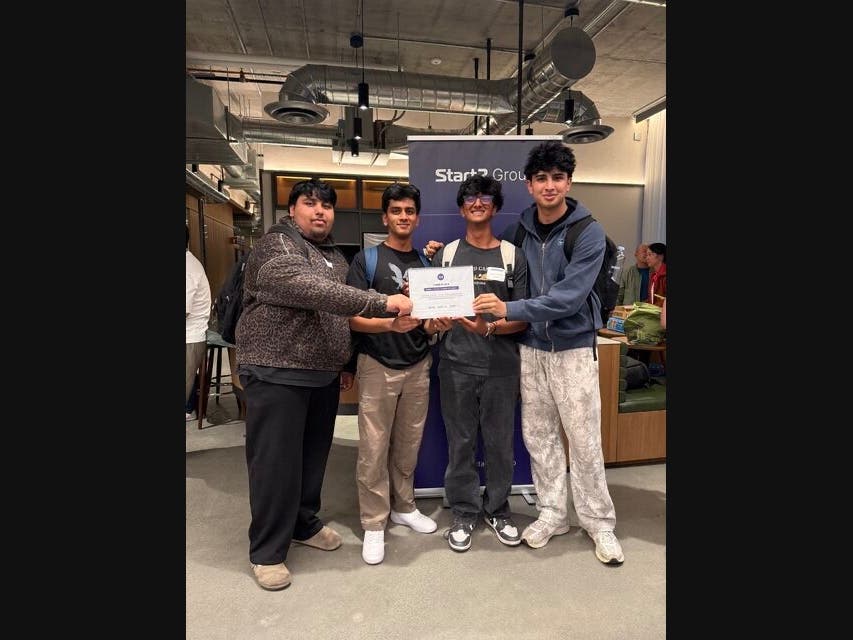
DUBLIN, Calif. — Rising Emerald High School seniors Rushil Baindla, Hrihaan Bhutani, Akshat Agrawal, and Avinash Amanchi earned Third Place at the OpenAI × Zendesk Hackathon after building an AI-powered accessibility tool for people with aphasia during a four-hour hackathon.
Their prototype, Wordless, is an AI-powered customer support tool that analyzes a customer's account activity instead of requiring them to describe their problem in words. Designed for people living with aphasia, the system addresses a communication barrier affecting nearly two million Americans.
Picture a 70-year-old woman named Maria. She was just charged twice for the same order, and she has aphasia. This condition leaves her understanding everything perfectly but unable to produce the words to explain it reliably. The most she can manage to type into a support chat is "order... wrong..." A typical AI agent reads that, confidently returns an unrelated policy article, and closes the ticket. Maria is stuck, and she's done nothing wrong.
Find out what's happening in Dublinfor free with the latest updates from Patch.
That was the problem the four students set out to solve during the four-hour OpenAI × Zendesk Hackathon. Rushil Baindla, Hrihaan Bhutani, Akshat Agrawal, and Avinash Amanchi built an AI-powered support tool called Wordless that resolves a customer's problem from their account activity instead of asking them to describe it at all.
'Every accessibility fix out there solves how you get information: screen readers, captions, contrast. Nobody was solving whether you can even ask the question in the first place," said Baindla.
Find out what's happening in Dublinfor free with the latest updates from Patch.
The team built Wordless at the OpenAI × Zendesk Hackathon, hosted at San Francisco's Hanwha AI Center, where teams had just four hours to design, build, and demonstrate a working AI-powered customer-support prototype using OpenAI's models, Zendesk's platform, Composio's agent tooling, and Octen. Following the four-hour build session, Wordless was selected as one of only five teams invited to present live before the judges, ultimately earning Third Place.
Nearly 2 million Americans live with aphasia, and close to 180,000 people acquire it every year, mostly following a stroke, according to the National Institute on Deafness and Other Communication Disorders. The counterintuitive part, the team said, is that comprehension is completely intact. What fails is retrieval: the ability to pull up a word on demand, a symptom called anomia that's nearly universal in the condition. The person knows exactly what's wrong. They simply can't produce the sentence that says so.
"Maria isn't an edge case. She's two million people who can read a help page perfectly and can't write the four words that would normally get them help," said Bhutani.
Most AI-powered customer support systems today, the team explained, are built description-first: a customer's text goes through intent classification, then retrieval, then a paraphrased answer, with every stage assuming the sentence itself is the only available signal. Feed a system a fragment like "order… wrong… the thing… help" and nothing degrades gracefully: it returns a low-confidence guess, retrieves the nearest lexical match, answers fluently and confidently, and closes the ticket. Web accessibility standards don't catch this gap either, the team pointed out, because they govern channels — contrast, screen readers, captions — not composition, the basic ability to form a sentence at all.
Wordless flips that model to evidence-first. Composio fans out read-only calls against a merchant's records, such as Stripe charges, order fulfillment status, prior support tickets, keyed only on the email address already attached to the ticket, the one piece of identifying information a customer never has to type. A rule engine built from patterns in historical ticket data scans that evidence for patterns that commonly indicate why someone might contact support, such as two identical charges seconds apart—and generates a plain-language explanation for each likely issue.. The customer's typed fragment still plays a role, but a smaller one: Octen compares it by meaning, not exact wording, matching something like "the boily thing" to "kettle" even though the two share no letters in common. Codex then renders the top few matches as tap-to-confirm cards in real time; nothing is acted on until the customer taps one.
"The tap is the whole point. We never act on a guess only on what she actually confirms," said Agrawal.
For Maria, that means Wordless surfaces a card reading simply: "You were charged twice." She taps it, and the support workflow proceeds immediately, no paragraph required.
“Accessibility usually focuses on how people consume information, like screen readers. We wanted to fix how people communicate. We're not making people describe their problem better, but we're stopping them from having to describe it entirely,” said Amanchi.
The team designed, built, and demonstrated a working version of Wordless in just four hours, earning Third Place for its creativity and technical execution. The prototype centered on a ticket-to-refund workflow and emphasized precision in its top suggested matches, measuring success by whether the correct solution appeared among the options for users to confirm rather than by the system's confidence alone.
The team plans to continue developing Wordless beyond the hackathon, exploring additional accessibility features and real-world applications. Contact the team: rushil.baindla@gmail.com, hribhu19@gmail.com, amanchi.avinash@gmail.com, akshat.sfo@gmail.com.