Health & Fitness
Particles You Can Believe In
The Big Bang, the "God Particle," and how we got here in the first place.
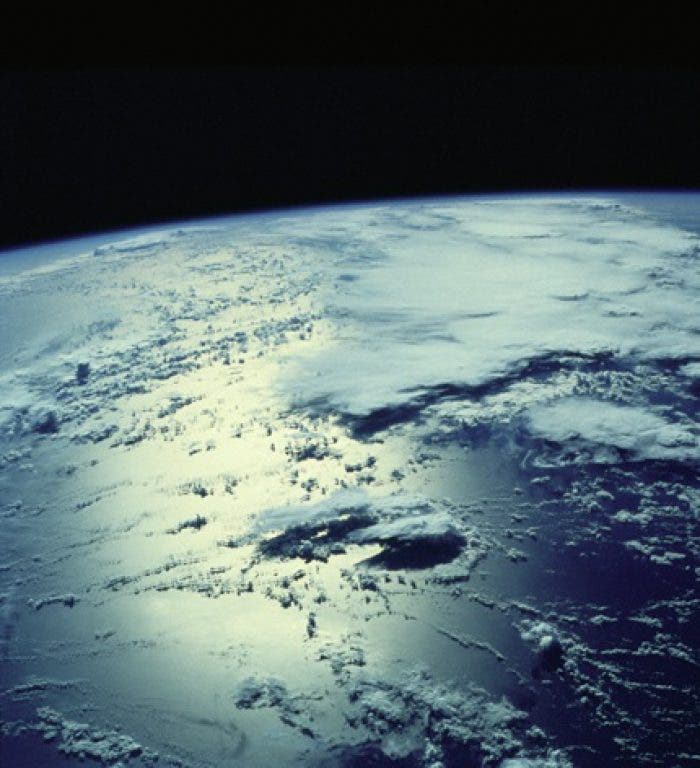
On Discovery Channel recently, in a show called Grand Design, physicist/cosmologist Stephen Hawking attempted to answer the deepest questions of the universe, including the deepest of all: How did we get here? Hawking describes a journey through the laws of nature, of how the universe was made and how it really works. Hawking says, “We mere mortals can understand how the universe works, although it takes courage to find the answers.”
People once believed in supernatural beings in order to make sense of natural phenomena, like a solar eclipse. Vikings believed that “skoll,” a wolf god that lived in the sky, ate the sun. The Vikings tried to scare it away, and believed their actions caused the sun to return. In Greece, long before the Vikings (about 350 B.C.), Aristotle realized a lunar eclipse was actually the shadow of the earth on the moon, proving the earth was spherical, not flat.
We learned that the stars are not holes in the floor of Heaven, but suns like ours, only a very long ways away. It seems the universe is a machine, run by the laws of nature, and can be understood by the human mind. So, the Catholic Church claimed the laws of nature are the laws of God, and we are still the center of the universe—that the sun and stars rotate around the earth.
Find out what's happening in Encinitasfor free with the latest updates from Patch.
In 1609, Galileo Galilei, father of modern day science, made a telescope to study Jupiter and discovered four “moons” orbiting that planet. He deduced that the earth revolved around the sun, and not vise-versa. The Pope cried “heresy” and placed Galileo under house arrest for the next nine years.
Over the next 300 years, scientists discovered other things that explained how the universe works—what makes stars shine, etc.—and ultimately asked the question, did God create the universe in the first place?
Find out what's happening in Encinitasfor free with the latest updates from Patch.
In 1985, the Pope said it was okay to study the workings of the universe, you just can’t ask questions about its origin, for that is the work of God. Stephen Hawking suggests it is the cosmologist’s duty to find out where the universe comes from.
It turns out you need only three ingredients to make the universe: 1. Matter (stuff that has mass – like dust, rock, ice, and gas); 2. Energy (you can feel it on your face – energy from a sun that is 93 million miles away); 3. Space (lots of space in all directions).
Where does it all come from? In the 20th Century, that question was answered by Albert Einstein. E=mc2 (Energy = Mass times the Speed of Light (C) squared). Mass and energy are kind of the same thing. Energy and space were created spontaneously in an event called the Big Bang. Space was created like blowing up a balloon. But, how did it appear out of nothing? The Catholic Church said God created the Big Bang. Science tells a different story.
To build a hill, you must dig a hole—the negative version of the hill. The laws of physics demand negative energy. The Big Bang created a vast amount of positive energy, and the same amount of negative energy. The positive energy we see is like the hill. The negative side of things is spread throughout space. This means that all of the universe, positive and negative, adds up to zero. And you don't need a god to create it.
Then what triggered the spontaneous appearance of a whole universe in the first place?
In the sub-atomic level, you can, at least for a short while, create something out of nothing—where particles obey the laws of quantum mechanics—and appear, stick around for a while, then disappear. Likewise, our universe was once quite small, infinitely dense, and smaller than a proton, which means it could have popped into existence without violating the laws of nature!
Did God create the “quantum” laws that allowed the Big Bang to occur? It is natural for people to believe that something causes everything, but that is not necessarily so. Nothing caused the Big Bang! Einstein again: Time itself began at the instant of the Big Bang. The universe created itself.
Nothing can escape the incredible gravity of a black hole. Even time slows down as it descends into a black hole—and eventually stops, because inside a black hole, time does not exist. As you go back in time, the universe gets infinitesimally small, condensing into a black hole. You can’t get to a time before the Big Bang, because there was no time before the Big Bang. We have found something that doesn't have a cause. There was no time for a cause to exist, or a creator to have existed. It has taken us 3,000 years of human endeavor to find the process that created "us."
Stephen Hawking says, “No one created the Universe. No one directs our fate – no Heaven, no 'after life,' either. We have this one life to appreciate the grand design of the universe. For that, I am grateful.”
Amen to that!
Now, scientists have discovered the long-sought Higgs boson, a class of sub-atomic particle that some are calling, the “God particle,” believed to be associated with the property of all matter known as mass, without which our universe could not exist. This may lead to the discovery of other sub-atomic particles with mass, affecting studies of mass, dark matter, and dark energy. How the “God particle” may affect our understanding of the universe – or contribute to a new gizmo – only time will tell. And we still have time.
Jac Flanders is the author of “What I Learned On The Way Down,” eBook and paperback versions from Amazon.com