Community Corner
Carmichael Resident Speaks Out About Life With Disabilities
Leigh Penny hopes to start a motivational speaking business to inspire more understanding about disabilities and show others what's possible.
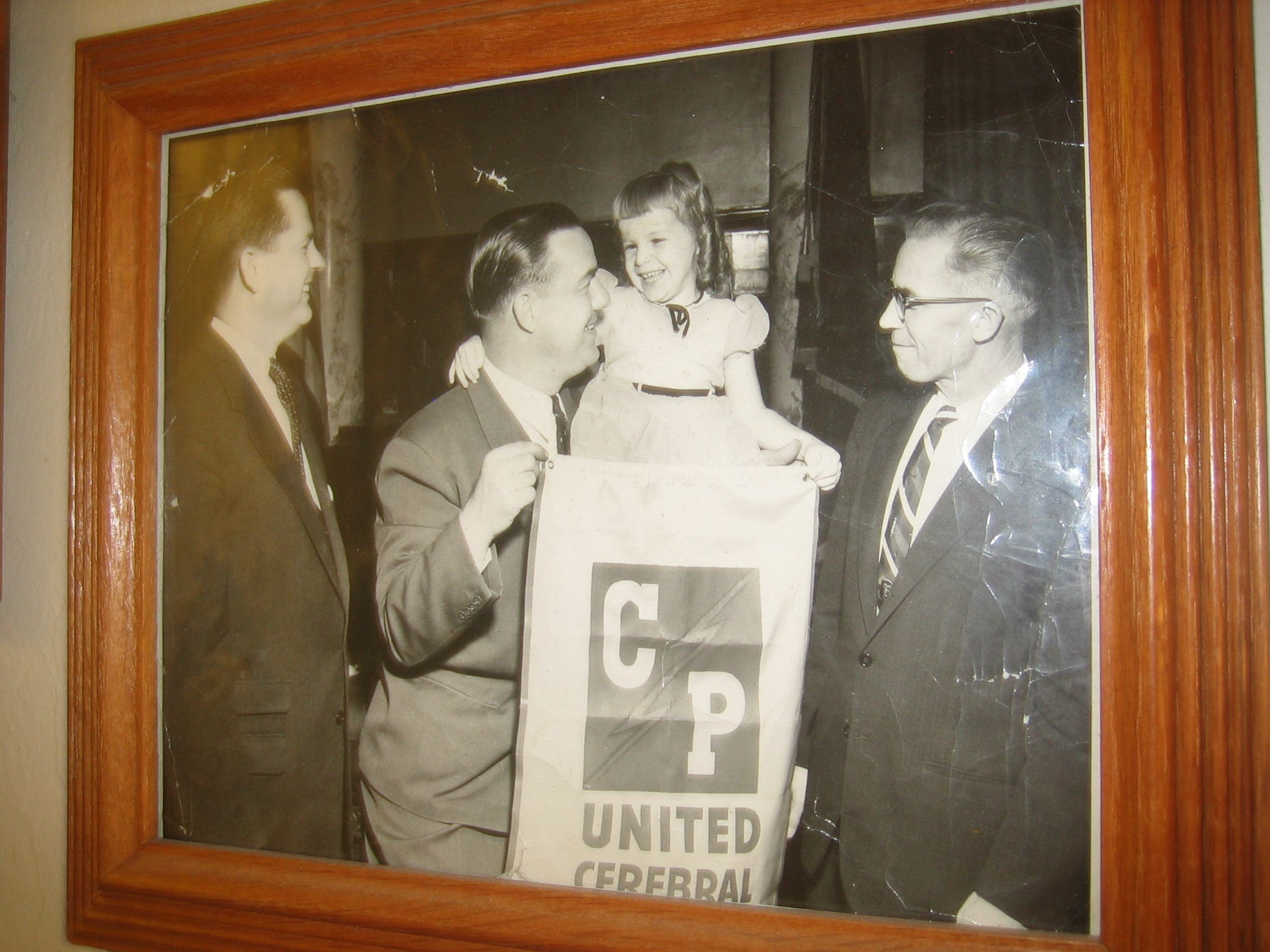

As a child, Carmichael resident Leigh Penny had two things that made her an easy pick to be a poster child for cerebral palsy: she was cute, and unlike many kids with CP, she could talk.
Cerebral palsy is a condition that affects brain and nervous system functions like motor skills, hearing, vision and cognitive ability. Most of the problems develop while the baby is in utero, but they can also happen within the first two years of life. Symptoms can include difficulty walking, tremors, seizures and problems with coordination, development and speech.
Though Penny did have problems walking and had to wear braces on her legs for much of her childhood, she had no trouble with her speech. Her parents, Jacqueline and Russell Penny, were involved with the United Cerebral Palsy Association. Her father was also a member of the Elks Club, which developed a therapy for CP, and Penny ended up being photographed to help raise money to fight the disease.
Find out what's happening in Fair Oaks-Carmichaelfor free with the latest updates from Patch.
"The best advocate for a disabled child is their parents. And my father, because he worked for the government, understood how things were funded," Penny said.
When local postmen organized a walk for cerebral palsy, she was the little girl who posed for the pictures. She was photographed with the mayor of Boise, Idaho, then Gov. Bob Smylie of Idaho and other local celebrities. She loved to pose, and stuck out her pinky finger to "look dainty."
Find out what's happening in Fair Oaks-Carmichaelfor free with the latest updates from Patch.
She was even featured on a local telethon in 1954. At the time, she was concerned that the people watching TV would see her braces, so she didn't wear them. The man who interviewed her had to prop her up.
Back then, Penny says, the telethons were put on to make people pity those affected by CP in order to bring in money to help cure the disease. "That was an era when they wanted to cure everything," she said. "They wanted to fix it. That's a little different than the way they look at it now."
To fix her legs, Leigh went through many surgeries to try to straighten her tendons. Since then, things have changed.
"The emphasis is not so much curing or improving the limitation, but on living with what you've got to the best of your ability and to develop self-pride and a sense of belonging."
In Penny's opinion, the telethons of today are less about trying to raise money through pity than demonstrating the full lives and many accomplishments of people who have CP.
When Penny was young she was put in special education kindergarten. But when she was the first child in the class to learn her colors and to spell her name, her parents pulled her out of the class and put her into regular public school classes. At the time this was highly unusual.
"That was 20 or 30 years ahead of time, and it was because my parents wanted me to be part of society," she said.
She stayed in public school through high school, where she was an active singer on campus. She also learned to play the piano and the accordion, and eventually got her master's in education from California State University, Sacramento.
As a student teacher, her professor noted that she had an unusual gait and asked her to "explain what my quote unquote problem was."
Penny did what she often did when children or others asked about her walk. She explained that she was injured at birth, and that it affected the way she moved.
When she was done, a little boy in the class "raised his shoulders and threw out his chest and said, 'Four and five are nine.' Children look at me and see the difference with a bit of understanding and a bit of 'so what? big deal?'" she said.
Penny herself taught a special ed class for a year before she was diagnosed at age 24 with another health problem - bipolar disorder. Her doctor told her she could not go back to school until she regained her mental health balance. It wasn't until she was treated that she was able to get back into schools as a teacher's aide, but she was laid off a year later.
In the years since, Penny has been outspoken about life with disabilities. For a time, she even wrote freelance articles for the now-defunct quarterly magazine Accent on Living, which published articles about, by and for the disabled. Penny wrote 11 pieces altogether over a three-year period.
She has also spoken to students about her disability, and keeps a policy of honesty with older students' questions, even when they are about her personal life. "If they're old enough to ask a question, they deserve an answer," she says. "Better to give them too much information."
Now 60, Penny is confined to a wheel chair and has 24-hour care. But she isn't done spreading her message about life with disabilities.
Penny wants to continue to reach out to schools and other groups to talk more about life as a disabled person. She is currently working on her own company, Motivation Plus, and hopes to book speaking engagements in the new year. She also has plans to rework a book of prayers that she wrote and published at her church, Carmichael Presbyterian, and to update her website daily with motivational thoughts.
To help with her writing and public speaking, she became a member of Toastmasters, an international group that helps people develop their speaking and leadership skills. On top of her piano sits the River City Firefighter of the Year award, which is given to the person who has filled in roles that other members weren't able to fill.
Fifty-six years after she was first featured on posters to raise money for CP, Penny wants to show people what she can do as a disabled person and inspire them to accomplish their goals.
"I hope my life would be inspiring enough to make a difference to these young people or disabled people," she said. "I want to set an example. I want to help them reach their potential."