Arts & Entertainment
First Blush Of Coastal Wildflowers: Spring Is Coming
Following a trail of flowers to find the first signs of spring.


Perhaps because I once lived on the East Coast and yearned for the end of the long cold winters there, still every year here on our coast I feel compelled to roam the hills looking for the first signs of the arrival of spring. I particularly watch for the red flowering currant to bloom on sheltered bluffs above the ocean.
This past week the currant (Ribes sanguineum glutinosum) was in full bloom. Its blossoms and those of other early spring flowers will reward you if you take time to go and seek them out.
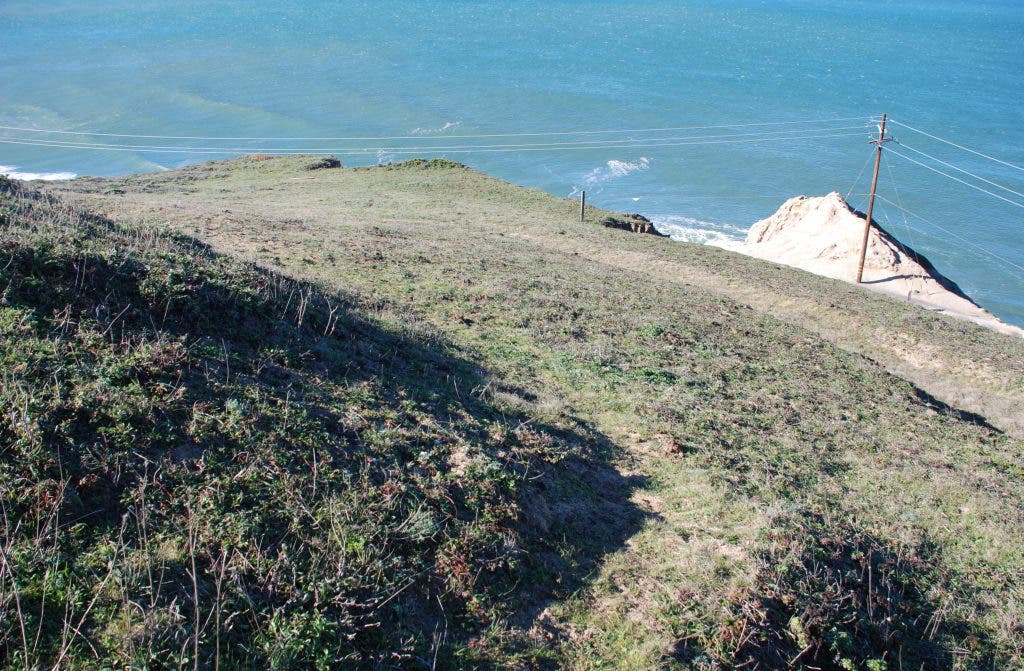
If you are looking for spring, there’s no better place to go than Gray Whale Cove Trail, in McNee Ranch, a part of Montara State Beach. The north end of the trail begins at Gray Whale Cove State Beach parking lot, on the east side of Highway 1, just south of the construction work for the Devil’s Slide tunnel. After a short, steep climb from the parking lot, the trail levels out and winds south, back toward Montara—each bend in the trail providing new, spectacular views of the hills and the ocean below.
Find out what's happening in Half Moon Bayfor free with the latest updates from Patch.
You will come upon the first and most conspicuous red flowering currant bush almost immediately after the climb from the parking lot—right next to the trail, at the foot of a shady, north-facing slope. Its clusters of bell-shaped blossoms, in bright shades of pink, are hard to miss. The currant's fan-shaped leaves are sticky to the touch and exude a strong, somewhat unpleasant odor. By summer the flowers will develop into currants—dark, purple-black fruit favored by birds but reportedly not really very good to eat. (I haven’t tried them myself. I leave them for the birds.)
The currant occurs naturally only in North America, growing near the coast from Santa Barbara County to British Columbia. It is a popular ornamental garden plant in Europe, however—testament to an adventurous 19th Century Scottish botanist and explorer, David Douglas, who collected specimens of the currant, along with hundreds of other plants and seeds and sent them back to England. Currant plants were so popular, according to some accounts, that their sale paid for the entire cost of the two-year expedition. Douglas died at a young age under suspicious circumstances in Hawaii. He was found apparently gored to death in a pit to trap wild cattle, but some thought he was murdered. His memory lives on in scores of plants, such as the Douglas fir, which bear his name.
Find out what's happening in Half Moon Bayfor free with the latest updates from Patch.
Beyond the currant bush, the Gray Whale Cove Trail winds beside rocky cliffs adorned with ferns and flowering plants not yet in bloom, except for the small wood strawberry (Fragaria vesca)—one of the two wild strawberries that grow along the trail.
A short distance further, on the ocean side of the trail, you will find the first pink flowers of the checkerbloom (Sidalcea malvaeflora), or checker mallow, coming into bloom. This is one of the most showy of the coastal spring flowers. By March the low-growing checkerbloom will carpet the sides of the trail in bright blooms. It is a fairly common perennial wildflower, native to California from Oregon south to Baja California, and is a larval host for several California butterflies, including the West Coast Lady.
Moving further south, coastal sage scrub lines both sides of the trail, dominated by the sweet-smelling, silver bushes of California sagebrush (Artemisia californica), with wildflowers growing in between the bushes.
Occasionally there are breaks in the scrub with patches of grasslands—coastal prairie—where wildflowers can spread out and flourish. At one point a large slope opens below. The checkerbloom and many other flowers will bloom there soon, but now you can find the yellow glow of the aptly named footsteps of spring (Sanicula arctopoides).
Footsteps of spring is an inconspicuous plant, but a true harbinger of spring, just as its name suggests. It is a member of the Apiaceae plant family, which includes such vegetables as carrots, celery, and parsley, as well as highly poisonous plants such as poison hemlock. The plants—with bright yellow blossoms and yellow-green, celery-like leaves—look like drops of sunlight spilled on the grass.
A little over a half mile from the trailhead is another grassy bluff, with two benches offering the opportunity to sit and contemplate a spectacular view of Montara State Beach and the coast beyond. Vegetation around the benches clings to the ground, flattened by both strong winds off the ocean and the trampling of hikers. Despite the severe environment, here again you will find the emerging blooms of footsteps of spring and also the diminutive blossoms of goldfields (Lasthenia californica)—looking as though someone sprinkled the slope with gold.
The trail goes further south, ending finally at the cypress tree-lined road leading to the main entrance to McNee Ranch, across from the northern end of Montara State Beach. There are many other trails in McNee Ranch that you may want to explore—leading up to the summit of Montara Mountain and over the mountains to San Pedro Valley County Park in Pacifica.
Asked about Montara State Beach and McNee Ranch, San Mateo Coast State Park Sector Superintendent Paul Keel said “a main focus now is following the tunnel project and integrating with the other agencies on trails, signs, etc. in the area, as may be needed.” He added that State Parks also hopes to do something about illegal trails on the mountain that are causing erosion. “We would like to restore those areas,” he said, but “it's tough to get on work like that in times of financial hardship.”
I encourage readers to go to the hills themselves and see the flowers along Gray Whale Cove Trail bringing the promise of spring to our coast. In the words of Louis Halle, who wrote of spring coming to the East Coast:
“To snatch the passing moment and examine it for signs of eternity is the noblest of occupations. … If I could learn just when spring arrived, in what manner and in what guises, I should have grown in knowledge of reality and established a bond of common experience with my fellow travelers in eternity.”
Note: You can see photographs of other flowers along Gray Whale Cove Trail on my Flickr page and read about them on the website Native Plants of Montara Mountain.
On Sunday, 1 May the Santa Clara Valley chapter of the California Native Plant Society is sponsoring a plant walk on Gray Whale Cove Trail, led by local botanist Toni Corelli. The walk, from 10 am to 3 pm, will begin at the southern end of the trail and include a detour to the new open space area Rancho Corral de Tierra, managed by Golden Gate National Recreation Area (GGNRA), to see the rare Hickman’s cinquefoil (Potentilla hickmanii). The walk will pass through maritime plant communities including oastal scrub, maritime chaparral, and coastal prairie. Members of the public are welcome to participate. Bring lunch and water, and wear layers. There will be an elevation gain of 200-300 feet. For more information, contact Toni Corelli (650) 464-1289 or corelli@coastside.net. Park at the Montara State Beach parking lot on the west side of Highway 1 approximately 1/3 mile past the La Costanera restaurant.