Community Corner
A Visit to Whiting’s 'Ranche'
When a self-described "knight of the quill" comes calling, journalistic brickbats are, for the most part, left behind.


The pursuit of positive publicity isn't a just 21st- or even 20th-century phenomenon.
Take, for example, the following episode, recounted in the Sept. 8, 1892, edition of The Blade, one of Santa Ana's most prominent newspapers—which, within a short time, will reappear in
Our story begins on a mellow Wednesday afternoon when a Blade reporter—his identity never revealed—strolls over to the Santa Ana depot and boards a San Diego-bound train. His purpose? To disembark at the little hamlet of El Toro, meet up with Dwight Whiting and write an article about the gentleman farmer's showplace “ranche.”
Find out what's happening in Lake Forestfor free with the latest updates from Patch.
ALL ABOARD FOR EL TORO!
“A ride of twenty minutes, yesterday, , brought a representative of The Blade to El Toro, a little village in the centre of Los Alisos Valley, one of the most picturesque sections of Southern California,” he begins.
Find out what's happening in Lake Forestfor free with the latest updates from Patch.
“Near El Toro, a distance of only 1000 feet from the depot, is the home of Mr. Dwight Whiting, and the knight of the quill made a bee-line for that gentleman’s residence, knowing that there he would be royally entertained.”
The reporter then wows his readers with the following statistic:
"Mr. Whiting's Ranche consists of 8,500 acres, and comprises almost all kinds of soil, from the rich, alluvial valley to the rocky, barren mountains."
But lest you think this “knight of the quill” is in the El Toro land baron’s pocket, he next mentions his less-than-enthusiastic first impression of the house.
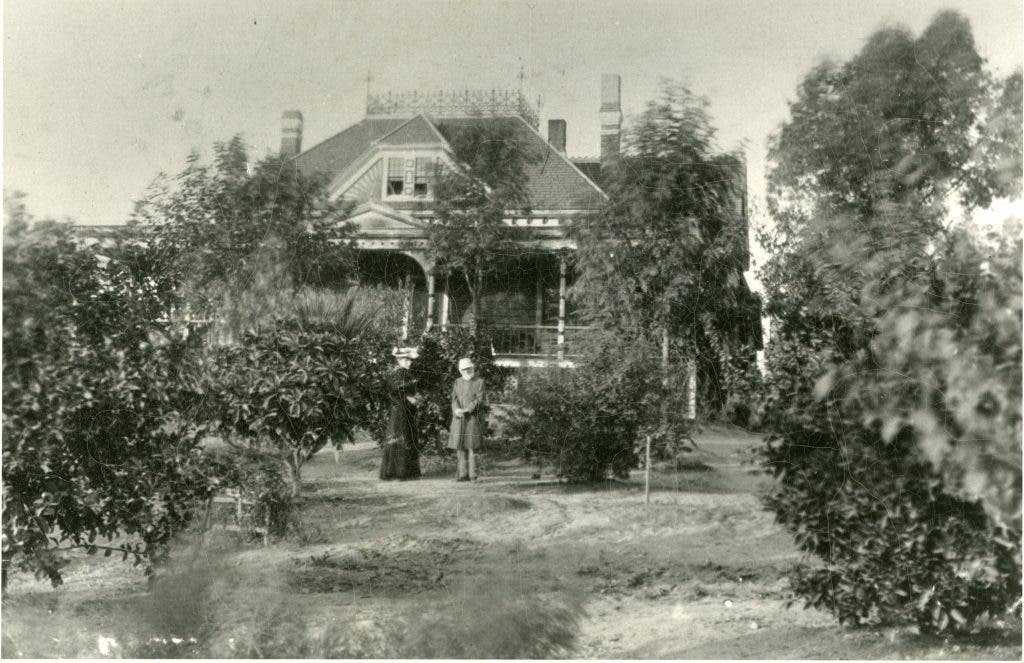
“The farmhouse, or bungalow ... is a one-story frame building, covering a large area of ground, and while not really pleasing to the eye, from an architectural point of view, is convincing to the mind that [it] was built for comfort.”
But the “wow” factor cannot be long denied, for it is next mentioned that “the structure contains fourteen rooms besides a bath, and water is piped to all parts of the house.”
Your 2011 El Toro & More columnist longs for details of the home’s interior. But in 1892, The Blade’s representative only briefly remarks on the “elegant” furnishings, including “large Turkish couches” and “all that taste and refinement could suggest.”
Then, stepping back outside, the Santa Ana scribe homes in on a major selling point of the El Toro lifestyle versus Santa Ana's urban pace.
“On the east and south sides of the house and extending half around is a broad veranda, and creeping up over its walls are trailing vines of ivy and honeysuckle, whilst easy wicker chairs and settees are placed up on the piazza.” The temptation is too great, he says, “and so we sink into a mammoth wicker chair and cast our eyes over the country spread out before us ... we soon lose ourselves in day-dreaming of the beauties and productiveness of this glorious sunset land”—but only for a brief time, for the proprietor is eager to show his guest around.
ON WITH THE TOUR
Imagine how it must have been: The area just below the railroad tracks and El Toro Road, bisected by a country lane that ultimately will become the lower portion of Orange Avenue and surrounded by new, developing orchards.
Now step across that lane and walk toward another El Toro knoll, where Whiting and the reporter “soon find ourselves in a new and well-constructed ten-room cottage, a short distance from the farmhouse, and but recently completed.”
This was the home Whiting had commissioned for his in-laws, Judge and Mrs. Keating.
“The dwelling is situated on a little eminence, and is furnished with every modern convenience. A telephone connects the two houses, and thus the occupants communicate with each other at will. This dwelling, too, has a broad veranda, extending around the south and east portions, and from this point the city of Santa Ana can be seen almost any clear day.
“Surrounding both houses are beautiful flower gardens, and the pretty coloured flowers are now in full bloom. Overhanging the farmhouse are affording a most grateful shade.”
Next up: Whiting's barn, “divided into three compartments—a carriage house, in which is kept some very fine vehicles; a hay department; and a carpenter’s shop with blacksmith’s shop adjacent. There is also a stable, and two warehouses well filled with golden grain. In a little corral is kept Jumbo, a fine, large roan Percheron stallion, weighing 1600 pounds.”
At this point, readers are informed that Whiting takes a great pride in the raising of fine horses, having “12 or 14 fine, large brood mares” and “half-a-dozen geldings and saddle horses.”
Attention is then turned to Whiting’s excellent barnyard fowl—chickens, ducks, and turkeys—plus “half a dozen Shorthorn and Jersey cows” and a Jersey bull.
It’s easy to imagine Whiting orchestrating the next few moments into a jaw-dropping photo op. He poses, the picture is taken, and the reporter later will write that “by the side of the barn grows a row of stately banana trees, their giant leaves rustling in the wind and showing that in this land of sunshine tropical fruits will flourish and grow to perfection.”
That, in fact, is a wonderful segue to the central idea of this visit.
A FRUITFUL LAND
“Mr. Whiting’s chief pride is his orchard,” says the reporter, adding that just below the house are row upon row of prune trees—100 acres in all—“stretching to the south for half a mile and to the west for at least a quarter of a mile,” as well as “ten acres of apricots, five acres of Bartlett pears, ten acres of chestnuts and pecans, ten acres of soft shell walnuts, five or six acres of an assorted family orchard, and an acre nursery of nut-bearing trees."
Then they get into a waiting buggy drawn by “a fine, large chestnut-sorrel mare that trots along at the rate of a mile every three or four minutes easily, and is a grand specimen of horseflesh.”
They drive "beside the rows of graceful fruit trees up to the top of a little hill, south of the farmhouses and orchard ... at our feet is a cornfield, whose stalks are rustling in the gentle breezes.”
The orchards, he adds, are “still clothed in their leafy dress of green” and “a little further on can be seen the railroad track, the steel rails glistening in the sunlight, and marking out the pathway over which the iron horse speeds.” Nearby is “the pretty little church with its spire pointing heavenward ... in the distance towers the grand old mountains, in whose canyons the wild deer frolic in their native ranges.”
They drive on through a large “grain-field,” then “pause for a moment under a giant sycamore tree, and in front of an ice cold spring,” where, the reporter is told, , both to water the horses and also allow passengers to quench their thirst.
Crossing Los Alisos Creek, “whose banks are fringed with sycamore trees,” Whiting directs his buggy up the road and directs the reporter's attention to the remains of an old kiln where, it is said, "missionary fathers burned the lime used for constructing the old mission at Capistrano.” They continue, stopping briefly at the house of the foreman, which the reporter describes as a “comfortable structure consisting of six rooms ... most conveniently arranged.”
Back in the buggy, they proceed up the incline until at last Whiting stops his horse, and, “turning our eyes southward, the broad expanse of waters can be seen, and the Pacific Ocean stretches out before our gaze, its blue surface finally seeming to unite in a band of azure blue with the cloudless sky above.”
At this juncture a remark on the area's famous weather cannot be denied. “Situated as it is but seven miles from the Pacific Ocean, the sea breezes temper the heat of summer and the cold of winter, and the climate is as near perfections as one could desire.”
FINAL SALES PITCH
But now they must return, for “the shadows of evening” are beginning to fall.
The reporter, however, cannot resist a final emphasis of Whiting’s creation, mentioning that “tennis and croquet grounds are found near the farmhouse” and a half-acre kitchen garden also exists, where green peas, tomatoes and other vegetables are raised throughout the year. As for the many conveniences of El Toro life? Daily mail via the train, a Wells Fargo office, a general merchandise store, a and—once again—an “Episcopal Church, presided over by Rev. George Robinson, late of London, England, but now of Tustin and El Toro.”
And so, as “the whistling of the approaching train tells us to bid our agreeable host good-bye, and as we climb aboard the train and seat ourself comfortably in the car ... we realize that Mr. Whiting has one of the best Ranches in California, and that El Toro and Orange County have a bright future ahead.”