Politics & Government
Lake Forest Animal Network. Part 3 - The Model
How would the service delivery work without a shelter?

We’re spending an entire week looking at an alternate animal care proposal for Lake Forest residents and their pets. Monday we looked at the current situation with our contract with Orange County. Tuesday we looked at what an intensive analysis of the data suggests as the necessary service delivery. Today we’ll look at the way the model would function.
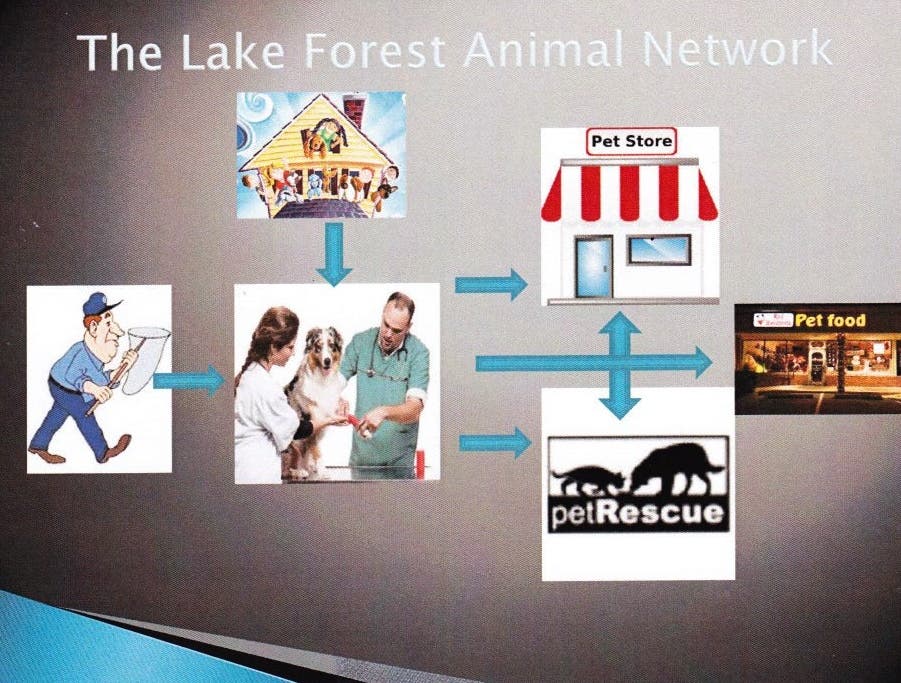
To get an overall picture, please look at the picture accompanying this article.
INTAKE
Find out what's happening in Lake Forestfor free with the latest updates from Patch.
Animals would come to attention through two avenues – (1) reports of stray or injured animals and (2) owners wanting to surrender their animals.
In the case of stray or injured animals, Animal Control Officers would respond and bring the animal to one of the local Vets. If it’s a dog or cat, the Vet would try to contact the owner (we had over 80 in 2014) and the pet would be returned. Otherwise, the Vet would provide whatever treatment is needed. Many of the injured animals won’t make it (over 100 didn’t in 2014), but many will. If it’s a dog or cat, the Vet will provide required vaccinations and spay/neuter if needed, and then release to the Pet Center. If it’s a bird or raccoon or possum, the Vet will release to a rescue group.
Find out what's happening in Lake Forestfor free with the latest updates from Patch.
In the case of an owner who wants to surrender their pet, the Pet Center will provide help to determine if the pet can remain in their home. Perhaps the owner needs some help getting food. Or maybe there is a big medical bill that the owner can’t pay. Or maybe there is a behavioral problem that the owner can’t handle. The job of the “help desk” is to explore all avenues to keep the owner and the pet together. This won‘t always be possible, so when it isn’t, the owner will be referred to one of our local Vets, and then the same procedure will be followed as is used with stray animals (e.g., vaccinate and spay./neuter as needed).
This system is more or less similar to the system used by most cities and counties that operate shelters, except there is no need for a shelter. Instead the pet goes straight to the adoption center, which is located in a highly visible retail area. The other major difference is the use of a “Help Desk” which is designed to help the owner keep the pet in his/her home. This program has been shown to be effective in reducing admissions in dogs and cats.
CARE
Instead of a large shelter, the animals would go to the Pet Center which would be in a retail area and have only a few pets. There are many problems involved with using a large shelter, including the increased risk of disease, reduced sociability, and increased chances of depression. All of these are avoided by using the Pet Center.
The Pet Center would also give pets a much more enriched environment. They would spend significantly more time out of cages and more time with volunteers, all of which means greater chances of being adopted. It also means less chance of developing diseases, which means the operating expenses will be lower.
ADOPTION
As stated earlier, the Pet Center creates an environment that fosters health and socialization, thus making a pet more adoptable. In addition, potential owners can view the dog or cat in a more normal situation. Getting to the Pet Center is also easier since it is in our community instead of 30 to 45 minutes away. Even more significant, going to the Pet Center is an enjoyable experience while going to the Shelter can be depressing.
By placing the Pet Center in a high traffic retail area, there is also the possibility of prospective owners considering a pet even when this was not their original intention.
Because the whole operation is local, adoption events will be much more frequent. They can be scheduled along with many City events (e.g., Bunny Blast, SnowFest) and also held at the local dog park. In fact, it would be relatively easy to hold an adoption event every month with little cost just by using local resources.
Adoption will also be easier by using local volunteers to provide grooming services as well as photographic services.
Tomorrow we’ll look at the budget.
ABOUT THE AUTHOR
Dr. Jim Gardner is on the City Council for Lake Forest. You can check him out on LinkedIn and/or Facebook and you can share your thoughts about the City at Lake Forest Town Square on Facebook. His comments are not meant to reflect official City Policy.
Dr. Gardner has office hours every Tuesday from 4 pm to 6 pm at the City Hall. In addition, he holds a Town Hall meeting every quarter. The next meeting will be on March 26 at 2 pm at the Foothill Ranch Public Library.