Politics & Government
Lake Forest Animal Network. Part 4 - Dollars and Sense
Looking and expenses and revenues for the new model

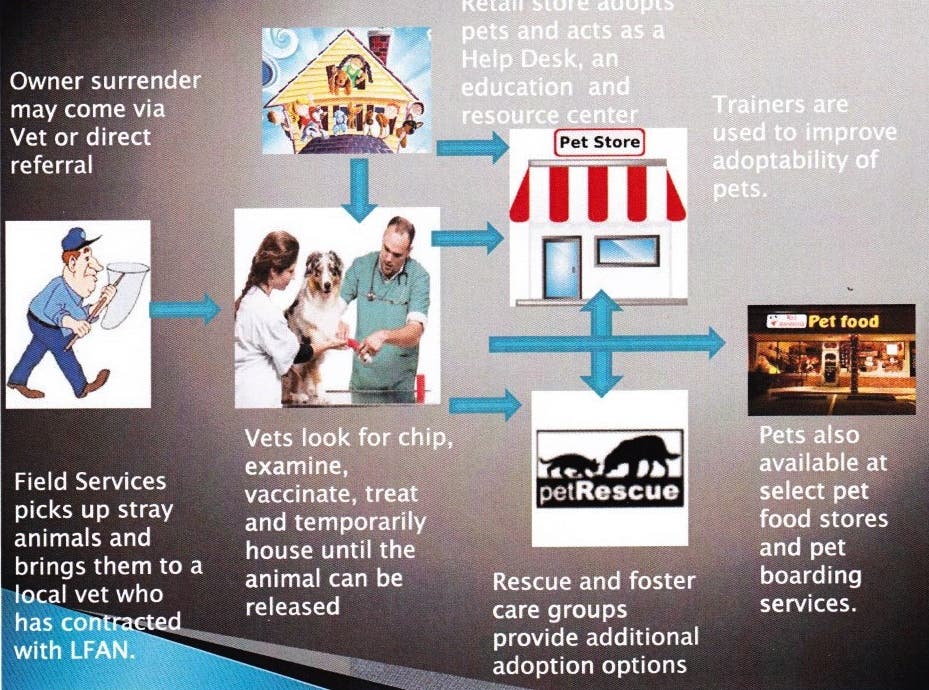
On March 15 the City Council will vote on whether or not to accept a new model for delivering animal care services to the people of Lake Forest and their pets
We’re spending an entire week looking at an alternate animal care proposal for Lake Forest residents and their pets. Monday we looked at the current situation with our contract with Orange County. Tuesday we looked at what an intensive analysis of the data suggests as the necessary service delivery. Wednesday we examined the way the model would function. Today we’ll examine the budgetary implications of the service delivery model.
Bear in mind that all the figures quoted here are best estimates based on the current data. The model is projecting what revenues and expenses will be starting in September 2017.
Find out what's happening in Lake Forestfor free with the latest updates from Patch.
OPERATING EXPENSES
Tuesday we outlined the following services as a result of our analysis
Find out what's happening in Lake Forestfor free with the latest updates from Patch.
- · Contract services from local Veterinarians for 1 to 2 animals per day
- · Two animal control officers to pick up stray animals
- · One licensing specialist to gain revenue
- · Two animal care workers, one of whom is a licensed Vet Technician
- · A Pet Center at least 1,400 square feet
Estimated annual costs for each of these are –
- · Contract services from local Veterinarians for 1 to 2 animals per day - $75,000
- · Two animal control officers - $174,000
- · One licensing specialist - $75,000
- · Two animal care workers, one of whom is a licensed Vet Technician - $140,000
- · A Pet Center at least 1,400 square feet - $50,000
The personnel costs are based on normal costs in the nonprofit world. If the City chooses to run the program as a wholly managed City program, costs would be about 20% higher. OTOH the City prides itself as a contract City so in keeping with that model, the most likely outcome would be a contract with a nonprofit agency to handle the animal care component.
In addition to these expenses, there are the normal overhead expenses that include, phones, IT expenses, office supplied, truck maintenance, insurance, etc. These have been estimated at $50,000.
As a rough estimate, the operating expenses for the first year are $569,000. Strangely enough that’s about how much we pay OCAC for their services.
These costs could be expanded to provide even better service and care. An additional animal care worker would cost $60,000 and a larger retail center would cost $75,000 and maybe $100,000 if we wanted to rent the Cadillac. So $600,000 is probably a good medium price point.
START-UP EXPENSES
Any enterprise has start-up costs which are different from the normal operating expenses. For this model, the start-up costs include –
- · 2 animal control vehicles - $130,000
- · 1 mobile marketing van - $25,000
- · Cages and Kennels - $7,000
- · Materials and supplies - $10,000
All in, the start-up expenses are about $200,000.
TRANSITION EXPENSES
If the County is ready by September 2017, our contract will end at that point, so we need to be fully operational before that deadline. That means that all the pieces should be in place, tested, and fully functional before that time. All staff and the Center should be operational 2 to 3 months before the program starts. Therefore, 25% of annual operating expenses for staff ($449,000), the center ($75,000) and admin ($50,000) will be needed as part of the transition beginning June 2017.
One staff member would begin over a year prior to starting and would be concerned primarily with education, TNR, and other programs designed to reduce admissions, as well as licensing. By doing this, we can expect a 10% to 25% decrease in admissions which is a savings of $100,000, and a 10% increase in licensing which is $30,000 – IOW cost savings should compensate for transition costs
During the transition, the Mobile Center, Marketing Materials, Vehicles, etc. would be used, but these costs are included in the Start Up.
The cost to do all this is about $200,000.
SUMMARY OF EXPENSES
Based on our needs analysis, the expenses look like this -
- · Operating Costs - $600,000 (Year 1)
- · Start-up Costs - $200,000
- · Transition Costs - $200,000
Now compare these figures with OCAC
- · Operating Costs - $600,000 +
- · Start-up Costs - $500,000 to $900,000
Hmmmm.
On an operating basis, the expenses are about the same, but the start-up costs for OCAC are significantly higher. Bear in mind, the service and care are significantly higher with the LFAN model.
REVENUE
Of course, expenses are only one side of the ledger. The other side is revenue.
The major sources of revenue for OCAC (and for LFAN) are licensing fees and business fees. These come to nearly $400,000 under the present system.
LICENSING
OCAC achieves only 42% compliance. Many agencies achieve 50% or more and some achieve as high as 90%. So there is plenty of room for improvement, especially with a local emphasis, a full time licensing specialist, and help from our valuable STARS personnel.
In addition, a source of new income would be cat licenses. Cats are a major source of expense, so it makes sense to ask cat owners to help.
By increasing our compliance rate and by adding cat licenses to our income stream, we can increase the licensing revenue by nearly $200,000.
FEES
OCAC collects about $62,000 in various types of fees, including business licenses ($9,883), vicious dogs ($11,076), barking dog complaints ($1,288), clinic services ($28,776). To these could be added minimum fees for rescue groups, owner surrender fees, returned to owner fees, etc. which would generated another $7,000 per year in revenue.
GRANTS AND DONATIONS
Grants and donations can mean hundreds of thousands of dollars a year to agencies, but Lake Forest gets none of this income as a result of being attached to OCAC. In contrast, our neighbor, Mission Viejo, gets more than $100,000 a year in donations.
SUMMARY OF REVENUE
Here is the projected revenue –
- · Adoption fees - $20,700
- · License fees - $486,145
- · Misc. fees - $74,690
- · Retail Sales - $10,000
- · Grants – $5,000
- · Donations - $50,000
This is a total of $651,535 which is more or less the projected expenses. If you assume a worst case scenario, where the projected increase in dog licensing revenue hits 50% instead of 60%, and cat licensing achieves 25% instead of 50%, and donations come in at 50% of expected, then the revenues are $491,056. In this case, the City’s general fund would have to make up the difference - $287,944. That’s more or less what we will pay from the general fund if we stay with OCAC.
BOTTOM LINE
On an operating basis we have projected income and expenses that are approximately equal. In a worst case scenario, the City would have to cough up nearly $300,000, which is more or less what the City will have to provide if we stay with OCAC.
In terms of start-up costs, OCAC is going to demand between $500,000 and $900,000 while using this model, the start-up costs would be about $400,000 (includes start-up and transition)
Most important, using the Lake Forest Animal Network model, we get better service and better care. Let’s explore this dimension tomorrow.
ABOUT THE AUTHOR
Dr. Jim Gardner is on the City Council for Lake Forest. You can check him out on LinkedIn and/or Facebook and you can share your thoughts about the City at Lake Forest Town Square on Facebook. His comments are not meant to reflect official City Policy.
Dr. Gardner has office hours every Tuesday from 4 pm to 6 pm at the City Hall. In addition, he holds a Town Hall meeting every quarter. The next meeting will be on March 26 at 2 pm at the Foothill Ranch Public Library.
tiT>