Community Corner
Architects Envisioned a ‘Spectacular’ Postwar La Mesa: Homes Seen in Tour
Lloyd Ruocco sought a "mecca for both sightseers and those who want to live in tomorrow's town."


Updated Nov. 21, 2011
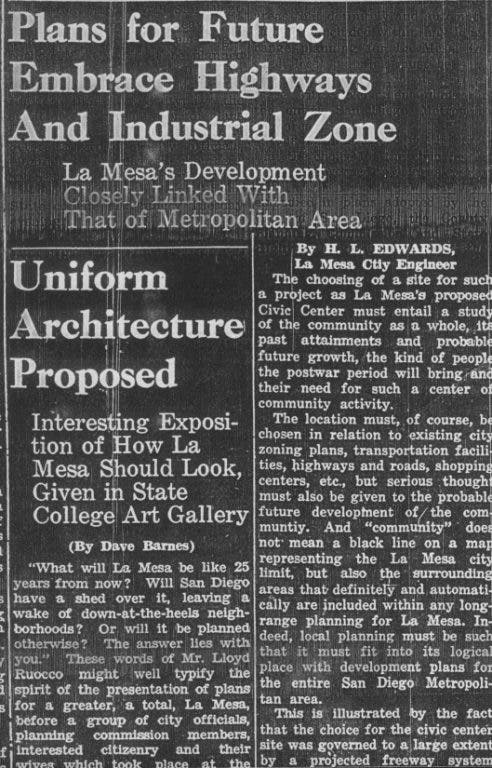
“What will La Mesa be like 25 years from now? Will San Diego have a shed over it, leaving a wake of down-at-the-heels neighborhoods? Or will it be planned otherwise? The answer lies with you.”
—Lloyd Ruocco, August 15, 1944
Find out what's happening in La Mesa-Mount Helixfor free with the latest updates from Patch.
Lloyd Ruocco, an articulate and erudite 37-year-old architect and planner, stood before an august group of La Mesa city officials, Planning Commission members and interested citizens.
They had gathered that Tuesday evening at the San Diego State College Art Gallery to see the results of a select group of young designers and planners led by Ruocco.
Find out what's happening in La Mesa-Mount Helixfor free with the latest updates from Patch.
The La Mesa Planning Commission had commissioned, and the Chamber of Commerce funded, the design team to provide plans for “a face-lifting program for the business section of the city.”
City Planning Commission member and renowned sculptor James Tank Porter (of the pioneering and influential La Mesa Porter Family) had been a key mover in getting the design group formed—and garnering the chamber’s support funds for their efforts.
Porter was also a founding member of Mayor Ben Polak’s “Greater La Mesa Committee.”
Polak had formed the Greater La Mesa Committee in summer 1943 to help prepare the small city for dealing with its existing growth due to World War II, and the expected exponential postwar growth to follow.
As Mayor Polak directed subcommittees for how to plan and fund the perceived needs for a civic center, park and recreation facilities, war memorial and community auditorium, Porter suggested the need for a more professional and visionary plan to help guide it.
He apparently contacted the duo of Lloyd Ruocco and Ilse Hamann. Hamann was a professor of art and interior design at San Diego State College (one of the originators of today’s Art & Environmental Design program). She also was Ruocco’s fiancée. Lloyd and Ilse would marry in late 1944.
They gathered a number of Ilse’s student artists and Lloyd’s associate architects, engineers, and city planners, including Laura Andresen, Francis Box, Mary Ellen Bowlby, Jack Dertola, George Storz, Jack Hillmer, Jack Schoberg and Carl Wieger for their team.
Ruocco was working at the time as the Navy’s head draftsman in the 11th Naval District offices—where many local designers settled while waiting for the private building industry to re-engage after the war. Several team members were reported as working with him “in the local defense industry.”
The Vision for “America’s New Model City”
James Tank Porter himself had introduced Ruocco to the crowd of dignitaries that Tuesday evening for the initial presentation.
Ruocco presented the group’s three planning and design concepts to the La Mesa civic leaders.
La Mesa Scout reporter Dave Barnes detailed the proposals in an Aug. 18, 1944, article as did San Diego Union reporter Etta Mae Wallace in a Sept. 17, 1944, article prior to the public unveiling of the plans.
One wall of the gallery featured a study of the existing La Mesa Boulevard business district—a composite photograph of the street facade. The designers presented a thematically unified decorative treatment. The team’s goal was to show how a unified architectural treatment could “beautify” the eclectic existing facades.
The second wall featured the title and exhibits for “Greater La Mesa, A Better Town Thru Bold Planning.” Ruocco and the team took a new approach to the existing development plan of downtown while expanding on ideas for accommodating a civic center and other land use changes through enhancements of existing facilities and landscape for accommodating “traffic, travel and trade.”
Barnes quoted Ruocco on “the importance of making La Mesa a pleasant, even exciting, place to go to for trade or recreation.”
A third exhibit wall, titled “Total La Mesa—The Greatest Benefits from the Broadest Vision,” reflected the Modernist style and land-use philosophy that Ruocco would display in his future groundbreaking work.
Considering La Mesa’s natural landscape and resources, along with its planning potential, the Ruocco group considered all factors to create their vision for a La Mesa future full of freeways, shopping centers and even a heliport, all within its natural landscape that considered its existing “topography and soil structure.”
The exhibits featured sketches representing what Barnes described as “a vivid and exciting total La Mesa.” The new, visionary downtown was clustered around a civic center core “constructed in the exposition spirit.”
Ruocco described the exposition spirit thusly:
“Actually the big steady attractions at the expositions have been those which gave Americans a look-in on the possibilities of future living, free from over-crowding, the din and confusion that have played havoc with urban nerves.”
Residence areas featured a Ruocco design concept he called “superblocks.” These residential zones of quiet, traffic calmed streets all focused into common park and recreation facilities that formed not just streets—but neighborhoods—“safe for children and the old to live and play in.”
Ruocco described his La Mesa "superblocks" and their hoped-for affects:
A typical superblock for the new La Mesa might be 10 blocks long and five blocks wide, with a parklike central area running down the center. The people of this community would have a pleasant, safe living area, free from the rush of traffic.
In this area children could play and there would be a place for adult sports. Especially-nice knolls would be haved for church, school or club, a landscaped area for all to enjoy. Children could walk to school without danger. Paths would lead through the parkway to community clinic, library and neighborhood markets.
Every citizen would be part owner of the superblock; neighborliness and community spirit would thrive and citizenship would assume a new meaning."
The concept would have created a “new” La Mesa, one that the visionary designer and his team acknowledged would create a City of the future from the small municipality.
Ruocco summarized the opportunity, although radical, that he hoped to convince the La Mesa leaders to embrace:
“Only a plan that is fundamental, taking in the entire community, including streets, roadways, parks, sewers, police, fire prevention, can cure the “disease of cities.” …[if implemented] it [La Mesa] would become the mecca for both sightseers and those who want to live in tomorrow’s town, today.”
A Visionary Architect
So, who was this visionary architect/designer?
Lloyd Pietrantonio Ruocco was a native of Maine whose family had moved to San Diego County in the early 1920s—settling near Santee.
As Ruocco’s biographer Todd Pitman (a Mount Helix resident and owner of a Ruocco designed home) has documented in various lectures and articles, such as at the modernsandiego.com website, Lloyd was inspired by his high school drafting teacher at San Diego High, the noted architect Lillian Rice, to consider architecture and design.
After graduating from UC Berkeley, he returned to San Diego, gaining experience in the office of leading architects Richard Requa (designer of local landmarks La Mesa Grammar School and the Mount Helix Theatre) and William Templeton Johnson.
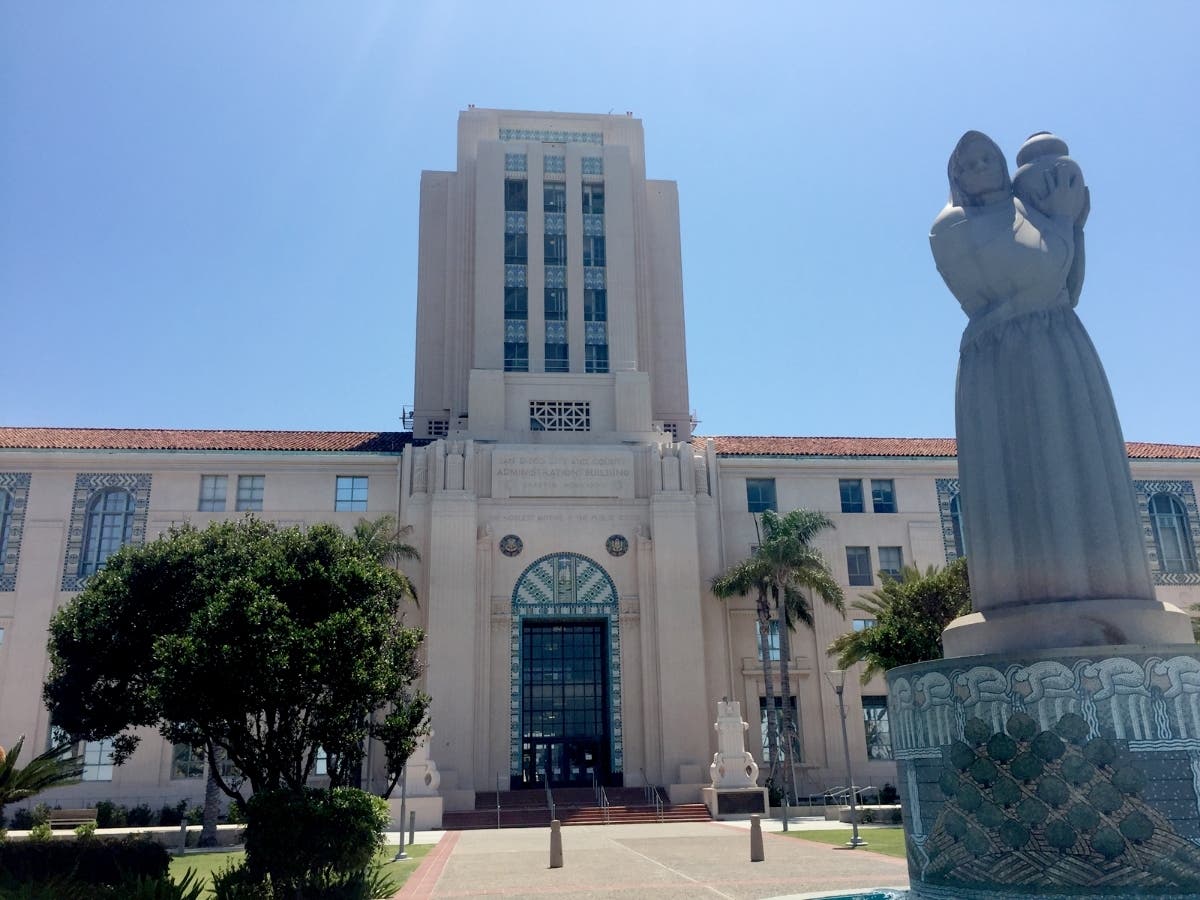
Ruocco gained practical experience in architecture and design working on the 1935 Panama-California Exposition, the County Administration Building and with Requa associate Rice on the master plan for Rancho Santa Fe.
Yet his work with these masters of the popular inter-war “Spanish and Mediterranean revival” styles did not sway Ruocco from his interest in the cutting-edge ideals of Modernism and Modern design.
For his contemporaries such as noted San Diego Modernist architect Bob Mosher, Lloyd Ruocco would become the leader of the local San Diego Modernist movement.
Mosher remarked on Ruocco that “He was the person to whom you turned for inspiration. He was the modernist.”
In 1949 Lloyd and Ilse established the Design Center in San Diego on Fifth Avenue in Hillcrest. From here many of San Diego’s notable Modernist architects and designers would gain knowledge, experience and inspiration until Lloyd’s passing in 1981.
Ruocco’s influence would lead to many notable projects and in 1961, after one of his visionary speeches, this time to the League of Women Voters, he and several local designers and planners formed the Citizens Coordinate for Century 3.
The C-3 group became an important and influential civic organization having just celebrated its 50th anniversary this year in its Ruocco-inspired mission to “achieve the highest standards of environmental quality, physical design, economic benefit, and social progress” for the region.”
Such were his lifetime achievements that recently the San Diego Unified Port District named its new $7.3 million public project north of Seaport Village—Ruocco Park.
“Super Dream for Model City Deemed Not Practical”
Today urban historians and planners may see the concepts of “new urbanism” and “smart growth” in Ruocco’s then visionary planning ideas—but for Mayor Polak and the civic leaders of 1944 La Mesa—it may have been interesting, but it was considered, at minimum, impractical.
Mayor Polak was even more direct in his contempt for the too-visionary “Total La Mesa” concept. Polak was quoted during a speech at the city’s “Everyman’s Club” reported in the Sept. 22, 1944 La Mesa Scout:
“[Ruocco’s plan] is not connected in any way with the Greater La Mesa Committee’s plans and activities. Someone was a super-dreamer [poking fun at Ruocco’s “superblocks”]. It is not our plan by any means.”
The Scout noted that the first two concepts for upgrading and unifying the existing business district and presenting some concept of placing a new civic center into the city core had some merit.
The editorializing article then reiterated that Ruocco’s initial charge was to undertake these two initial tasks but that “the third plan, however, is purely his own.”
Adding another political as well as personal critique of Ruocco’s plan, the article noted that although “the plan was interesting and focused much attention on La Mesa, it represented the using of this community as a guinea pig for the progressive architectural enthusiasm of its author.”
The “progressive” label being a veiled attack on the concepts of New Deal era public housing and planned community projects as “socialist” ideas—ones that many in the building and construction industries of the time challenged as un-American in concept for decades to come.
After the plans were exhibited at the San Diego State College gallery, city leaders dismissed such radical development plans as Ruocco proposed.
Within a year the city would engage another local architect, Requa associate and native La Mesan Sam Hamill, to design a plan for a new civic center and war memorial building (none of which would be built either).
As such, Lloyd Ruocco’s plans for turning La Mesa into “America’s Model City” were forgotten as the small city would focus on the practical challenges of raising the funds and building its new civic center (eventually finished in 1958—only George Hatch’s City Administration Building is currently left from that complex).
(As urban historians such as this author note: La Mesans should not be too hard on its forefathers for rejecting Ruocco’s visionary plan. Our larger neighbor to the west, San Diego, twice ignored the efforts of the world-renowned city planner John Nolen and his 1908 and 1926 plans for creating a “city beautiful” vision for that city).
Ruocco Still Makes His Mark on the Local Landscape
Luckily the rejection of Ruocco’s plan for La Mesa in 1944 did not end his work in the area.
According to Todd Pitman, shortly after this project Lloyd and Ilse were married in a small ceremony on Mount Helix. As a wedding gift, he designed a house for her nearby in La Mesa in which he named “Il Cavo.”
Ruocco also built and sold numerous spec and custom houses in the Grossmont, Helix and La Mesa areas over the next few years as Lloyd and Ilse built up their practices and the Design Center.
As Pitman has documented, these early houses reflected Ruocco’s interest in the natural landscape of the region. Ruocco built most of these houses with redwood and glass to maximize their relationship to the natural resources of the sites. He would use local stone and when feasible incorporate boulders or other landscape elements of the sites into his buildings.
These early Organic design elements were a practical and literal interpretation of his building philosophy of the time to take advantage of the indigenous materials of the area to create a harmonious building within its natural landscape.
The following statement illustrating his basic approach:
“Good architecture should call for the minimum use of materials for the most interesting and functional enclosure of space.”
2011 Home Tour Provides Glimpse at Ruocco’s Design Brilliance
Although Ruocco’s Il Cavo has since been demolished along with the equally impressive 1968 Grossmont “spec house,” the La Mesa Historical Society on Saturday, Nov. 5, presents a rare opportunity to visit two local Lloyd Ruocco designed homes.
One, the Cole Residence, was built in 1952 and is a classic example of his early work in the Mid-Century Modern style.
In addition, the Crouse/Bos House in Grossmont features the initial work of two master designer/architects—Cliff May and Lloyd Ruocco.
The original Cliff May designed building is in his original “California Hacienda” style. It is a great example of May’s early work, designed and built for Alphus Crouse, patriarch of the long-serving postmaster family of Grossmont, and later longtime home of Dr. Jacob Bos and his wife, Josephine.
In 1965, the Boses hired Ruocco to expand the original May home.
Ruocco’s sensitive intertwining of the Modern style into the historically inspired California Ranch “hacienda” is a great example of his skill as well as his knowledge of the significance of by then, internationally famous local designer May’s, early work.
In addition, this year’s tour features another Mid-Century Modern gem, the Ron Davis designed Smith House. Davis, later a key partner of award-winning Modernist architects Fred Liebhardt and Henry Hester, built this commission for a family friend. It is one of his best works and features the owners' own stained glass work, and a beautiful front door designed by noted artist/architect James Hubbell.
The tour is rounded out with two beautiful and updated 1930s era Mediterranean Revival style homes—the Upp/Cassady and Scott Houses.
Tour Tickets and Info
Day of Tickets ($20 and $18 for Society members) are available at the 2011 La Mesa Historical Society Home Tour Check-In and Shuttle Shop at the La Mesa Women’s Club, 5220 Wilson St. (southwest corner with Grossmont Boulevard).
The five featured homes will be open from 10 a.m. to 3 p.m. (The last shuttle will leave the Tour Center at 2:30 p.m.).
Due to the narrow streets and severely limited or nonexistent parking, the society recommends taking the complimentary Old Town Trolley buses that are included with ticket purchase to access the homes.
No tickets will be sold at the homes.
Call 619-465-1883 or visit lamesahistory.com for further information.