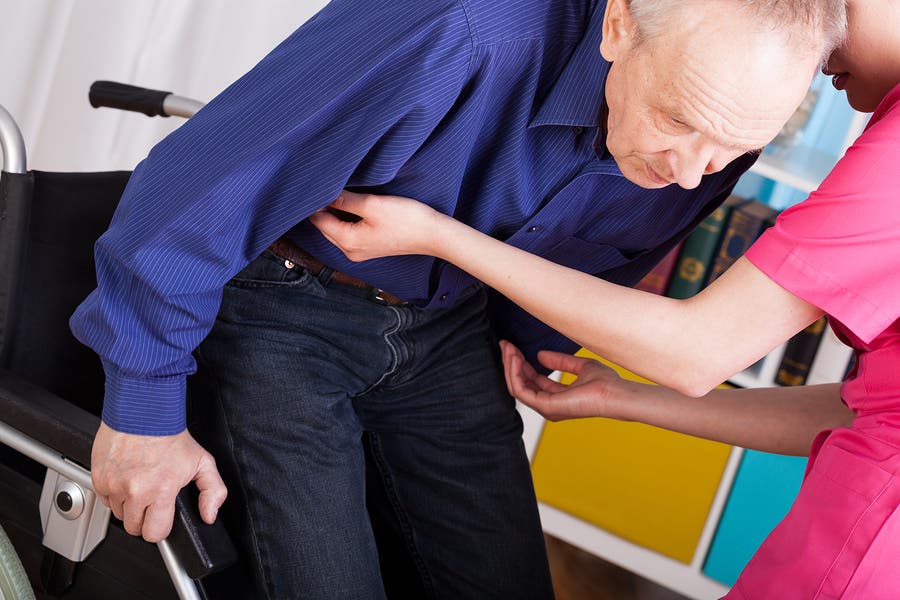
For those of you who are responsible for assisting in the care of a loved one, your life is full of unique challenges that you may never have even considered before embracing this role. If you are a petite or average sized woman caring for a much larger husband or father, these tasks can create an even greater challenge. While caring for an elderly and/or disabled loved one, you will most likely be needed to assist in lifting and transferring them. It is crucial to take the correct precautions and follow safe lifting techniques in order to prevent injury to both your loved one and yourself.
According to the Bureau of Labor Statistics, in 2014 the incident rate for overexertion and bodily reaction was five times higher for nurses than the majority of other industries. Therefore, not only are these dangerous tasks for nurses to perform, who have been professionally trained with the proper skills, it’s even more dangerous for amateur caregivers who are caring for their own loved ones. Consequently, it is extremely important to equip yourself with the knowledge and basic skills to assist in lifting a person correctly. Your loved one is depending on you to care for them, which means you also need to care for yourself so that your body can remain healthy and active.
The Caregiver Action Network says that the key to being able to safely assist your loved one at home is to maintain your own health and learn proper body mechanics, or the ways in which we use our bodies. There are some steps you can follow to strengthen your body and prevent wear and tear. It is crucial to exercise in order to develop strength and flexibility of your muscles, which will help you in your lifting techniques. It is also important to practice good posture, when standing, sitting, and lying down. Choose comfortable shoes that will help you to maintain correct posture, and focus on keeping your head erect and your shoulders back. Use support when seated for long periods of time if needed as well.
Find out what's happening in Lamorindafor free with the latest updates from Patch.
When helping to lift and transfer your loved one, be sure to communicate with them about what will be happening, even if they do not seem fully aware. They should put in as much work as they are fully capable of. The idea here is that you are assisting your loved one in their move, not doing it for them. Be aware of any pains or injuries the person has, so you can be careful to avoid aggravating those areas. Ideally, your living space should be conducive to transferring your loved one as well. The room should be free of clutter and hazards to prevent tripping. Any necessary equipment to assist you in your lift should be nearby and ready to utilize. The revised NIOSH lifting equation says that the maximum weight limit for one person to lift safely is 35 lbs. There are many tools that can make the process safer, that insurance will often cover, such as transfer boards, lift beds, and sling lifts.
By Amanda Schmid
Find out what's happening in Lamorindafor free with the latest updates from Patch.
To read the rest of this article, visit EldercareAnswers.com.