Community Corner
'Did You Feel It?' CA Quake Survivors Asked To Share Memories
Facing a sudden increase in significant quakes, experts are helping California prep for the big one by understanding past temblors.


CALIFORNIA—Thirty-five years ago, it was just another day in the Bay Area until a 6.9-magnitude earthquake rocked Loma Prieta, killing 63 people and injuring 3,757 more. The U.S. Geological Survey is still gathering data on the quake, asking people in the area to register their memories in the "Did you feel it?" database.
More than 11,500 people have shared their responses, helping the USGS build a retroactive shake map.
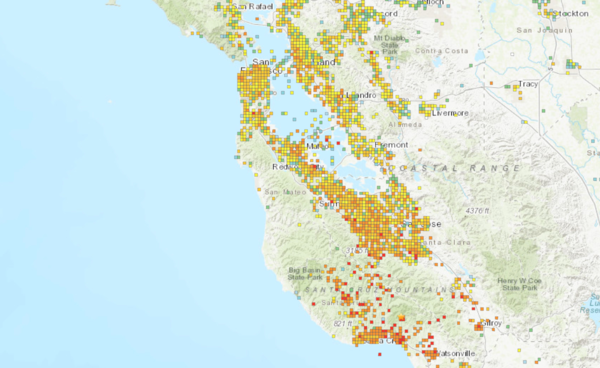
The database questionnaire is simple to use, and among the more valuable applications invented by USGS. It first came online in 1999, inviting anyone who felt something to share their reactions online, according to Christine Goulet, Earthquake Science Center director. "The type of data collected from the public helps us better understand the impact of past and future earthquakes."
Find out what's happening in Los Angelesfor free with the latest updates from Patch.
Find out what's happening in Los Angelesfor free with the latest updates from Patch.
In Los Angeles, “there are a lot of faults … that have a high probability of having a large, damaging earthquake in the next 30 years,” Stephen DeLong, supervisory research geologist in the USGS Earthquake Science Center, told SFGATE . “We don’t know that it will occur in five years or 30 years, but a large earthquake will occur.”
Southern California saw a dramatic increase in quakes of a magnitude 4.0 or above in 2024. Thus far in 2024, 21 magnitude 4.0—and higher quakes have struck the Golden State, nearly double the annual average over the last two decades. The sharp upturn in quakes doesn't make it more or less likely for the big one to hit.
“The stress builds up, and the stress continues to build until it’s released,” DeLong added. “It would take hundreds and hundreds of little earthquakes to release the amount of stress that’s released in a big one."
One thing we can do is stay prepared.
The 2024 Great Shakeout drill is scheduled for Thursday, October 17, at 10:17 a.m. across the Golden State. Schools, government offices, and emergency responders will “drop, cover and hold on,” now considered standard practice for earthquake preparedness.
As of Tuesday afternoon, the Shakeout.org website noted that over 10.5 million Californians were slated to participate in the drill, about 300,000 more than last year. That attention may be due to the number of magnitude of 4.5 and greater quakes that have rocked California thus far in 2024.
The Great Shakeout has been a practice in California since 2008. Many know the drill and have seen mobile vehicles mimicking different points on the Richter Scale. But since it began, scientists have pushed new technologies to learn more about why the earth moves and, better yet, steps toward predicting when it will move next.
What's different in 2024?
This year, the 21 significant quakes have gotten California's attention. However, seismologists say they do not predict a larger quake or release pressure to prevent one.
A magnitude 5.2 earthquake struck Bakersfield in August, with lingering aftershocks felt across Kern County. An early morning quake in September shuddered Malibu, this one a 4.7 magnitude, felt across more than 100 miles. Again, the earthquake was followed by numerous aftershocks felt across the region. Many Californians who registered for the free MyShake or ShakeAlert Apps got advanced warning notices, allowing them to take cover.
"More quakes just mean more quakes," Dr. Lucy Jones, seismologist and author of "The Big Ones," frequently told reporters.
Jones tweeted at the time of the Bakersfield quake that,"like any quake in SoCal, there is a 5% chance that it will be followed by something bigger. That means a 95% chance that this is the largest. We have never found any characteristic that makes a quake more likely to be a foreshock."
The study of earth sciences is reaching new heights for those with their ear to the ground.
A recent $6.1 million National Science Foundation Grant has expanded UCS’s Southern California Earthquake Center efforts to broaden its reach by recasting itself as the Statewide California Earthquake Center. Under the new name and the ongoing leadership of Director Yehuda Ben-Zion, professor of earth sciences at USC, more information is available to develop a deeper understanding of earthquakes.
The group will continue to study the San Andreas Fault system in Southern California, across the Golden State, and the Pacific North America plate boundary in California and surrounding regions. By doing so, the SCEC’s consortium of multiple institutions will be able to provide better information to reduce earthquake risk for residents.
Meanwhile, the Great Shakeout continues its objective to emphasize precautions during a 7.8-magnitude or larger quake along the southernmost portion of the San Andreas fault. Why 7.8? The state’s longest faultline, rattled with deadly force of a magnitude 7.8 quake in 1857.
Officials believe such a tectonic shift could produce waves of movement for hundreds of miles over four minutes. According to the U.S. Geological Survey, some 2,000 people would die, tens of thousands would be injured, and more than $200 billion in damage would result. The cataclysm would be 50 times the intensity of the Jan. 17, 1994, Northridge earthquake that killed 57 people, injured thousands, and caused tens of billions in damage.
According to the U.S. Geological Survey, an 8.0 magnitude quake could kill more than 1,800 people, injure 50,000 more and cause hundreds of billions in damage. If and when "The Big One" hits, hundreds of aftershocks would ensue, a few of them nearly as big as the original quake.
In 2019, a large earthquake struck the community of Ridgecrest, just months after the Great Shakeout drills. The 6.4—and 7.1-magnitude temblors caused significant damage to roads and structures in the hamlet, which lies just south of the China Lake Naval Air Weapons Station. No one was killed or seriously injured in that event, but residents have continued to share their story years later, according to an SB Sun article. Namely, help comes from the community.
According to local and state officials, Californians should be prepared to be self-sufficient for 72 hours following a major disaster. Each resident should have a complete first-aid kit, medications, food, and enough water for each household member to drink one gallon daily.
Homeowners and renters should also know how to turn off the gas in their residences in case of leaks.
According to the Earthquake Country Alliance, there are seven steps to earthquake safety to ensure your survival and ability to help others:
Here’s how you can prepare for earthquakes:
- Secure tall, heavy furniture to the walls
- Create a family disaster plan, including backup means of communicating with one another if cell phone towers are down, such as designating an out-of-state relative as a point of contact or establishing an emergency family hashtag for communicating.
- Maintain an earthquake survival kit including a first aid kit, food and water for a week, medications, spare eyeglasses/lenses, and contact lens solution, copies of ID cards and insurance cards, pet supplies, flashlight, blankets, batteries, solar-powered chargers, a whistle, cash, list of important phone numbers, toiletries, plastic bags, cooking utensils, a wrench to turn off gas and water enough for each person to have 1 gallon a day.
HOW TO SURVIVE:
Drop cover and hold on. Doorways are no longer considered a safe place to wait out a quake. Experts advise taking cover under sturdy furniture. Evacuate when it is safe to do so.
There is still time to register, according to the website. "By participating in the Great Shakeout, you can have peace of mind that you, your family, your co-workers and millions of others will be better prepared to survive and recover quickly from the next damaging earthquake."
Get more local news delivered straight to your inbox. Sign up for free Patch newsletters and alerts.