Local Voices
Fire and Art
An eight year journey brings the resilience of nature and the science of fire into one...or about one hundred thousand...scenes.

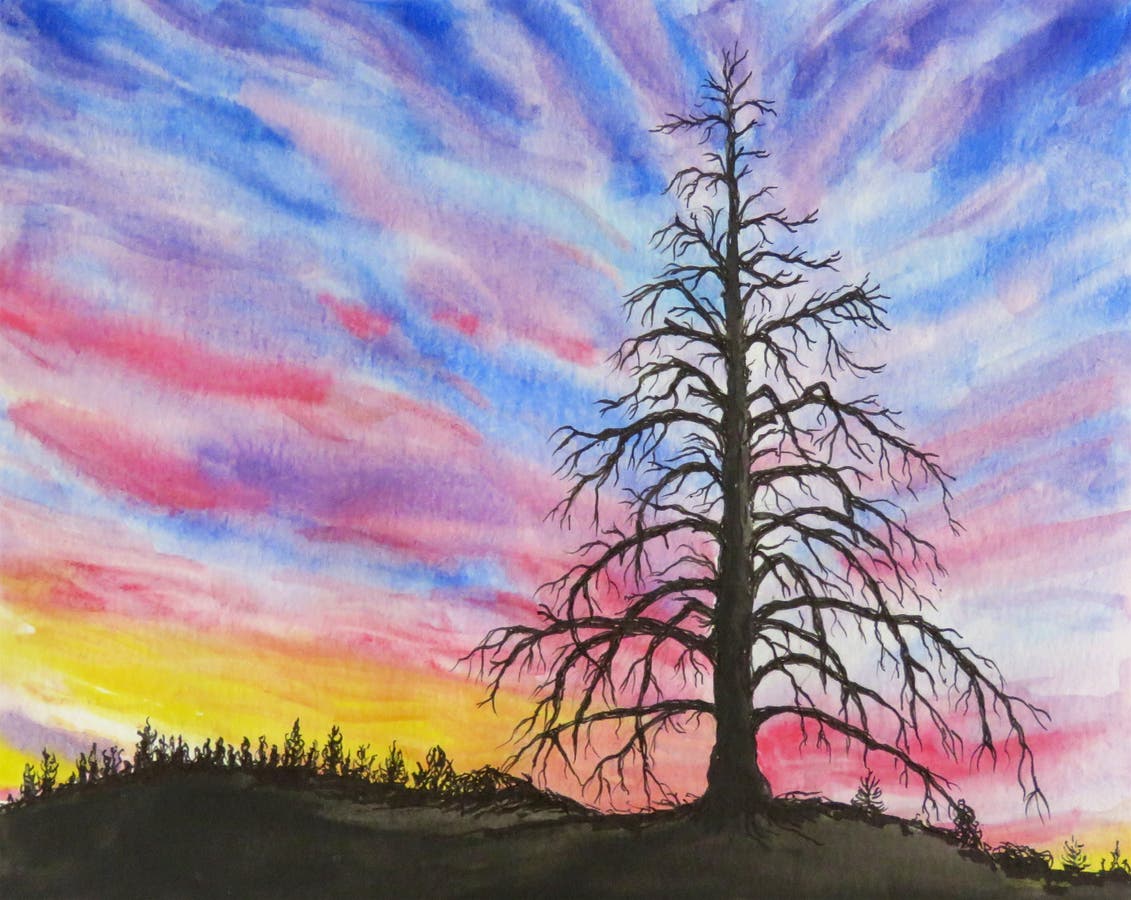


Nel Graham's mixed media illustration was a crowd favorite in a recent art show called "Highway 2 - the journey and the destination". The image it is based on was taken in 2014, in the burn footprint of the Station Fire. The largest wild fire in the history of Los Angels County, it devastated a quarter of the conifer forest in the Angeles and left many skeletal silhouettes on the skyline.
It is one of roughly one hundred thousand images in the Forest Recovery Project, a documentary in photographs illustrating the natural recovery of the Angeles National Forest from the Station Fire of 2009.
It is an independent effort born out of the desire to help ordinary people understand, cope with and prepare for fire; to know it as an integral part of the long term health of ecosystems and to appreciate the ability of healthy ecosystems to recover and in fact thrive in the wake of fire.
Find out what's happening in Los Angelesfor free with the latest updates from Patch.
The complex and not entirely predictable nature of fire is much more than most of us care to study. We have some basic, survival-based reactions to wild fire...we want it to be put out as soon as possible and we fear for the loss of our lives, our loved ones and personal belongings. A raging wild fire is terrifying and often unstoppable. Fear is an absolutely valid and logical response.
When the Station Fire erupted, I was one of the first people to evacuate. I was scared in a way I don't ever remember being before. The fire was still miles away...but it had exploded across the steep landscape, and you could just feel its energy. There was going to be significant loss. I drove past a community on my way down the mountain that lined a seasonal creek. Some of the homes were nestled in a thick canopy of trees and shrubs. Others were perched at the end of narrow driveways against the side of the mountain, with no access for emergency vehicles. Within 72 hours those homes were reduced to rubble. Only a hand full of them survived the fire.
Find out what's happening in Los Angelesfor free with the latest updates from Patch.
The Station Fire of 2009 remains the largest wild land fire in the history of Los Angeles County, burning 160,577 acres, most of it in the Angeles National Forest. Two firefighters lost their lives and nearly 100 structures, including roughly 80 homes, were lost in the blaze.
In the wake of a fire there's a desire to respond that represents the best intentions of humanity. But in the last century, most of us have turned away from nature and toward the urban life. In doing so we've lost our understanding of our local ecosystems. So that desire to respond is noble, but not grounded in knowledge. We want to do something to make things better. But what?
I would return to the forest after the fire, because everything I had ever been taught about fire - most of it from an indigenous land management perspective - suggested that this terrible arson fire did not actually destroy the forest. It did a radical transformation, yes, and it did tremendous damage to the conifer population. But the forest would recover. I stayed on to document that recovery, and to share it with whoever cared to see it, because most people would not get to experience the first few years of new growth. The forest was closed to the public, and with good reason. The highways had been severely compromised and would wash away the following winter, and the forest itself was a dangerous landscape, with frequent landslides, falling snags and "dry quicksand" in the most intense burn areas...soil that collapsed when you stepped on it.
I wanted to make a positive contribution to the forest, and to those who experienced a tremendous sense of loss as a result of the fire. I wanted to bring them hope...but also understanding. An understanding that we've suppressed fire for about as long as we're going to be able to. And now, we're experiencing the backlash. Catastrophic fires. Huge fuel loads dried to a crisp by a changing local climate. Somehow, we have to re-introduce fire as a management tool...and that's not going to be easy when so much human life and property is at stake.
To some degree, approaching the subject of fire with a collection of photographs is a very passive way of addressing a pressing land management and human safety issue. But it's working. Nature images have a way of reaching us...addressing perhaps some lost longing to connect with the natural world which we, not so long ago, understood. Pictures help us believe that ecosystems can and do recover, that fire is an element of immense power but not necessarily pure evil, and hopefully, through dialogue and discussion, we become willing to think about fire in different terms...in terms of fire as a management tool and a natural part of many of not most terrestrial ecosystems.
Although it is still a work in progress, The Forest Recovery Project was released to the public on June 21, 2017. Arranged by year and then by month, over 100,000 images strong, the Forest Recovery Project seeks to reveal the beauty of a forest in its life/death/life transition, offering an often intimate view into a unique, sometimes harsh, always fascinating landscape. You can view the images here:
https://forest-recovery-projec...
Many organizations and individuals have supported this effort, including Southern California Edison/Edison International, the JiJi Foundation, Ralphs/Food4Less, Los Angeles County Arts Commission, The Haven Foundation, California Native Plant Society, Kevin McKinder, Ralph Ortiz, Robert Torres, Scott Brown, Erli Bittencourt, Holly and Randy MacLaren, Dan Bond, Cheri Howlett, Debra Gottschalk Delahunty, Mark Beaulieu, Michael McIntyre, Chad Pansini, Roger Klemm, SmugMug, Toyota Motor Corporation, L.A. County Fire Division of Forestry Chief John Todd, Deputy Chief J. Lopez, Jose Martinez, L.A. County Fire Captains Ray Mitcheson and Bob Goldman, Maria Muriello, Hooman Salari, Leslie Miller, Julia Houser, A.C. Arch, Patricia Seymour, Facebook, Frank Catticochio, Haramokngna American Indian Cultural Center, Joseph Villa (God bless and keep you), The Flintridge Foundation, Larry Lopez, Todd Smith, Dr. Richard Schneider, Johnine Peterson, Gary and Lori Fuller, Mary McDaniel, E.J. Gallo Winery Inc., PAR Electric, Jamie Sullo, James Lorrigan, Starbucks, Ray Rivera, Les and Ruth Dios, Dan Corvin, Michael Reifel, Michael O'Hair, Mari Martin, Robert Owens Greygrass (happy hunting brother), Dan Running Bear, Wayne Scott, Mitch Brown, Shelley Owen, Jeff Zimmerman, Joe Peduto, USFS Battalion Chief Chris St. Pierre, USFS Fuels Battalion Chief Scott Lowden, USFS Resource Manager Steve Bear, Gary Pickett, Gabriel Baptista, The Taricco Corporation, Steve Golden, David J. Cline, Demetri, Tigger...and doubtlessly, others whose names escape me and whom I have yet to meet on this beautiful and soulful journey.
The parent organization making all of this possible is Redbird, a 501(c)(3) Native American and environmental non profit association, founded in 1994. We have five main program areas, of which the Forest Recovery Project is one. Learn more about our mission, our signature event, The Children of Many Colors Native American Powwow, who we are, what we do and how you can be a part of it at www.RedbirdsVision.org