Community Corner
Cold War Fears Set Off a Politically Charged 'Battle' in La Crescenta
A 1947 raid on a Democratic meeting by the Glendale American Legion sparked the so-called "Battle of El Moreno Street" at the home of British expatriate Hugh Hardyman.

On the night of Nov. 14, 1947, a meeting of the Crescenta-Cañada Democratic Club convened at the house of Hugh Hardyman on El Moreno Street in La Crescenta. Hardyman, a British expatriate, was serving as the club’s program chairman.
The speaker of the evening was David Leff, a former information officer for the United Nations Relief and Rehabilitation Administration, who had recently completed a trip to Yugoslavia, where he had assisted with a food distribution program. On this particular occasion, he was speaking about the ramifications of the Marshall Plan.
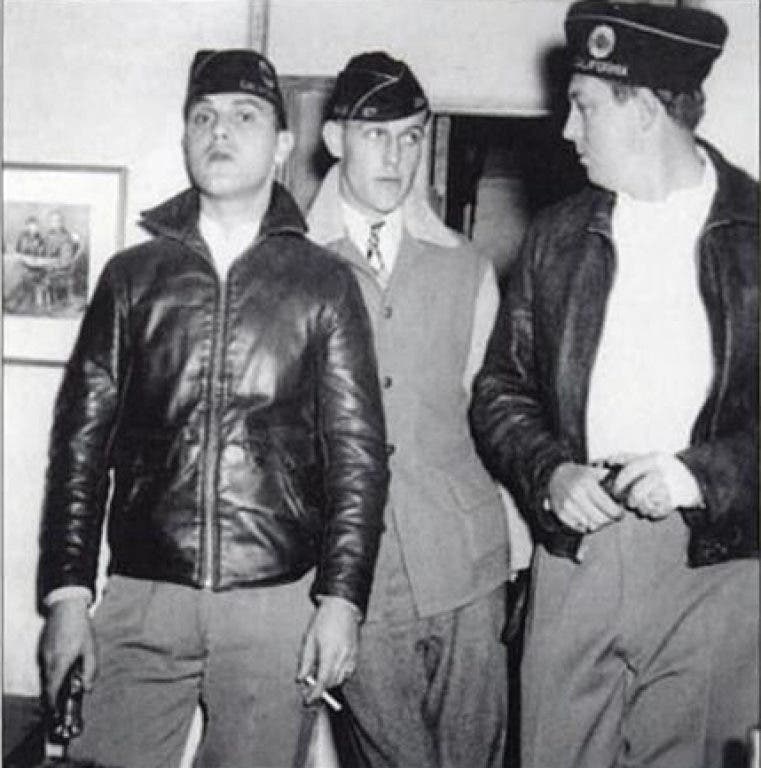
Without warning, 20 men wearing American Legion caps stormed into the house. Later, it was revealed that they belonged to Glendale American Legion Post 127, but at the time, a spokesman for the group introduced them as members of the "Americanization Committee for Community Betterment."
Find out what's happening in Montrose-La Crescentafor free with the latest updates from Patch.
The leader spoke to the 30 or so gathered members of the club as the PCA—or Progressive Citizens of America, an organization that at the time advocated diplomacy with the Soviet Union to pacify Cold War tensions and avoid possible war.
Explaining that the PCA wanted to undermine the U.S. Government, the man threatened that they would not allow such an organization to exist in the community. He entreated the members of the Democratic Club to return home and “thank God you live in the United States.”
Find out what's happening in Montrose-La Crescentafor free with the latest updates from Patch.
The legion members had invited a member of the press along, who took pictures. A photographer from the Crescenta Valley Ledger was already there covering the meeting and took more photos. Before leaving, several legion members lingered on the lawn of Hardyman’s home, perhaps itching for a more physical confrontation, until Montrose sheriff’s deputies arrived following a phone call that had been made.
The meeting continued, but the brief disruption had enraged Hardyman and would spark a struggle for legal redress that dragged on several years.
To explore the slightly confused reasoning behind what happened that evening, it's necessary to know a little bit of the history of the American Legion. Founded as a patriotic organization in 1919 by soldiers returning from World War I, the stated intention of the league was to aid veterans. In 1921, they were instrumental in the creation of the U.S. Veterans Bureau. From their earliest days, however, a hot-headed and reactionary streak ran through the society. In August 1921, Legionnaires in Iowa kidnapped Ida Crouch-Hazlett, national organizer for the American Socialist Party, driving her 20 miles out of town, where they harassed and intimidated her before letting her go. In 1923, the legion’s commander, Alvin Owsley, praised Italian fascists for dealing with the “obstructionists who menaced Italy.”
By the 1950s, the American Legion was sponsoring efforts in states like Illinois requiring all public sector workers to sign loyalty oaths proving they were not communists. Though it's toned down the rhetoric today, the legion was at that time one of the standard-bearers for the ultra-patriotic anti-communist movement that culminated in the investigations of the House Un-American Activities Committee and U.S. Sen. Joseph McCarthy.
It is quite possible that the men who tried to break up Hardyman's meeting genuinely believed it was a communist organization, however misguided this belief may have been. “It's worth noting what a radically far-right community this was back then,” said local historian Mike Lawler. “In the '20s, a major KKK rally was held in Glendale, marching down Brand and burning a cross above Glendale College. ... When a black family bought a house in La Cañada in the '50s, a mass rally was held to drive them out.”
Hardyman's background shows that he was by no means moderate. Born George Hugh Hardyman in Bath, Somerset, England in 1902, he emigrated to the United States in 1920, becoming a naturalized citizen in 1927.
His baptism into radical politics came early in life. At the age of 20, he became swept up in a dockworkers strike in San Pedro, during which socialist author Upton Sinclair appeared and attempted to read the Bill of Rights and the Constitution to a gathered crowd.
Hardyman also took the podium, managing a only few words before the LAPD detained him. “This is a very pleasant evening,” he said. “It will be interesting to see how it will turn out. I am happy to be here.” Along with Sinclair and several others, Hardyman was arrested.
The details of Hardyman’s early life are a bit sketchy; some accounts state that he was a journalist. Remembered by Sinclair’s wife, Mary Craig, as “tall, pale, a Rossetti angel," he later became a date grower, settling permanently in California in 1938, before retiring at the rather early age of 42.
By the 1940s, Hardyman had settled in La Crescenta with his family, where he began to host speakers such as future Nobel prize-winning scientist and activist Linus Pauling at his modest home on El Moreno. Hardyman undoubtedly kept in touch with Sinclair as well, who lived in Pasadena from 1916 until 1943, before moving to Monrovia. "Hardyman, tame by our standards, was way out there back then in this community," said Lawler.
Following the incident at his house, Hardyman moved to press charges against those involved with trying to disperse the gathering. From the beginning, he remained adamant about his First Amendment rights, telling Capt. William Deal of the Montrose sheriff’s substation that “all groups, including communists and Republicans, are entitled to hold meetings for discussions." Eventually, he filed a motion with District Attorney William E. Simpson to have the legion men brought to justice.
Orville Collins, commander of Glendale Legion Post 127, stated to the press shortly after the raid, “Although it is common knowledge that the American Legion is strongly anti-communist, direct action of this type was not authorized by post officials.”
Hardyman publicized the incident, which eventually became known as the “The Battle of El Moreno Street” or "The Battle of La Crescenta" and received national attention. When the "raiders" turned themselves in and were eventually tried and more than half of them convicted, they only received fines of between $25 and $250, a ruling Hardyman found too lenient.
Hardyman believed his and the other Democratic club members' civil rights had been violated and took his case to the U.S. Circuit Court, the Superior Court and finally to the U.S. Supreme Court in the four years that followed. The Supreme Court eventually ruled in 1951 that there were insufficient grounds for a violation of Hardyman's civil rights and dismissed the case.
Perhaps radicalized by the decision, Hardyman left the United States in 1952 and toured Communist countries, including China and Poland, where he condemned the alleged use of germ warfare by the United States during the Korean War.
This trip did not sit well with the House Un-American Activities Committee, who called him before its Los Angeles panel on June 27, 1955, where they grilled him about his trip abroad and questioned his patriotism.
Asked by the committee “What is your occupation?” Hardyman displayed some of the wit that surfaced when he took the podium at the 1923 dockworkers strike. “I spend most of my time reading,” he responded.
Citing the first, fourth, fifth, ninth and 10th Amendments in his defense, Hardyman gave little information apart from his name and a few biographical details and chastised the committee for the “rather un-American doctrine of guilt by association." He did, however, state his opinion that the enemy lives lost during the Korean War were every bit as tragic as the losses suffered by the U.S.
Though he was eventually dismissed, in their January 1956 report, HUAC stated: “While he denied actual Communist Party membership, Mr. Hardyman betrayed himself as a staunch supporter of the party by repeating his heinous propaganda statements at committee hearings.”
As of 1955, Hardyman had moved to Topanga Canyon—notable at the time for being the home of blacklisted actor Will Geer, where he helped organize the Ormsby Village for Youth, a camp for underprivileged children that was associated with the First Unitarian Church of Los Angeles, which was also scrutinized by HUAC.
Hardyman’s exact fate remains unknown, but his wife Susan’s 1983 obituary in the L.A. Times provides a possible clue. Hardyman was said to have died in Mexico in 1960, and the obituary states that he and his wife had founded the Ormsby Hill Trust, which “established schools in Manchester, Vermont and Huejotitan, Mexico.” Having probably made friends during previous trips, the likelihood that Hardyman spent his last years in Huejotitán, a municipality of the Northern Mexican state of Chihuahua, is strong.
As Mike Lawler explained, Hardyman's legacy, good or bad, is commemorated in the Hardyman Center at the First Unitarian Church—named and sponsored by his friend Linus Pauling, who supposedly funded construction using part of the money he was awarded for his two Nobel prizes.