Health & Fitness
Hot on the Trail: the Other Glass Beach
What happens when curious 60-something women with adventurous spirits and too much time on their hands are set loose on the world?


Curiosity is one form of feminine bravery.--Victor Hugo
On a recent cold January morning, three of us women of a certain age arrived at the parking lot just west of Wetlands Edge Road in American Canyon. Our goal: to bird-watch our way to “Glass Beach,” where the remains of the area’s old incinerator are rumored to be located. We'd heard about the Glass Beach near Mendocino, but were interested to see this one closer to home.
Find out what's happening in Napa Valleyfor free with the latest updates from Patch.
After adjusting layers of clothing to accommodate our fluctuating internal thermometers, armed with binoculars, high-fiber snacks, Motrin and aluminum water bottles (never bottled water!), we walked west, skirting the now-capped landfill. Working our way along the edge of the restored wetlands, we admired the ducks and waterfowl that were happily paddling in the water or rummaging about in the mud. My sister Kathi and I can never remember the names of these migrating waterfowl, but luckily our friend Kathleen does, and she helps us re-learn them each year.
I was relying on my aging sense of direction to find Glass Beach, based on the general directions my son had given me. We admired a clump of blooming agave plants alongside the trail, and shortly beyond that, we came to the shore of the immense estuary where the Napa River merges with the San Pablo bay (who knew it was so wide? The view from the Butler Bridge doesn’t do it justice.) Walking ahead, my sister Kathi called, "Here it is!” We had stumbled upon Glass Beach.
Find out what's happening in Napa Valleyfor free with the latest updates from Patch.
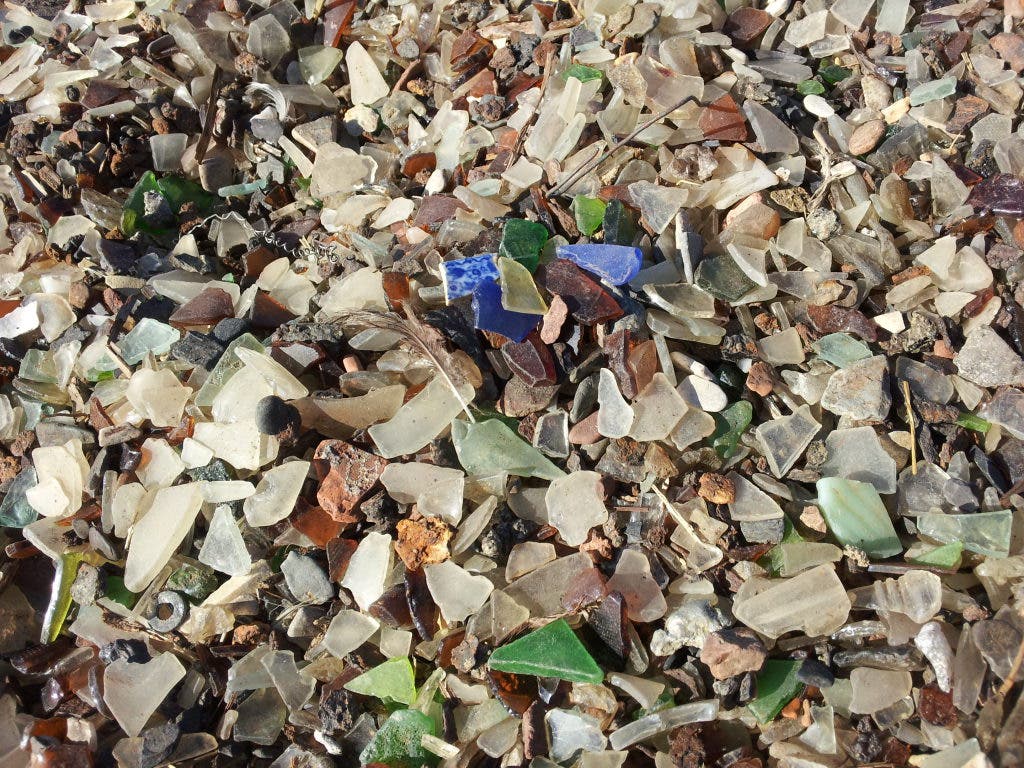
We were captivated by the stretches of smooth multicolored bits of glass covering the shore. Even more intriguing, further along we discovered what looked like a shelf of igneous rock spewed from some ancient volcano. This turned out to be a mass of melted metal, studded with random bits of glass, crockery, and weird amorphous lumps, a strange otherworldly monument created by tons of incinerated garbage. Scattered about were random chunks of glass melted into contorted shapes. Discarded tin cans, car parts and broken dishes from many decades past had become objects of art and curiosity admired by three aging gentlewoman adventurers. We were careful not to remove any of these treasures, so they will be there for the next lucky explorers who come upon them.
Back at the parking lot, we reviewed our bird list and enjoyed our picnic (culinary discovery of the day: Fromager d’Affinois, a soft French double-cream cheese that’s delicious with crackers and crisp Fuji apples). As always after such a walk, we explored possible answers to our many questions. I invite you, gentle reader, to weigh in.
1. We guess that no one knows the names of the Wappo men and women whose photos are displayed on the informative sign in the parking lot. We know that the name “Wappo” was bestowed upon them by the Spanish explorers, but does anyone know what they called themselves?
2. Is the agave native to California, or an imported species?
3. Is the gas emitting from the capped American Canyon landfill being captured and used in some way? Or is it escaping into the atmosphere?
Bird list 1/13/2012, American Canyon wetlands:
Gadwall
American Wigeon
Mallard
Blue-winged Teal
Cinnamon Teal
Northern Shoveler
Green-winged Teal
Bufflehead
Ruddy Duck
House Finch
Great Blue Heron
Great Egret
Northern Flicker
Double-crested Cormorant
Snowy Egret
Turkey Vulture
White-tailed Kite
Wilson's Snipe
Ring-billed Gull
Western Gull
Tern, sp
Rock Pigeon
Belted Kingfisher
Nuttall's Woodpecker
Anna's Hummingbird
Black Phoebe
Say's Phoebe
American Crow
Violet-green Swallow
Ruby-crowned Kinglet
American Pipit
Yellow-rumped Warbler
Common Yellowthroat
Song Sparrow
White-crowned Sparrow
Dark-eyed Junco
Brewer's Blackbird