Schools
Orange County Senator Predicts Financial Crisis In Public Schools
25 years ago, Sen. Moorlach predicted the bankruptcy of the county. Now he looks to the school districts as the "canary in the coal mine."



NEWPORT BEACH, CA — California State Sen. John Moorlach may well be giving an encore performance of his role as the canary in the coal mine preceding Orange County’s bankruptcy almost a quarter-century ago when he correctly predicted financial disaster while a candidate for county Treasurer-Tax Collector.
This time Moorlach, a Certified Public Accountant who represents Orange County’s 37th District and serves on the Senate Budget & Fiscal Review Committee and its education subcommittee, isn’t concerned about county government. What bothers him now are the brewing money problems facing hundreds of school districts across California, all experiencing what he sees as a growing deterioration of their financial stability.
In a report issued in October 2018, summarizing an analysis of the most recent financial statements issued by 944 K-12 school districts, Moorlach found more than 85 percent reported deficits on their general fund balance sheets, something he says indicates that many of these districts “could soon reach a tipping point into insolvency and receivership.”
Find out what's happening in Newport Beach-Corona Del Marfor free with the latest updates from Patch.
Moorlach’s conclusion: “It’s not a pretty picture and it’s likely to get worse.”
In Orange County all but one of the 27 school districts reported deficits ranging from $7 million to nearly half a billion dollars. Of these, 14 school districts are located in Patch communities, and only one of those, the Fountain Valley Elementary School District reported positive results.
Find out what's happening in Newport Beach-Corona Del Marfor free with the latest updates from Patch.
Moorlach’s report focused on the Unrestricted Net Position (UNP), an accounting function contained on a school district’s balance sheet portraying what is essentially the net worth of its general fund – the account from which it pays salaries, benefits, administrative costs, maintenance of school buildings and other general operating expenses such as insurance, consulting services and travel.
Michael Fine, chief executive officer of the Financial Crisis & Management Assistance Team (FCMAT), a state service designed to provide school districts with financial advice and management assistance, agrees that Moorlach’s analysis of UNP “is accurate and should not be dismissed.”
“However, it has little practical impact on the daily operations of California’s public school districts,” Fine told Patch. “Parents and taxpayers are unlikely to see any direct implications on programs and services purely by a growth in negative UNP.”
Moorlach disagrees, saying he’s not “sure this is a generalization one should hang their hat on.
“The deeper the negative UNP, the more likely there are higher annual payments for pensions and retiree medical. Higher annual payments ‘crowd out’ other expenses, like programming and supplies,” he said.
Unrestricted general fund revenues are primarily derived from local property taxes, state and federal financial aid not earmarked for specific – or restricted – purposes and other income such as parcel taxes. In many districts the unrestricted state and federal funding exceeds the amount of property tax revenues.
The UNP is just one of three components that in combination provide a detailed picture of just where a district stands financially at the end of its fiscal year.
A second component reports the value of capital assets such as school buildings and property after outstanding debt and depreciation has been subtracted – assets that cannot be used for operating purposes.
The third category reports assets restricted to federal and state programs such as special education. Most school districts consistently report positive results – or surpluses -- in both of these categories.
But it’s the UNP that tells school officials just where their district stands when it comes to funds available for paying general operating costs and other expenses. For the majority of K-12 districts in California this significant number is negative, reflecting the fact a district has set aside insufficient assets to pay its obligations – including pension and other retiree benefits.
Orange County School Districts' UNP, Explained
A school district’s UNP is similar in concept to an individual’s personal finances where the value of what is owned such as cash investments, a home, cars and other personal property is subtracted from that what is owed, such as a mortgage, credit card debt and monthly expenses. The difference would be the individual’s net worth, a factor considered by banks when assessing the financial and credit quality of a loan applicant.
To provide a more accurate means of comparing and ranking school districts Moorhead divided the UNP deficits by the population in each district to produce a per capita apportionment. In theory this would be the amount each district resident would have to pay over and above existing school taxes to eliminate the general fund deficit in their district.
In the Orange County Patch districts Moorlach’s study found this per capita amount ranged from a positive $78 in Fountain Valley to $1,089 in Newport-Mesa Unified.

The larger the negative UNP per capita, the more likely a school district’s revenues are being used to pay pension and other retirement benefits, Moorlach said. “This means less funding for other programs and possible elimination of certain areas of study.”
“There is simply insufficient funding [for] K-12 to eliminate negative UNP at this time” said Fine, who agreed with Moorlach that it will get worse before it gets better.
On average, over the past six years per-student state funding has grown 13% annually, Fine said, but that’s about to change because annual growth rate is expected to be less than 3% beginning with the next fiscal year.
This level of funding is “a fraction of what is needed to sustain programs and services to students,” said Fine, particularly after you factor in the entire spectrum of expenses incurred by school districts faced with declining enrollments and substantial increases in the cost of special education services.
“Every school district has a different and unique story,” says Moorlach. But the common denominator is the growing cost of pensions and Other Post Retirement Benefits (OPEB). Salaries and benefits are major factors contributing to growing UNPs, Moorlach said, and every time districts increase employee salaries, there’s an attendant increase in retirement costs. This particularly impacts districts in areas with high costs of living, such as Orange County.
Orange County teachers tend to have higher salaries and therefore a “greater share of the California State Teacher Retirement System’s Unfunded Liabilities," the Orange County Department of Education spokesperson Ian Hanigan told Patch.
There may be light at the end of the tunnel for Orange County school districts, as those liabilities are expected to “level off” based upon higher contributions by employers who “hope to improve the outlook for the state’s pension systems,”Hanigan said.
Spiraling Costs Of Employee Pensions
During the past five years for which audited financial statements are available, salaries for teachers and other school employees have increased an average of 25% while the cost of benefits has jumped by an average of almost 50% with some individual districts seeing increases in excess of 75 and 80%.
School districts have little control over the spiraling costs of their annual payments to employee pensions. All districts participate in both the California State Teachers Retirement System (CalSTRS), that provides pensions for teachers and the California Public Employees Retirement System (CalPERS) which handles pension for other district employees.
Each year these pension funds calculate the amount each district must contribute, rates that have been steadily increasing because both funds are significantly underfunded. In addition, the state makes contributions “on-behalf” of every district, money derived from California’s own general fund and included in the total amount the state budgets for education.
In 2017 direct payments from the state’s general fund to CalSTRS on-behalf of Patch school districts in Orange County totaled $89 million in addition to the $141.2 million the districts’ collectively paid from their own funds for teacher pensions.
Combined, pension payments made directly by Orange County Patch districts to both CalSTRS and CalPERS, over and above the state payments totaled $193.7 million in 2017.
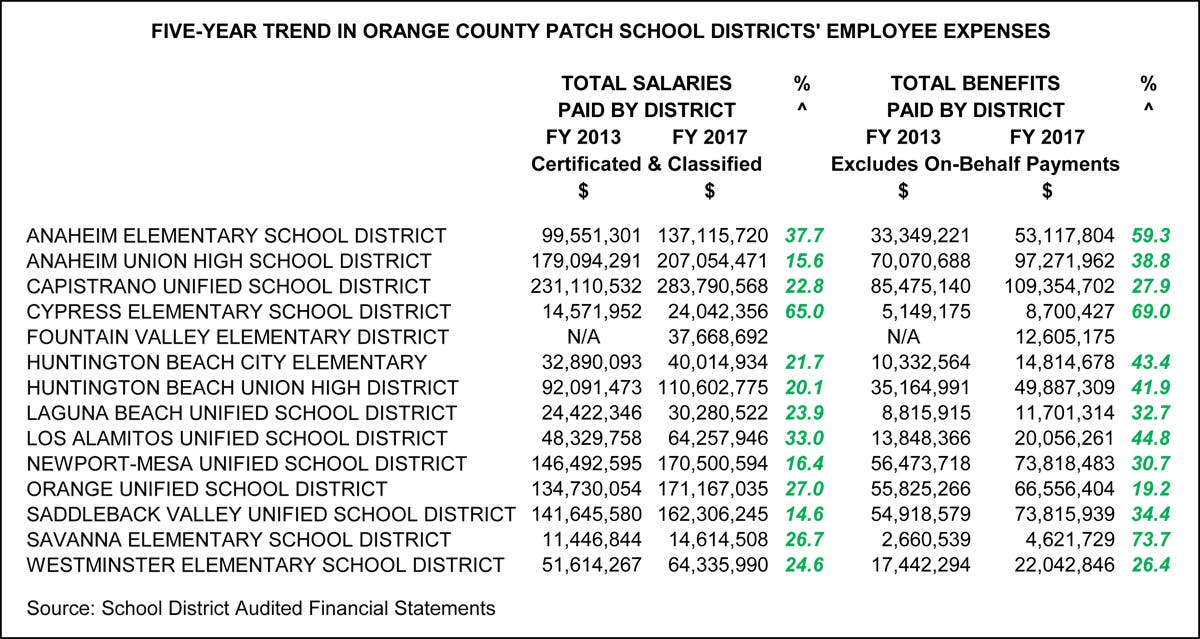
Fine agrees that pension and OPEB contributions are fueling the growth of UNP and says by 2022 contribution rates will have more than doubled, a trend that “has a direct impact on the district’s ability to support its programs and deliver services.”
“Most districts use the ‘pay as you go’ method of funding, ignoring the long term liability,” says Fine. “This isn’t an unrealistic approach for most districts, but there are examples where a significant portion of [a] district’s annual budget designed to serve today’s students must be set aside to cover benefits for employees that served yesterday’s students.”
While the costs of employee benefits have steadily added to growing UNP deficits, the true magnitude of this subtle erosion in the financial stability of school districts has been hidden in footnotes to annual financial statements most taxpayers don’t bother to read.
However, beginning with the fiscal year ending in June 2015, new rules by the Governmental Accounting Standards Board (GASB), an independent organization that sets financial accounting standards for state and local government, required pension liabilities to be included on the actual balance sheets.
Newport Mesa Unified School District told Patch they were aware of Senator Moorlach’s recent citation “that their district had more liabilities than assets.”
According to the NMUSD, the new condition for government agencies to include pension liabilities in the district’s Statement of Net Position, “as opposed to separating pension liabilities into the State’s statement, as it had been in past years.”
Almost overnight California school districts were forced to increase their general fund liabilities – a major factor in calculating UNP – by millions of dollars. These numbers will only grow, further deteriorating UNP, when financial statements for the 2018 fiscal year begin appearing in December because those reports will reflect GASB’s requirement that additional millions in liabilities for retiree healthcare and other post-employment benefits must also be included on balance sheets.
What can be done to stem the red ink?
Moorlach believes one solution is stronger fiscal management. Another might be re-negotiating labor contracts to reduce the cost of retiree medical benefits, something that’s anathema to the powerful teachers’ and other public employee unions.
“Other than that, districts need to have revenues in excess of expenditures every year and the net excess should be plowed into building reserves and reducing liabilities,” Moorlach said. “That’s how you run a fiscally distressed entity.”
As the financial pressures grow will school district start going bankrupt?
Fine, whose FCMAT staff regularly deals with troubled school districts, doesn’t think so because the state is there to bail them out.
“Senator Moorlach’s analysis ignores the fact that in California, the state guarantees the continued operation of a public school district or community college by providing a backstop to fiscal insolvency,” Fine said. “Ultimately, when a school district becomes insolvent, the state legislature [makes] an emergency appropriation for that district. This has happened nine times since 1991.”
Moorlach said he’s not ignoring emergency state financial aid to insolvent districts, he just wonders where the state will come up with the resources to bail out multiple districts which might seek help simultaneously, noting the state’s “rainy day” fund only contains $13 billion.
“We’re creating a massive pretzel once a multi-year economic down cycle takes full effect. Then parents and taxpayers will understand what can happen when the fiscal squeeze is on,” said Moorlach. “Regretfully, then it will be too late. Forewarned is forearmed. The sooner we get in front of this the better.”
Bob Porterfield, with Patch Editor Ashley Ludwig contributing to this report.
Shutterstock Photo
Get more local news delivered straight to your inbox. Sign up for free Patch newsletters and alerts.