Community Corner
4 Puma Kittens, 2 Adults Discovered In Local Mountains
Researchers are tracking four new kittens found in the Santa Monica Mountains and two adults found in the Santa Susana Mountains.


LOS ANGELES, CA — It's a lioness's world in the Santa Monica Mountains and Santa Susana Mountains where the National Park Service tagged six more mountain lions — all female — the National Park Service announced Tuesday. At once, the newly identified pumas represent hope for Los Angeles County's endangered population of pumas as well as despair because one of the animals shows a potential sign of problematic inbreeding.
First, park service officials announced the good news. Four of the newly tagged lions are healthy blue-eyed kittens that appear to be thriving under their mother's care.
"We’ve added a kitten litter and two adult female mountain lions to our 20-year research study on mountain lions!," the National Parks Service's Santa Monica Mountains National Recreation Area unit announced on Twitter. "Say hello to P-109 through P-112 – all female kittens born around July 21 and tagged Aug. 24 when they were estimated to be 34 days old. While their mother, P-99, was away from the den, they were discovered in a well-protected shelter in the western Santa Monica Mountains."
Find out what's happening in Northridge-Chatsworthfor free with the latest updates from Patch.

Getting to the kittens without attracting the ire of their mom was no easy feat. A biologist used radio telemetry to follow the mother while colleagues approached the den area, according to the park service. While the mom was safely away, researchers found the kittens and conducted a workup on the kittens a short distance away from the den.
"Biologists remain in constant radio contact with each other during this time," assured National Park Service officials.
Find out what's happening in Northridge-Chatsworthfor free with the latest updates from Patch.
Researchers will continue to monitor their progress and attempt to keep tabs on them throughout their lives. Recently, litters in the Santa Monica Mountains have met with mixed fates. Some have thrived and moved on when it was time to carve out their own territories and find mates.
One litter of kittens lost their mother in an ill-fated freeway crossing while still vulnerable juveniles. One of the kittens died on the same freeway a short time later.
In addition to the newly discovered kittens, researchers recently identified two new adult female cougars.
"Female adult mountain lions P-105 and P-106 were captured in the Santa Susana Mountains," the park service announced.
P-105, captured on July 28, weighed 93 pounds and is estimated to be about 4 years old, according to the park Service.


P-106, a 91-pound cat believed to be about six years old, has a kinked tail, park service biologists observed.
"Biologists noticed that P-106 has a tail kink, possibly indicating a genetic abnormality. This is likely the same kinked-tail mountain lion we picked up on remote cameras in the same area a couple years ago," the National Park Service wrote.
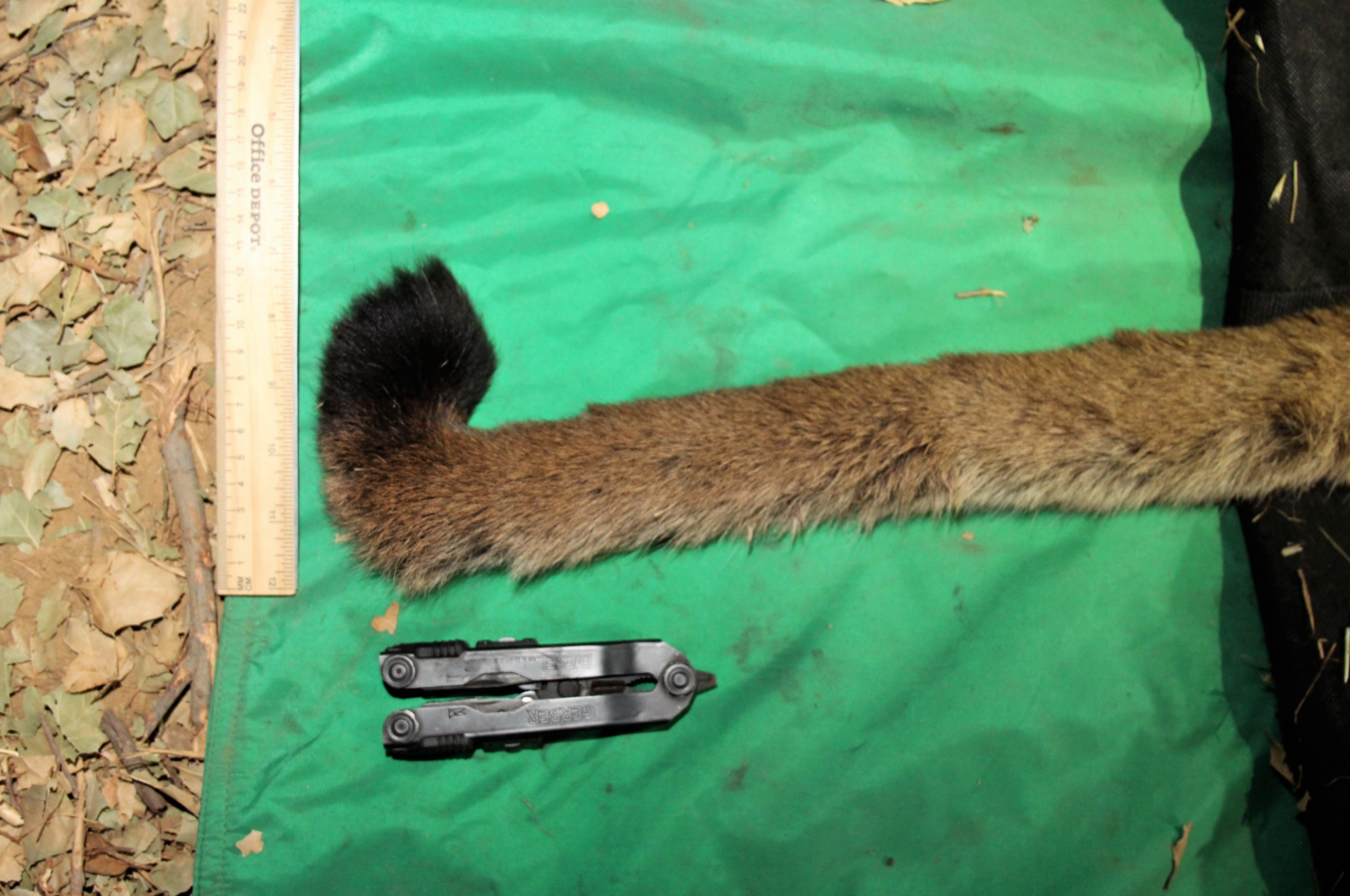
Researchers began observing lions with kinked tails in 2020 in local mountains. It's believed to reflect the lack of genetic diversity in the local population and dangerous levels of inbreeding.
The first local lion identified with a kinked tale was a young male P-81.
"This critical discovery represents the first potential physical manifestations of low genetic diversity within this small mountain lion population in and just north of the City of Los Angeles," the park service announced in 2020.
“This is something we hoped to never see,” said wildlife biologist Jeff Sikich said at the time. “We knew that genetic diversity was low here, but this is the first time we have actually seen physical evidence of it. This grave discovery underscores the need for measures to better support this population.”
A University of California, Los Angles-led study released this year examined 12 mountain lions from Dec. 2019 to Dec. 2020 from the Santa Monica and Santa Ana Mountain ranges for signs of a population decline based on inbreeding.
Researchers have already been aware of high rates of inbreeding among Southern California mountain lions, but this newer study detects dangerous physiological and reproductive problems caused by inbreeding.
The animals studied averaged a 93% abnormal sperm rate, while some also displayed physical signs of inbreeding, like deformed tails or testicular defects.
The scientists cited a real risk of extinction for the mountain lions in the Santa Monica and Santa Ana ranges. Once significant inbreeding depression is found — meaning decreased fertility and reduced kitten survival — extinction is predicted to occur within 50 years, according to 2016 and 2019 papers evaluating population viability that included scientists from UCLA, National Parks Service, University of California, Davis, the University of Wyoming and the University of Nebraska.
Southern California mountain lions have among the lowest genetic variation of any mountain lion population, matched only by the Florida panther, according to the study. This is largely because freeways separate genetically different populations of mountain lions, according to the study.
In an effort to combat the problem construction on the long-awaited Wallis Annenberg Liberty Canyon Wildlife Crossing began this year. It will link mountain ranges over ten lanes of the US-101 Hollywood/Ventura Freeway when it is completed in 2025.
Get more local news delivered straight to your inbox. Sign up for free Patch newsletters and alerts.