Neighbor News
Do Matching Funds In LA City Council Race Create An OLIGOPOLY?
"It's a situation in which a small number of organizations or companies has control of an area of business, so that others have no share"


Investopedia author Will Kenton, in a February 2018 article, said of an Oligopoly
"Oligopolies in history include steel manufacturers, oil companies, rail roads, tire manufacturing, grocery store chains, and wireless carriers. The economic and legal concern is that an oligopoly can block new entrants, slow innovation, and increase prices, which harms consumers."
While the U.S. Government has long been guilty of a monopoly of letter and package delivery, that is not so anymore. The delivery efficiency of UPS and FedEx undermined the USPS monopoly of package delivery; and then Amazon upended all three because the volume of orders finally warranted their own delivery trucks in larger metropolitan areas. Now electronic mail has cut into the USPS letter delivery business, so while a monopoly may suggest a hold on a market, time and innovation will undo even the best (or worst) monopolies.
Find out what's happening in Northridge-Chatsworthfor free with the latest updates from Patch.
So essentially a monopoly is a market condition with one dominate player.
Whereas in an oligopoly there are two or more "players" dominating the market, but they produce similar products.
Thus, both market conditions deliberately exclude newcomers, stifle innovation, and limit participants in the market share.
Find out what's happening in Northridge-Chatsworthfor free with the latest updates from Patch.
The Los Angeles City Council Ethics Commission (which is under investigation for other activities) makes the recommendations concerning the City's matching funds for candidates. However, the City Council authorizes, by vote, those recommendations. The parameters for Los Angeles City Council Candidates to receive matching funds were changed in October 2018, in time for a special election to replace the 12th District seat. The Ethics Commission recommended a $11,400 minimum raised by the candidate; whereas the Council approved a $20,000 minimum down from $25,000. The other change was a maximum of $115 down from $250, per resident of the City. This change would require candidates have 176 donors at $115 vs the prior 100 donors at $250.
While the Los Angeles City Council Seats are nonpartisan, and each of 15 members hold 6.66 percent of the vote, the vacated seat was held by the only Republican. Which would mean Republicans had a 6.66 percent citywide representation.
Then, earlier this month, the Ethics Commission recommended the City Council resume the prior parameters AFTER the Special Election. It is unknown if there is a precedent for Special Elections to have matching fund criteria changed. However, the Daily News picked up an article by the City News Service detailing an alarming fallout in the December decision by the City Council:
Critics argued that the lowered maximum contribution would continue to make it harder for candidates without deep pockets to be viable, because they still would have to collect a high number of donations.
The changes recommended by the commission would return the number of required donations to 100.
“It was a big step in the right direction to expand the matching funds program. But we believe it is an unintentional but cruel irony that in doing so we actually made it more difficult for grassroots candidates to qualify,” Bonin’s deputy chief of staff, David Graham-Caso, told the Ethics Commission before the vote.
Meanwhile, the Los Angeles Times Editorial Board 2018 Christmas Eve article voiced concerns:
But that works to the advantage of politicians who are already in office. “You might as well call this the incumbency protection act,” one advocate of campaign finance reform told the council.
The Los Angeles City Council deliberately set the parameters for matching funds to create a Council mirroring the existing politics. The problem is the money for those matching funds comes from the taxpayers. The Los Angeles City Council is super funding candidates with SIX TIMES what they have raised, if they meet the minimum criteria. There are 15 candidates who each need to raise ONLY $20,000 in order to receive $120,000. However, while there is a $151,000 cap during the primary, it is still taxpayer money! Apparently, because the $19.7 million fund has been "underused" the City Council has forgotten where the money originated from AND they lost the ability to think about REDUCING the taxes which infuses that particular line item.
There are 15 candidates vying for the opportunity to be the 6.66 percent voice in the Los Angeles City Council.
While public property placement of campaign signs may suggest the best strategy for marketing a candidate. Signage on private property is indicative of a voter convinced enough to let his/her property be used. We feel the best representation comes from the candidate who has lived continuously in the district, who has knocked on doors to meet voters, and who unequivocally gives a consistent answer to questions about issues affecting the residents in the district and City of Los Angeles. We think Brandon Saario meets these qualifications.
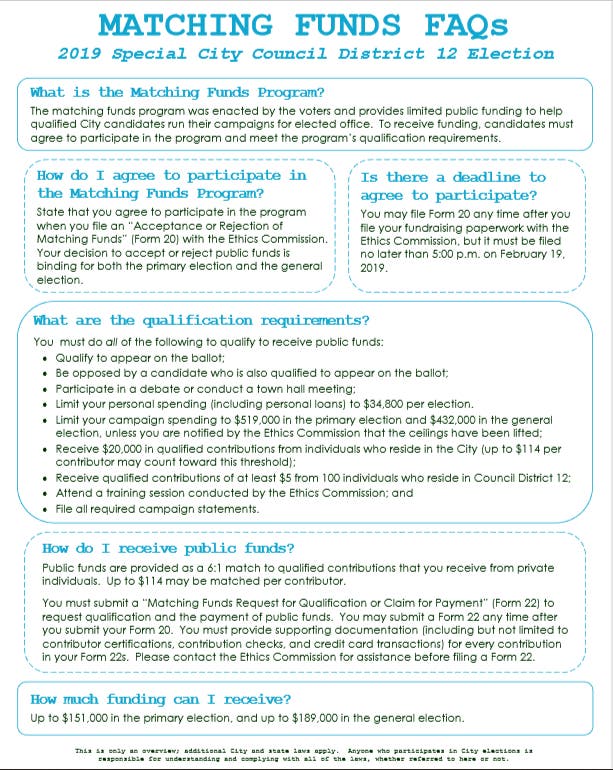
https://ethics.lacity.org/wp-c...