Schools
School Board Postpones Approval of Oddstad Surplus
A late amendment to increase the amount of land surplused caused the board to push the decision into 2012.

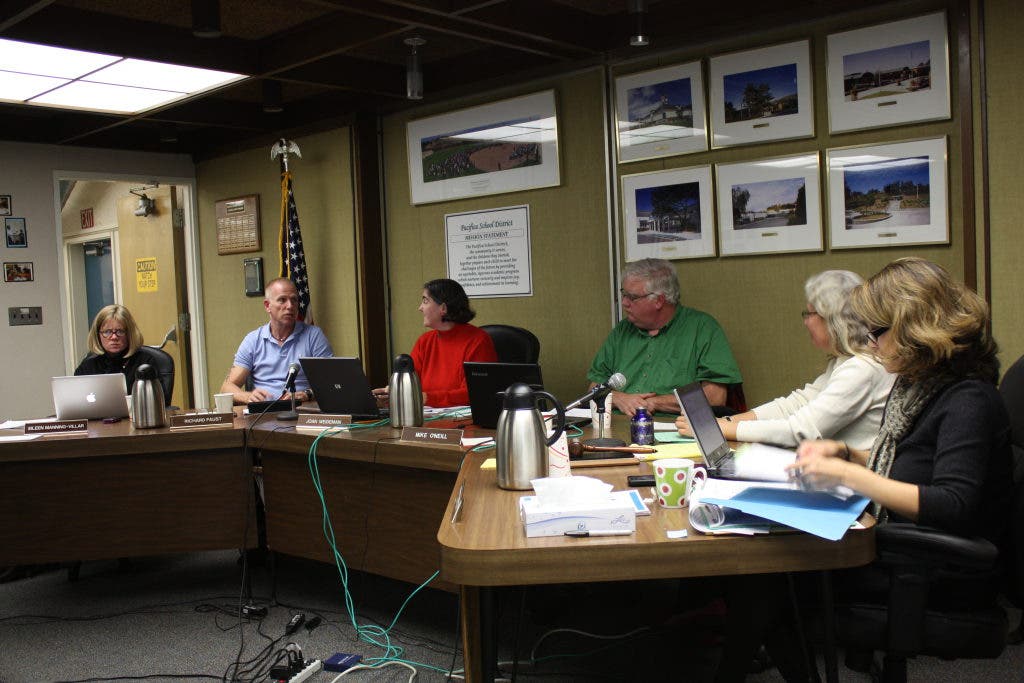


The Board of Trustees held off on a vote to put a swath of district-owned land up for sale or lease Wednesday night.
The board agreed to delay the vote after Trustee Joan Weideman proposed an amendment that would have fundamentally changed the way by which the land on Oddstad Boulevard could be sold or leased, how part of it could be used by the buyer or leaser and the amount of potential revenue the district could glean from the move. The amendment would have arguably increased flexibility of development at the site, however.
A long process
The property, approximately 11.5 acres on Oddstad Boulevard, was a functioning school site until 2005. Since then, the playing fields in the southern section have been used frequently for youth sports. Kiewit, the construction firm building the Devil’s Slide tunnel, leases space in the old school buildings, but will depart in 2012.
Find out what's happening in Pacificafor free with the latest updates from Patch.
The process leading up to the potential vote on Wednesday night began in September 2010 when the district put the question of what to do with the land to an appointed committee.
The , as it was known, held several meetings and heard from the public about the issue.
Find out what's happening in Pacificafor free with the latest updates from Patch.
Throughout public input, one theme was clear: keep the playing fields for kids.
The 7-11 Advisory Committee made a recommendation to the board in November that did just that: 8.38 acres on which the school buildings sit ought to be declared surplus, or put up for lease or sale, and that three acres comprised playing fields should be retained by the district for recreational purposes.
The committee and board favor leasing the land, because, besides the steady annual income that offers, money from selling the land could only be used for capital projects, whereas rent money can be used for operational costs at the district.
A resolution reflecting the committee’s recommendation was drafted by the law firm guiding the district through the surplus process, Lozana Smith, and was put on the agenda for the board’s approval Wednesday.
A bid to surplus it all
At the start of the board’s discussion of the resolution, however, Weideman suggested that the entire Oddstad property be surplused.
Her reasoning behind the suggestion was threefold:
If the entire property is surplused, whoever decides to develop the land will have greater flexibility in doing so because the entity could hypothetically move the playing fields north and build where they currently are; that the district may have to surplus the three acres of playing fields in the future and that alone the tract of land won’t be as valuable as it is as part of the whole; and that protections in the California Education Code under what is called the Naylor Act will help keep the land in the public recreational realm.
“I just want some flexibility in being able to do something really productive with that property,” Weideman said.
Under the Naylor Act, recreational use of the land by youth sports would continue regardless of whom might end up leasing or buying the property.
“The whole idea behind the Naylor Act is to retain land that has a recreational purpose, so in this case, the playing fields, if those are included in the resolution, the Naylor Act gets triggered and certain agencies within the city and county that have recreational purposes, the park and recreation, they have a right to make an offer,” Kevin Angstenberger of Lozano Smith law firm said.
But the Naylor Act also restricts the amount of money the district could make from a sale or lease of the property—5 percent of its original acquisition cost annually for a lease and between 25 percent of its current estimated market value up to the original acquisition cost for a sale.
At Wednesday night’s meeting, other trustees supported Weideman’s proposal, stating that her amendment might make the property more palatable to a potential buyer or leaser.
“Our goal is to make the best use of the property,” said Trustee Richard Faust. “And it might be more leasable if we have the possibility for somebody to come in a flip the two areas. It might be more leasable if somebody’s able to put something in that crosshatch area (current playing fields) as opposed to the upper field.”
Original intent?
Angstenberger told the board that he was under the impression that the intention was to avoid triggering the Naylor Act.
“I think one of the original goals, and correct me if I’m wrong, with the resolution that is going to be considered tonight, by separating the property and taking out the playing field, we would circumvent the need to notify the Naylor Act agencies. Then the agencies that would have to be notified, what we classify as Tier 1 and Tier 2 agencies as spelled out in the ed. Code—the Tier 1 agencies are a number of different government agencies that have to be notified, the second tier includes the University of California trustees, various groups that are spelled out. They have to be notified, and they have an opportunity to submit an offer to the district.”
Not declaring the sports fields surplus would also be a simple way to ensure that youth sports will continue at Oddstad without interruption, something many community members said they were concerned about at 7-11 Advisory Committee public hearings. The district would also retain the cost of maintaining the fields, however.
Also, if the district retains the sports fields and just the land on which the buildings sit and a field to the north is declared surplus, the Naylor Act would not be triggered and the district could likely draw a sale price or lease rate closer to a fair market value from a broader group of organizations.
But the flexibility for development that declaring the whole tract surplus offered and the assurance that the Naylor Act would preserve the playing fields remained attractive to some trustees.
“I feel really strongly, and I think whenever the board has talked about this people have said this really clearly, that we want to maintain playing fields for the community that there is no question about that,” said Trustee Cynthia Kauffman. “But the idea that, and one of the reasons I like Joan’s idea of declaring the whole thing surplus is it allows more flexibility, because if we were to try to have some housing or something on some of that property, it may be that whomever we wanted to deal with would want it to be in the crosshatched area (current playing fields) and would want the fields to back in the other area so we just want to be able to have the flexibility.”
Going forward
Naylor Act or not, the board plans to control what type of development could occur on the property by including language in its notices to potential buyers or leasers indicating what it will go for in negotiations.
That vision for the property, as it were, has yet to be defined by the board. It will meet for a study session in early January to discuss ideas, but Weideman said at the meeting Wednesday night that some kind of workforce housing is a possibility.
If no organizations respond with interest after a resolution is passed, a more general request for proposals could be issued and the board would decide if any of the proposals fit the bill.
After discussion of Joan’s amendment to the resolution, Kauffman asked for time for both the board and public to think things over.
“What Joan raised is a really new idea for us, to declare the whole thing surplus,” she said. “So what I’d like to do is postpone, in other words, to have us vote on that at a future meeting because I just feel like the public needs some time to digest that thought. I don’t want anybody to feel like we pulled a switcheroo at the meeting and it ended all the sudden with something totally different than what we’ve been talking about.”
Kauffman went on to suggest that at the next meeting a resolution reflecting Weideman’s proposal to surplus the entire property be ready to go and the board can either approve it or vote to amend it, returning it to its original form.
Staff suggested instead that the board discuss at its next meeting in January which resolution it prefers and select that one for approval. The board agreed.
“Personally I was ready to vote for the this one, and then it got brought up and Joan’s reasoning made sense to me, but I guess it just put a different spin on the whole thing,” said Trustee Eileen Manning-Villar. “My major thing is I want to make sure the fields are preserved as playing fields so I want to look at it with that in mind. If we do surplus it the whole way, which is probably fine, I want to make sure that that’s not too much of a risk that the fields would be removed.”
For more news about Pacifica and surrounding areas, including the San Mateo County Coastside, follow us on Twitter and "like" us on Facebook.
Get more local news delivered straight to your inbox. Sign up for free Patch newsletters and alerts.