Community Corner
Solar Eclipse 2017 Times Across California: When You Can See The Aug. 21 Main Event [Interactive Maps]
Curious as to when you should head outside to view the "Great American Eclipse"? We've got you covered with start, peak and end times in CA


So, you want to watch an eclipse, do you? Well, even though it may not be a full eclipse here in California, you'll want to head outside by about 9 a.m. PST on Monday, Aug. 21 to take a look at what's still sure to be an exciting event. At the peak of the long-anticipated "Great American Eclipse," the percent of sun that will be covered as viewed from California varies greatly, with about 90 percent covered up in Crescent City and about 57 percent down in San Diego, according to NASA.
The entire event will take about an hour and a half to happen. For eclipse chasers, it’s the party of a lifetime. A phenomenon like this, in which the eclipse barrels across the entire continental United States, hasn’t happened in 99 years. It was June 8, 1918, and World War I would officially end in a few months.
The time that the eclipse will peak for Californians depends on where you'll be viewing from. Fortunately, NASA has created a couple of useful tools to help you determine when you can expect to see the eclipse start, peak and end from anywhere in the nation.
Find out what's happening in Palm Desertfor free with the latest updates from Patch.
For a quick reference, we've compiled the data from a handful of cities across the Golden State so you have a rough idea on times that the (partial) eclipse will be visible: (Get Patch real-time email alerts for the latest news from your California neighborhood. And iPhone users: Check out Patch's new app. Also, be sure to follow your local Patch on Facebook!)
Hilt - 91.84 percent obscuration
Find out what's happening in Palm Desertfor free with the latest updates from Patch.
- Start of partial eclipse (C1): 16:03:22 UT / 9:03 a.m. PST
- Maximum eclipse: 17:17:05 UT / 10:17 a.m. PST
- End of partial eclipse (C4): 18:38:08 UT / 11:38 a.m. PST
Mount Shasta - 89.28 percent obscuration
- Start of partial eclipse (C1): 16:03:11 UT / 9:03 a.m. PST
- Maximum eclipse: 17:17:09 UT / 10:17 a.m. PST
- End of partial eclipse (C4): 18:38:34 UT / 11:38 a.m. PST
Eureka - 86.98 percent obscuration
- Start of partial eclipse (C1): 16:01:20 UT / 9:01 a.m. PST
- Maximum eclipse: 17:14:17 UT / 10:14 a.m. PST
- End of partial eclipse (C4): 18:34:55 UT / 11:34 a.m. PST
Chico - 83.25 percent obscuration
- Start of partial eclipse (C1): 16:02:45 UT / 9:02 a.m. PST
- Maximum eclipse: 17:17:02 UT / 10:17 a.m. PST
- End of partial eclipse (C4): 18:39:03 UT / 11:39 a.m. PST
Lake Tahoe - 81.29 percent obscuration
- Start of partial eclipse (C1): 16:04:07 UT / 9:04 a.m. PST
- Maximum eclipse: 17:19:25 UT / 10:19 a.m. PST
- End of partial eclipse (C4): 18:42:23 UT / 11:42 a.m. PST
Sacramento - 78.88 percent obscuration
- Start of partial eclipse (C1): 16:02:37 UT / 9:02 a.m. PST
- Maximum eclipse: 17:17:02 UT / 10:17 a.m. PST
- End of partial eclipse (C4): 18:39:23 UT / 11:39 a.m. PST
Yosemite Valley - 76.1 percent obscuration
- Start of partial eclipse (C1): 16:04:15 UT / 9:04 a.m. PST
- Maximum eclipse: 17:19:47 UT / 10:19 a.m. PST
- End of partial eclipse (C4): 18:43:10 UT / 11:43 a.m. PST
San Francisco - 75.52 percent obscuration
- Start of partial eclipse (C1): 16:01:31 UT / 9:01 a.m. PST
- Maximum eclipse: 17:15:16 UT / 10:15 a.m. PST
- End of partial eclipse (C4): 18:37:08 UT / 11:37 a.m. PST
Death Valley (Stovepipe Wells) - 72.51 percent obscuration
- Start of partial eclipse (C1): 16:06:47 UT / 9:06 a.m. PST
- Maximum eclipse: 17:23:45 UT / 10:23 a.m. PST
- End of partial eclipse (C4): 18:48:24 UT / 11:48 a.m. PST
Fresno - 72.35 percent obscuration
- Start of partial eclipse (C1): 16:03:54 UT / 9:03 a.m. PST
- Maximum eclipse: 17:19:08 UT / 10:19 a.m. PST
- End of partial eclipse (C4): 18:42:25 UT / 11:42 a.m. PST
Monterey - 71.03 percent obscuration
- Start of partial eclipse (C1): 16:01:45 UT / 9:01 a.m. PST
- Maximum eclipse: 17:15:35 UT / 10:15 a.m. PST
- End of partial eclipse (C4): 18:37:39 UT / 11:37 a.m. PST
Bakersfield - 67.06 percent obscuration
- Start of partial eclipse (C1): 16:04:39 UT / 9:04 a.m. PST
- Maximum eclipse: 17:20:03 UT / 10:20 a.m. PST
- End of partial eclipse (C4): 18:43:34 UT / 11:43 a.m. PST
Joshua Tree National Park - 63.13 percent obscuration
- Start of partial eclipse (C1): 16:08:06 UT / 9:08 a.m. PST
- Maximum eclipse: 17:25:03 UT / 10:25 a.m. PST
- End of partial eclipse (C4): 18:49:48 UT / 11:49 a.m. PST
Los Angeles - 62.2 percent obscuration
- Start of partial eclipse (C1): 16:05:45 UT / 9:05 a.m. PST
- Maximum eclipse: 17:21:14 UT / 10:21 a.m. PST
- End of partial eclipse (C4): 18:44:51 UT / 11:44 a.m. PST
Palm Springs - 62.02 percent obscuration
- Start of partial eclipse (C1): 16:07:49 UT / 9:07 a.m. PST
- Maximum eclipse: 17:24:27 UT / 10:24 a.m. PST
- End of partial eclipse (C4): 18:48:57 UT / 11:48 a.m. PST
San Diego - 57.49 percent obscuration
- Start of partial eclipse (C1): 16:07:28 UT / 9:07 a.m. PST
- Maximum eclipse: 17:23:08 UT / 10:23 a.m. PST
- End of partial eclipse (C4): 18:46:52 UT / 11:46 a.m. PST
To search for more cities across California and beyond, you can click anywhere on this map created by NASA to find out eclipse times.

And, if you'd like to see an interactive "preview" of what the eclipse will look like, check out this awesome NASA tool that generates a mock eclipse.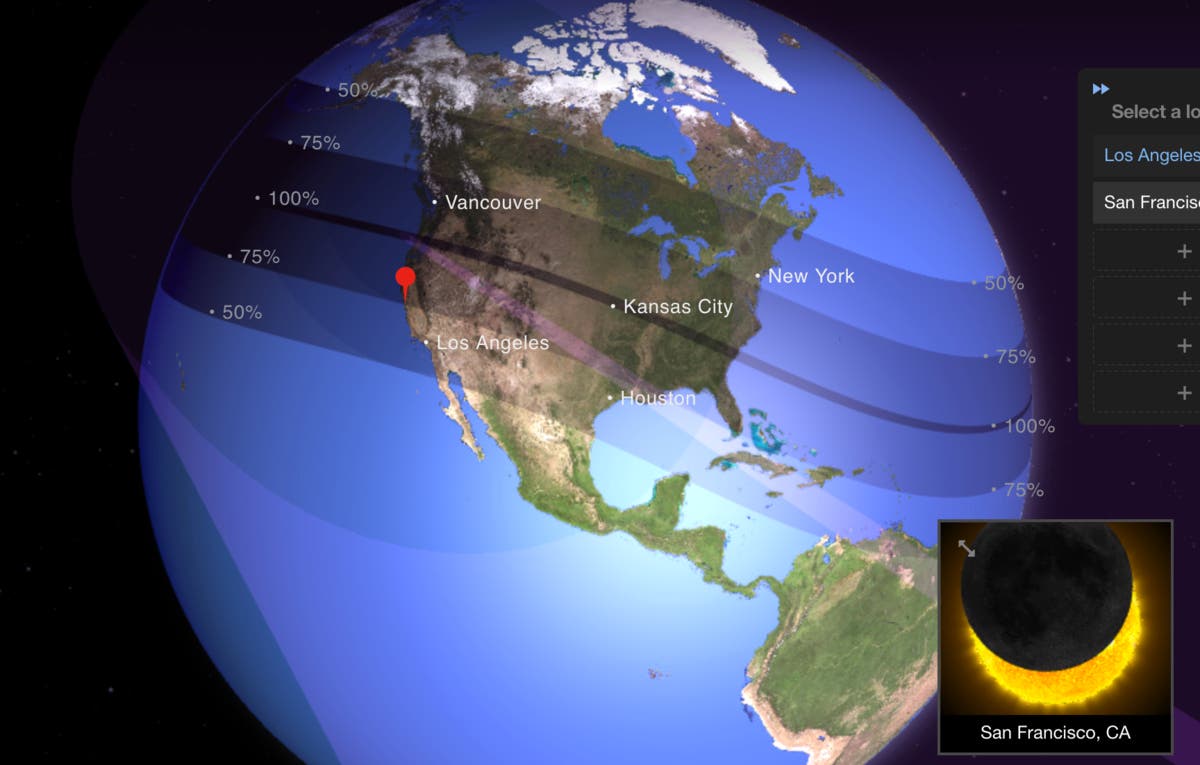
When it's time for the main event, the temptation may be to just go outside and look up. Scientists all agree: Don't do that! Even though the moon is blocking parts of its light, staring at an eclipse can be just as dangerous as staring directly at the sun.
NASA recommends getting a special set of eclipse glasses that meet these criteria:
- Have certification information with a designated ISO 12312-2 international standard
- Have the manufacturer’s name and address printed on the product
- Are less than three years old and don't have scratched or wrinkled lenses
"Go into your kitchen and get a spaghetti strainer or a colander," Tyson said. "Not with mesh, the kind with holes in it. Go outside and hold that up over the ground. Each one of those holes will act as a pinhole camera and you'll see hundreds of images of the crescent sun on the ground and you can watch the eclipse unfold safely…that's the urban version of watching the pinhole camera images through the modeled light of sunlight passing through the leaves of a tree. It'll just be fun."
The eclipse will also be more fun watched with friends, and there are parties planned across the country to celebrate the main event. So tell us in the comments, what are YOUR eclipse 2017 plans?
SEE ALSO:
- Sorry, California: Aug. 21, 2017, Total Solar Eclipse Will Only Be Partial In Golden State
- Aug. 21 Solar Eclipse, Travel Driving Bay Area Gas Prices Up, AAA Says
- Cosmic Conception During Oregon Eclipse? A San Francisco Man Seeks A Mate
Patch editors Marc Torrence and Beth Dalbey contributed to this report / Image via NASA.gov
Get more local news delivered straight to your inbox. Sign up for free Patch newsletters and alerts.