Business & Tech
PG&E Engineer Testifies On Pipeline Testing Policy: Week 3 Of Criminal Trial
The utility faces obstruction of justice charge for San Bruno explosion aftermath.
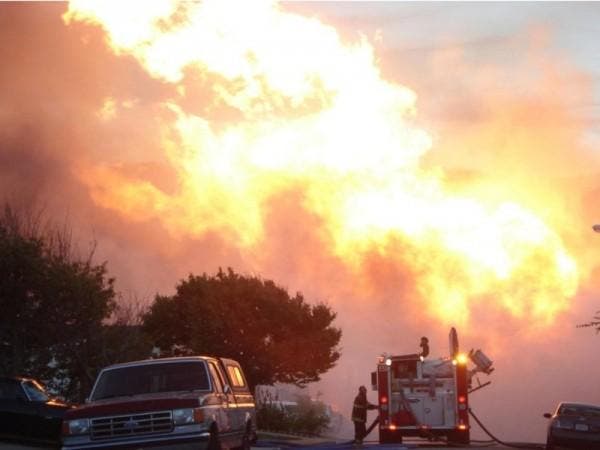
SAN FRANCISCO -- Federal prosecutors at the criminal trial of PG&E in San Francisco homed in Tuesday on evidence related to a charge that the utility obstructed an agency probe into a fatal pipeline blast in San Bruno.
The charge that PG&E obstructed the National Transportation Safety Board investigation into the explosion that killed eight people in 2010 is one of 13 counts to be decided by the jury in the court of U.S. District
Judge Thelton Henderson.
The other 12 counts allege PG&E violated record-keeping and safety assessment requirements of the U.S. Natural Gas Pipeline Safety Act for several Bay Area high-pressure transmission pipelines, including the line
that exploded in San Bruno.
Find out what's happening in Petalumafor free with the latest updates from Patch.
The obstruction charge concerns PG&E's policy on testing older pipelines installed before 1970, such as Line 132 in San Bruno.
During Tuesday's trial session, Assistant U.S. Attorney Hallie Hoffman questioned senior PG&E gas engineer Gene Muse about a document he wrote in 2008 concerning testing policy for such pipes.
Find out what's happening in Petalumafor free with the latest updates from Patch.
The document said PG&E would test older pipes with expensive high-pressure water tests only if a pipe's gas pressure had exceeded the historically allowed maximum by more than 10 percent.
"That was a draft," Muse told the jury.
Muse also denied that PG&E had implemented that policy.
"That was never the practice of PG&E?" Hoffman asked.
"No," Muse replied.
Prosecutors claim PG&E obstructed the NTSB by giving the 2008 document in February 2011 and then withdrawing it in April 2011, saying it was a draft that had not been approved.
In fact, a 2014 grand jury indictment contends, PG&E did follow the 10 percent policy from 2009 to April 2011 while knowing that it violated federal pipelines regulations and guidance.
Under questioning from Hoffman, Muse acknowledged that a U.S. Pipeline and Hazardous Materials Safety Administration guideline states that testing of pre-1970 pipelines is required if there has been "any pressure
increase regardless of amount" above the maximum allowed.
Muse, a 24-year employee of PG&E, also acknowledged that when he changed jobs in January 2010, he sent the 2008 document to the person who succeeded him as testing chief and did not say it was a draft.
This is the third week of the trial, which is expected to last about eight weeks. If convicted of the criminal charges, PG&E could be fined $562 million.
In separate civil proceedings, the California Public Utilities Commission fined PG&E $1.6 billion in 2015 for the San Bruno explosion and pipeline record-keeping and operation deficiencies, and PG&E paid about $565
million to settle lawsuits filed by San Bruno victims and their families.
The NTSB concluded that the cause of the explosion was a defectively welded seam in a segment of Line 132 that was installed in about 1956 and incorrectly listed in PG&E records as seamless. Another factor was
lax oversight by the CPUC, the safety board said.
--Bay City News/Patch file photo