Neighbor News
Letters from Abroad
Second in a series of letters from local Pleasanton student (Nagisa Smalheiser) during 1 year study abroad as an exchange student in Spain.



Dear Patch,
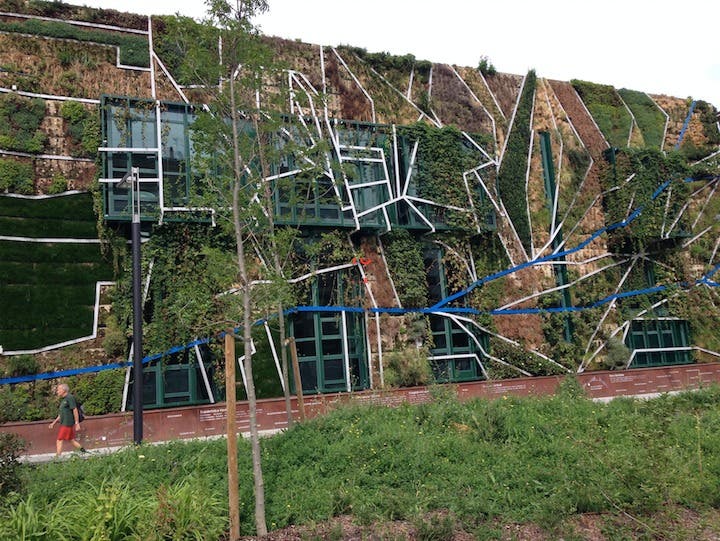
A month has gone by since I arrived in Spain, and it seems like I’ve been living here for years! By this, I do not mean that time goes by very slowly, but that I’ve gotten used to living here. And although I encounter new things on a daily basis, it was not very hard for me to adjust to living in Spain. I mostly have my host family to thank, as they have been really welcoming and have helped me tremendously. My host family consists of my mom, my dad and my nineteen year old sister, and we all either work or go to school in Vitoria [pictures 1-7], even though we live in Legutio [pictures 8-14].
I’ve been in school [pictures 15-16] for three weeks, and although it is difficult, I am getting used to it more and more everyday. Unlike my high school in the U.S., my school here has students from about 3 or 4 years old to 18 years old. The school itself is one big building, and every floor has a different “level” of school. The first floor is preschool/kindergarten, the second floor is elementary, etc. I am on the fourth floor, in Bachillerato, which consists of the last two grades before college. It is not mandatory (students can choose to leave school at 16 years old and decide to work instead), but most students choose to attend school until they are eighteen to pursue college afterwards.
Find out what's happening in Pleasantonfor free with the latest updates from Patch.
I also have a different schedule every day of the week, and instead of changing classrooms every period, the teachers come to us. This year I’m taking philosophy, economy, math, contemporary world history, (Spanish) language, computer science, P.E., english, science, and religion. That adds up to 10 classes, but I only have 7 periods a day, so I only take each class a few times a week. One thing I really like about this arrangement is that even if I am assigned homework, I sometimes have multiple days to finish it, as I do not have that same class again the next day. Another difference with the school system here is that every student buys their textbooks for the year, and it is totally normal to highlight sections of text or take notes in them. Although I do have to take my textbooks home and bring them back if I have any homework, since we only have one set.
Language-wise I do feel as though I’ve gotten better, although it is still difficult. I understand most of what is going on, but it is much harder for me to talk. All of my classes are in Spanish, and taking notes while the teacher is talking is tough (they don’t always enunciate so well), but reading my textbooks is easier. The first week of school I wrote a page front and back about myself for Spanish language class, and since then I’ve also written about Marxism and Keynes Economics for economy (all in Spanish of course!). I have to put in much more effort than my classmates except in English class. English, of course, is very easy for me, and since I am a native speaker, sometimes my teacher has me read aloud so other students can hear the correct pronunciation of things.
Find out what's happening in Pleasantonfor free with the latest updates from Patch.
After school, I generally take the bus home, which takes about half an hour. And unlike the U.S., I don’t eat lunch at school, so when I get home around 4 pm, I eat lunch either with my host sister or by myself if no one is home. And yes, the Spanish do eat late. Breakfast time is similar to the U.S., around 7 am on schooldays, but I usually take a sandwich or a snack to school to hold me over until lunchtime, which is between 4 and 4:30 for me. Lunch is the big meal here, and it is not uncommon to have a lunch with multiple courses. Dinner, which is usually a smaller meal, is between 9 and 11pm in my family, depending on the day’s schedule.
I think a new favorite food of mine is tortilla de patatas (also called tortilla española), which is kind of like a flat, round omelette with chopped potatoes inside [picture 17-18]. I’ve also tried (and now love) paella, Spain’s famous rice dish [picture 19] and flan [picture 20]. We have chorizo in the U.S., but it is much more common here, and I love it in a sandwich or in a dish called chorizo con patatas (soup with sausage and potatoes) [picture 21].
Some other foods I’ve encountered here also exist in the U.S., but they are a little bit different. For example, you can find bread at any grocery store in the U.S. (and in Spain as well), but here we have bakeries everywhere. Even in my small town (population: 1,700) we have a panadería (bakery), as families buy bread (baguettes) every morning to eat with lunch and dinner [picture 22]. Another well-known Spanish food is the ham. The ham here is not like the prepackaged ham that is sold in most American grocery stores. Every grocery store I’ve been to has a section just for legs of ham [picture 23-24]. It is usually eaten very thinly sliced [picture 25] with bread or cheese (or with both in a sandwich). Salad here is a little bit different as well. We still have lettuce with toppings like sliced tomatoes, onions, and hard boiled eggs, but instead of dressing, we have olive oil and a pinch of salt. Probably one of my favorite drinks here is what we would call hot chocolate in the U.S., except here, it is not milk with chocolate mixed in. It is pretty much melted chocolate [picture 26-27]. I could go on and on about food, since it is one of my favorite subjects, but I will move on to other things I’ve noticed in my time here.
The highways here (at least where I live) always seem to be two lanes in each direction. And like the U.S., the left-hand lane is the fast lane, but it seems more like a passing lane than a normal lane on the highway. I have yet to see a car drive in the left-hand lane if there aren’t any cars in the right-hand lane. Once in the city, however, most people opt to walk, ride their bikes, or use the local transportation [picture 28] rather than drive. It may be because there is not enough parking or because it’s better for the environment, but I’ve found that it is also good exercise. Also, there are roundabouts everywhere [picture 29]! When I was learning about roundabouts in driver’s ed, I was not too worried because there are very few in Pleasanton, but here it seems as though every other street has one!
Another big difference between California and Basque Country is the weather. More specifically, the rain. It’s probably rained more here in a month than in California in the past year! (I took a selfie with my umbrella since I don’t get to use one in California [picture 30].) And because of it, it is much greener here [pictures 31-33]. Temperature-wise, it’s also much cooler. When I wake up in the morning, there’s usually a lot of fog and it’s around 40 degrees Fahrenheit [picture 34]. During the day it may get up to 70 degrees, but it mostly stays cool. I have been wearing jeans a lot.
Before I sign off, I’d like to mention that in addition to practicing my Spanish, I’ve also picked up a few words of Euskera (Basque), which I’ve heard is the oldest European language. The words I now know are as follows:
Hello - Kaixo
Good morning - Egun on
Good night - Gabon
Yes - Bai
Happy birthday - Zorionak
Bye - Agur
Thank you - Eskerrik asko
Until next time,
Nagisa
P.S. I had an orientation this weekend in Madrid with all of the Rotary Youth Exchange students in Spain. I made lots of new friends, took lots of pictures and traded lots of pins. I’ve attached a picture from the orientation, a picture of my updated blazer, and a picture of me! : ) [pictures 35-37].