Community Corner
Acupuncture for Horses? One Skeptical Owner Is Won Over
Alternative treatments are available for a number of ailments.
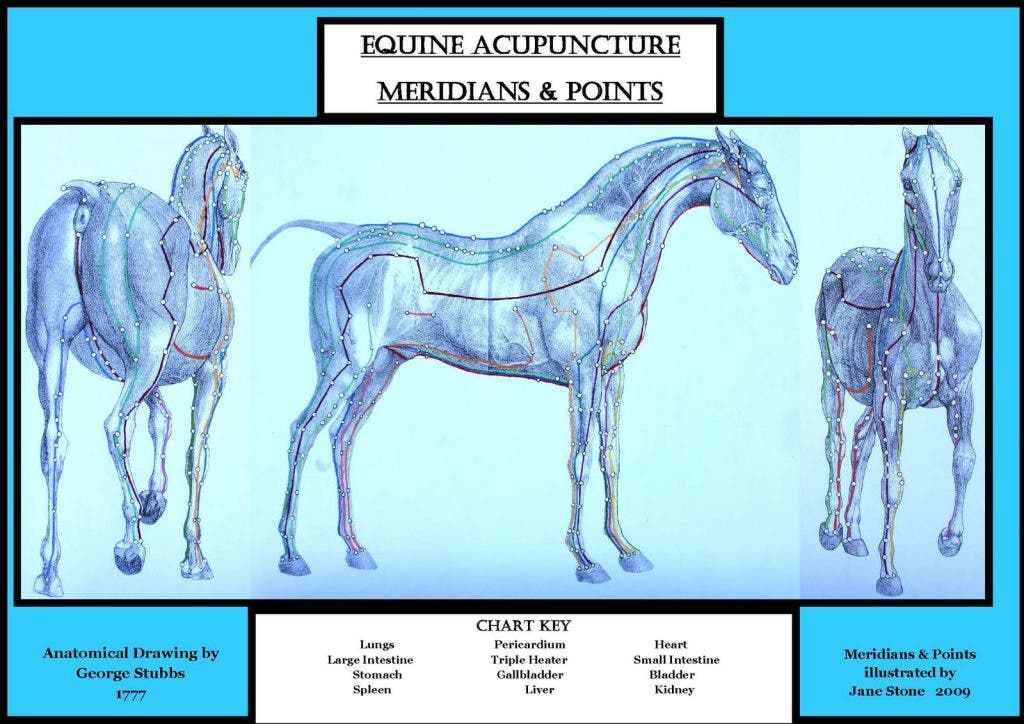


Did you know that acupuncture is available to horse owners for their equine friends? It has been for many years, but is becoming more popular these days. It seems to me that more and more people I know are moving away from traditional medicine and going toward holistic therapies, and many are also including their animals in that movement.
Personally, I believe that acupuncture can work in some circumstances; maybe not all, but some. Here’s my experience with the less traditional therapy for horses:
Some years ago, Jane became “cast” in a fence (stuck in a lying position under a fence). It happens to horses from time to time as they lie napping and move around, or if they are rolling in the dirt and get too close to the fencing and end up underneath it.
Find out what's happening in Powayfor free with the latest updates from Patch.
We were able to get her out from under the fence without much drama. Later she was sore and it was hard for her to move around, but the next day was awful. She wouldn’t even move when it was feeding time. She was in so much pain that she just stood there with her head hung low, so I moved her food to her and went to the barn to grab some pain relievers for her.
Horse people always have a first aid kit in the barn for the equines that cohabitate our lives. Wraps of every sort, oils, sprays, gauze, ointments, liniments and, of course, pain medications like Banamine paste (a potent non-narcotic, non-steroidal analgesic agent with anti-inflammatory and fever-reducing abilities) and bute tablets or powder (phenylbutazone—a non-steroidal anti-inflammatory for the treatment of chronic pain, including the symptoms of arthritis).
Find out what's happening in Powayfor free with the latest updates from Patch.
Having a horse in pain is very stressful for the animal and the owner alike.
Calling a vet at 9:00 p.m. is very expensive. Why is it that our horses always require a vet after 5:00 p.m., on weekends or holidays? Don’t answer that—I know it’s because that’s when we are with them to notice that they need a vet.
On that evening, after being stuck in the fence, all I gave Jane was bute. It didn’t seem to help at all. The next day I tried banamine, which also appeared to have done nothing. I felt her body for swelling and heat all over, especially her back and hips. There was nothing obvious, but that may have been due to the meds I’d given her since they have anti-inflammatory properties.
I rubbed along her spine, gently but firmly, and at her hip – aha! There it was. She flinched so hard her legs buckled, kind of like when someone pushes that certain part in the middle of your back and you nearly double backward in response. Thankfully she didn’t fall over. Definitely time to call my vet.
She came out the next day to assess Jane, and as luck would have it she had been studying acupuncture for years and was a practitioner on equines. She talked to me about acupuncture and its useful benefits, especially since it appeared that the traditional medications weren’t working. I knew it wouldn’t hurt Jane, so I agreed to give it a shot (no pun intended), even though I was a bit skeptical.
My vet developed a treatment plan for Jane and began that very day. She informed me that within two or three treatments we should see some improvement. I have to admit that my first thought was, “OK, so we’ll have a ‘series’ of treatments that will just cost more money. Nice. I hope this works.” I know that was all part of my skepticism.
Having needles inserted in various places in Jane’s body, the vet twisting certain ones, made me cringe, but not Jane. She just stood there. It obviously didn’t hurt her and that eased my mind. I am a needle-phobic person and fall ill at the sight of them.
After the treatment, the vet had me walk Jane slowly for just a minute. At first Jane didn’t want to move. Huh, did it not work or make her worse? She hadn’t been moving, so maybe she was just anticipating the same pain she’d been having since being stuck in the fence.
I tugged her lead rope and she began walking. Within a few strides she was markedly better than she was just that morning. Her movements began to flow more smoothly and the vet then told me to walk her a few times that day and the next and she’d return in two days for another treatment.
Jane continued to improve and after the second treatment and a short walk she obviously felt much better. There was no hesitation in Jane to move and her eyes softened too, which is a good indicator of relief in an equine. That evening she came over to her hay bucket for dinner willingly. After her third treatment the vet felt that Jane had improved enough and needed no further treatments.
I was impressed. No pills or powders that I had to try to hide in sweet feed so Jane would eat it. No chemicals were injected into her system either and there was my horse, moving nicely within days.
I am not intending to endorse one medical treatment over another. I merely wanted to share my experience with you and let you know there may be options out there you may have been unaware of or never considered. I am thankful my vet studied acupuncture and was able to treat my horse so ably and help her recover from the injury she sustained, and without chemicals.