Knee arthritis pain can slowly shrink your world. Stairs become something to avoid. A trip through the airport feels daunting. Golf, pickleball, walking the dog or simply getting out of a chair can become calculated decisions based on how much your knee is going to hurt.
For many seniors suffering from osteoarthritis, the treatment path is familiar. Pain medications. Physical therapy. Steroid injections. Then, eventually, a conversation about knee replacement.
But there is another option that most patients have still never heard of.
Genicular artery embolization, or GAE, is a minimally invasive treatment for knee osteoarthritis designed for patients who want to reduce their pain and preserve their natural knee.
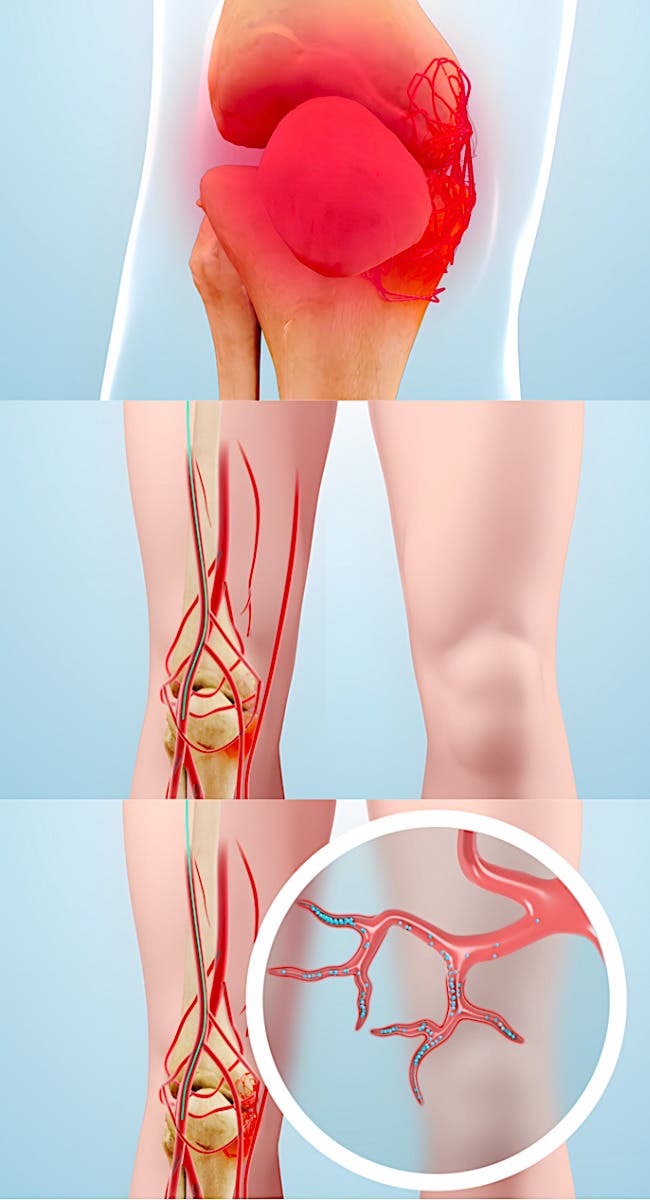
Arthritis is more than worn cartilage. An arthritic knee develops inflammation, and that inflammation can stimulate the growth of abnormal tiny blood vessels around the joint. Those vessels can help perpetuate inflammation and pain.
GAE targets those abnormal blood vessels.
Using X ray guidance, a physician guides a tiny catheter through an artery to the blood vessels surrounding the knee. Microscopic particles are then delivered to reduce blood flow to the abnormal vessels driving inflammation. There is no incision in the knee, nothing is implanted and there is no hospital stay. The procedure takes about an hour and patients go home the same day.
Dr. Pushpinder Sivia, a board certified vascular surgeon at Empire Vein and Vascular Specialists in the Coachella Valley, has performed more than 1,000 GAE procedures.
“I tell patients to think of arthritis like a fire inside the knee,” says Dr. Sivia. “Pain medication can turn down the smoke alarm. A steroid injection can temporarily quiet the fire. GAE is different because we are targeting one of the things helping feed that fire. We are treating a driver of the pain without removing or replacing the knee.”
That distinction is important. Steroid injections can provide temporary relief, but repeated injections are not benign. A randomized study published in JAMA found that patients receiving steroid injections every three months for two years experienced greater cartilage loss than patients receiving saline injections, without better long term pain relief.
GAE has now been studied for more than a decade. The first clinical study for knee osteoarthritis was published in 2015. A 2026 meta analysis reviewed 45 studies involving more than 2,200 patients. Published research has shown substantial improvements in pain and function. In one of the foundational studies, more than 80 percent of patients achieved at least a 50 percent reduction in knee pain at six months.
The treatment has also moved well beyond the experimental fringe. In 2026, the Society of Interventional Radiology stated that GAE should be offered to appropriately selected patients who have failed conservative treatment and want to delay or avoid knee replacement.
For many patients, GAE is covered through Medicare and other insurance plans.
For Sarah G., the benefit was not measured in medical terminology. It was measured in her life. “I no longer dread stairs. I can travel again. What I still cannot believe is that neither I nor my doctor had heard of GAE.”
The biggest challenge surrounding GAE today is awareness. Many patients do not know the treatment exists. Many physicians still do not discuss it. As a result, some patients reach the point of considering knee replacement without ever hearing about a less invasive option that might allow them to keep their natural knee.
GAE is not right for everyone, and knee replacement remains an excellent operation for the right patient. But replacing a joint is an irreversible decision. Knowing every reasonable option before making that decision matters.
“Too many patients believe they have only two choices: live with the pain or replace the knee,” says Dr. Sivia. “That is no longer true.”
If knee arthritis pain is pushing you toward knee replacement, there is one question worth asking before you schedule surgery:
Have I really run out of options, or have I simply not heard about all of them yet?
Empire Vein & Vascular Specialists serves patients throughout Southern California with locations in La Quinta, Rancho Mirage, Palm Springs, Riverside, Ontario and Victorville.
The practice specializes in minimally invasive treatments for knee pain, varicose veins, and circulation-related conditions, offering personalized care focused on long-term mobility and quality of life.
For more information or to schedule a consultation, visit EmpireVein.com or call 1-800-KNEE-CARE.