Community Corner
San Andreas 'Big One' Threat Rises In Wake Of Ridgecrest Quakes
A flurry of earthquakes in Ridgecrest a year ago may have raised the stakes in setting off a magnitude 7.5-plus quake on the San Andreas.


ORANGE COUNTY, CA — A swarm of earthquakes one year ago could be a prelude to an even more massive, more devastating quake along the San Andreas Fault line, a recent Seismological Society of America report says.
In July 2019, Ridgecrest, California, was startled awake by a magnitude 6.4 quake. The next day, a larger, magnitude 7.1 quake struck the region. In the six months that followed, more than 100,000 aftershocks frayed nerves of residents from the China Lake Naval Weapons Station and beyond. Scientists watched with a mixture of fascination and alarm as the fault line that caused the quake grew, sparking the first significant movement in 500 years along a major Mojave Desert fault, according to a report released Thursday by Caltech and NASA's Jet Propulsion Laboratory.
In October, Patch reported that a major quake on the Garlock Fault, which runs east-west from the San Andreas Fault to Death Valley, would produce strong shaking in the San Fernando Valley, Santa Clarita, Lancaster, Palmdale, Ventura, Oxnard, Bakersfield and Kern County.
Find out what's happening in Rancho Santa Margaritafor free with the latest updates from Patch.
The Ridgecrest quakes sparked movement along the 185-mile-long Garlock Fault, capable of triggering a major quake along the San Andreas fault. Monday's geological study brief — published by Kang Wang, Douglas S. Dreger, Elisa Tinti, Roland Bürgmann and Taka'aki Taira —further disclosed the possibility, however small, of a magnitude 7.5 or higher earthquake erupting along the San Andreas fault within the next 12 months.
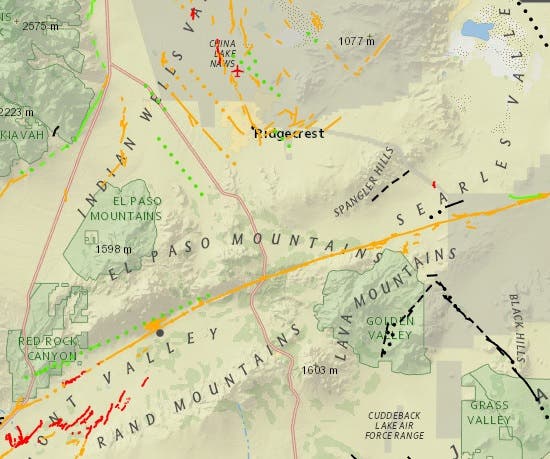
Monday's report suggests that if a massive earthquake strikes the Garlock Fault, currently a 2.3 percent possibility, the likelihood that would set off a significant quake along the San Andreas Fault has risen to 1.15 percent possibility.
Find out what's happening in Rancho Santa Margaritafor free with the latest updates from Patch.
That may not seem like a large number. Still, the geologic numbers translate into a near "tripling of the odds" of the fabled "Big One" striking the San Andreas, one of the study's co-authors told The Los Angeles Times.
Ross Stein, an earthquake scientist emeritus of the U.S. Geological Survey and adjunct professor of geophysics at Stanford University, told the newspaper that if the Garlock Fault ruptures, the probability of a big earthquake along the San Andreas fault could be "even odds."
At its closest, the San Andreas Fault is 35 miles from downtown Los Angeles.
"Now, you can think of the Ridgecrest earthquake as being so far from Greater Los Angeles ... that it is nearly harmless," Stein told The Times. "But the problem is that ... the Ridgecrest earthquake brought the Garlock Fault closer to rupture."
If the Garlock Fault ruptures within about 25 miles of the San Andreas, there is a "high likelihood, maybe a 50/50 shot, that it would immediately rupture on the San Andreas," Stein reported.
The San Andreas is one of the most studied fault lines in California. The Times reported that a hypothetical magnitude 7.8 quake on the San Andreas could cause more than 1,800 deaths, injure 5,000, displace 500,000 to 1 million people from their homes and cripple the region economically for a generation.
A quake of that magnitude would produce 45 times more energy than the 1994 magnitude 6.7 Northridge quake.
When a geologic report such as Monday's is published, eyes turn to the seasoned and trusted seismologist Dr. Lucy Jones, onetime spokeswoman of the USGS and now author of "The Big Ones: How Natural Disasters Have Shaped Us and What We Can Do About Them." Jones, not involved in the study released Monday, said its conclusions are as of yet theoretical.
"It's really interesting science, and I like the way they've been able to increase the complexity of how they do their modeling," Jones told the newspaper. "That's a real advance. But it's not yet proven."
According to an abstract of the report, Ridgecrest's quakes culminated in the largest seismic event in the state since the 7.1 magnitude Hector Mine quake in 1999.
The Ridgecrest activity "produced significant stress perturbations on nearby fault networks, especially along the Garlock Fault segment immediately southwest of the 2019 Ridgecrest rupture," according to that summary.
The probability and outcomes are speculative, the Times reports. The Ridgecrest earthquakes, far beneath the surface, may have begun a chain of events that could result in widespread devastation along the San Andreas Fault not seen since 1857. However, even Jones said California officials should be prepared and on the lookout for action on the Garlock Fault.
Read also: Fault Capable Of 8.0 Quake Awakens Thanks To Ridgecrest Temblors
City News Service, Patch Editor Paige Austin contributed to this report.
Get more local news delivered straight to your inbox. Sign up for free Patch newsletters and alerts.