Health & Fitness
Bamboo Tube Bee Houses
How to make bamboo nesting tubes for solitary, native bees that pollinate many food crops.
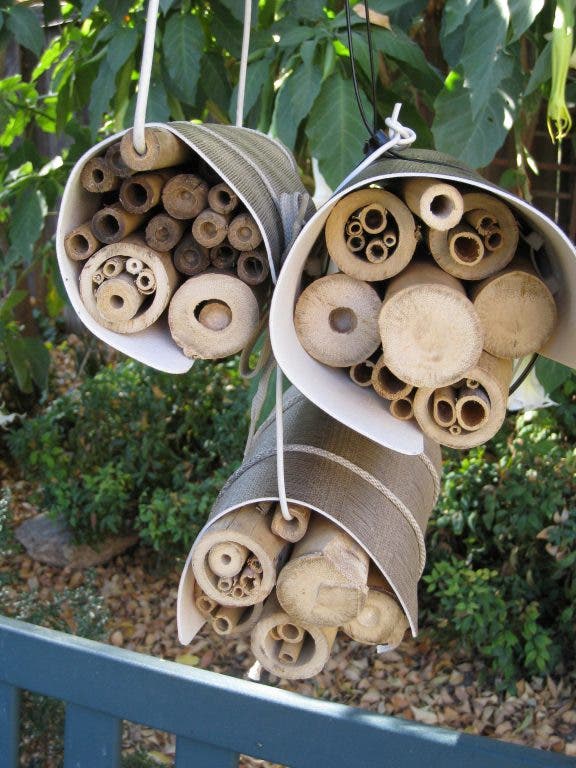


How to bee friends with the best pollinators
Earlier, I suggested we provide bee blocks, short 10 cm x 10 cm posts with holes drilled for eggs of native, solitary bees, important pollinators for many food plants. Hollow bamboo also attracts helpful bees. Leaf-cutter bees, wonderful pollinators in Southern California, prefer bamboo tubes for hiding eggs with perfect circles cut from soft leaves and flower petals. (Now you know whodunnit.)
I cut a bamboo garden stake into tubes for these bees. Not yet having a container, I threw the tubes on a shelf in my covered potting area. Later, I got a basket, and reaching for the tubes, I found bees were already using them. Eventually I put the tubes in a wire basket with a lid to keep out inquisitive wrens and hung it on the wall outside a window. Then I worried spiders would use the tubes while catching moths, so I moved them. Again, I found some already plugged with leaves and petals. Leaf-cutters are so short of nesting places that they will find all your bamboo no matter where you put it.
The bees want tubes around 10-20 cm long, each with one end open and the other closed with a natural joint. The diameters should vary from 5-30 mm. Get bamboo stems in a garden supply or from a friend who is trimming his bamboo. Inspect each stem carefully to insure hollow portions with a diameter over 5 mm and no splits.
Cut the bamboo into short tubes with a fine-toothed hack saw, supporting the bamboo with a saw horse or wood block. Use light pressure while sawing so as not to split the bamboo nor peel off skin. Clean the loose pulp and unhappy spiders out with a narrow brush.
My garden assistant, Sam Samra, and I fastened tubes into bundles and made sure each was covered for shelter from rain. We jammed some into old containers we found sitting around in the garage, kitchen, or second-hand store. Now in every store, I think of ways to use different items to make bee nurseries. One must remain on-mission and unperturbed, even when the spouse wonders, “What do you mean, my favorite lemonade pitcher has been upcycled?”
For protection from rain, we hung some open baskets of loose bamboo under the eaves. After putting them up, I realized black phoebes, wrens and robins would like nesting in these, but they are also welcome garden assistants.
We fastened some bundles together with zip ties and old shoe laces and tied pieces of place mats around some bundles. We put together tubes of varying diameters, some facing one direction, some the other.
I talked to one gardener who is concerned to keep birds and critters from exploring his bamboo tubes. He puts them inside a bird cage. I don’t set bee tubes on top of the fence in the paths of rats, racoons, or birds. I hang them on 30–60 cm lengths of wire or string instead. Bees prefer hidden, out-of-the-way spots about 1-3 m above the ground.
Footnote: Some other important bees are underfoot--bumble bees, whose buzz is the right frequency to dislodge pollen for tomato blossoms. This bee needs a dark, underground hole with two compartments -- the lobby, where the bee expels unwanted guests, and the inner sanctum. The sanctum requires a chicken-wire dish with cottony litter for holding egg cases off the ground. A tunnel 2-3 cm in diameter and 15 cm long leads from ground level down to this hide-away. Some gardeners have buried wooden boxes with pipes leading into them. One provided an upside-down pot with hose going underneath. Bumble bees, however, are picky, and not many human-made “sod houses” have been used. It’s best to let them occupy uncultivated, unwatered squares in our gardens, 30 cm or more on each side, with hillocks of grass and some old mouse holes.
The king’s beech: Carpenter bees pollinate earlier in spring and later in fall than honey bees, on cloudy days, and early morning till sundown. For carpenters, leave a section of tree trunk in an unbothered corner. Ask for a piece of log when workers trim a tree. Drill a few holes (1 cm wide, 12 cm deep) to get the bees started. The large females are all black, with shiny bodies. The large male is stunning, all gold velvet. We hear about the queen bee, but what about the king bee?
More information:
Xerces Society. http://www.xerces.org
Book: Bird, Bee & Bug Houses, Simple Projects for Your Garden by Derek Jones