Health & Fitness
The Bees Next Door
Gardener makes bee houses for help growing food. Won't you bee my neighbor?
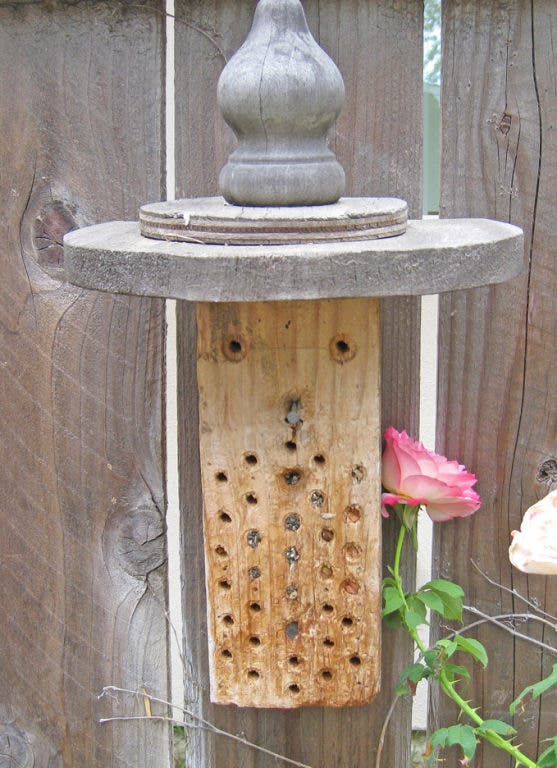


This is to suggest that the home gardener should welcome some bees next door. I don’t mean the communal honey bees kept by the wanna-be (wanna-bee) farmer on the outskirts, but the native, solitary bees that lay their eggs in hidden holes in unused ground or in old beetle holes in decaying trees. Why? Because these bees pollinate 85 percent of our food crops, including almonds, apples, cherries, berries, melons, pears, plums, squashes, and tomatoes. Wait–where is the unused patch of ground or the decaying, dead tree left standing, with old beetle holes? Most neighborhoods have none, and for that reason, gardeners and food-lovers all over the U.S. and the world are making and hanging up bee houses for these essential partners.
Mason bees and leaf-cutter bees use old beetle holes in wood. Each mother bee finds a narrow hole 3-5 inches deep, with a closed end, in a dry, protected, hidden spot. She puts into the end of the hole a little nectar, a little pollen, then an egg. She makes a thin wall, then more nectar and pollen and another egg, then a thin wall, and repeats this until the hole is sealed at the opening and full of eggs. To construct the walls, the mason bee uses a mixture of mud and plant crumbs.
The leaf-cutter bee uses circles cut out of thin leaves and petals, each circle carefully cut for perfect fit in the hole she’s found. Yes, those perfectly round little cut-outs in your rose leaves are her work, but I invite you to enjoy these holes, because she is your friend, busy laying eggs for next year’s team of bees to pollinate your food plants. A solitary bee has no communal hive to protect, and therefore she isn’t aggressive, carrying only a mild sting to use when a bare foot or hand presses down on her.
My garden assistant, Sam Samra, and I made bee houses by drilling holes in left-over pieces of untreated, unpainted 4-inch by 4-inch post, but pieces of 4x6 or 6x6 posts are good, too. If in a hurry and feeling uninspired, one can simply drill rows of holes, attach a crude roof, and then hang up the bee house. The bees will love you for it and your neighborhood will have more productive gardens and fruit trees. I’ve had one bee house hanging on the fence for two years. Right now, five holes are full of mason bee eggs and five full of leaf-cutter eggs, and the bees are busy filling more. You can have fun with this, and we did. Our game last week was to use only stuff we found in the garage, which for 30 years has been accumulating tin, boards, nails, washers, rubber tubing, and more.
Bee House
4 x 4 post or 4 x 6 post, cut into 14-18 inch sections
drill bits 3/32-inch, 3/8-inch, and in between
holes 3-5 inches deep
centers 3/4 inch apart
roof
wire on back for hanging
One can also make holes in sections of dry, cut branches or in adobe blocks. Next time: Bamboo-tube houses for native bees. Sod houses for ground-nesting bees.
On the internet, explore:
Images of bee houses
Orchard mason bees
Leaf-cutter bees
Xerces Society on bee-friendly farming.
Xerces Society on nests for native bees.
Pollinator Partnership.
Inhabitat.
ATTRA,NCAT articles on sustainable agriculture.
ATTRA.NCAT wonderfully informative booklet on bee houses, 28 pages, $4.95 for digital download.