Crime & Safety
66K+ Lose Power As 'Bomb Cyclone' Hammers Bay Area
A powerful storm brought torrential rains and strong gusts over the weekend, knocking out power for thousands and flooding roadways.


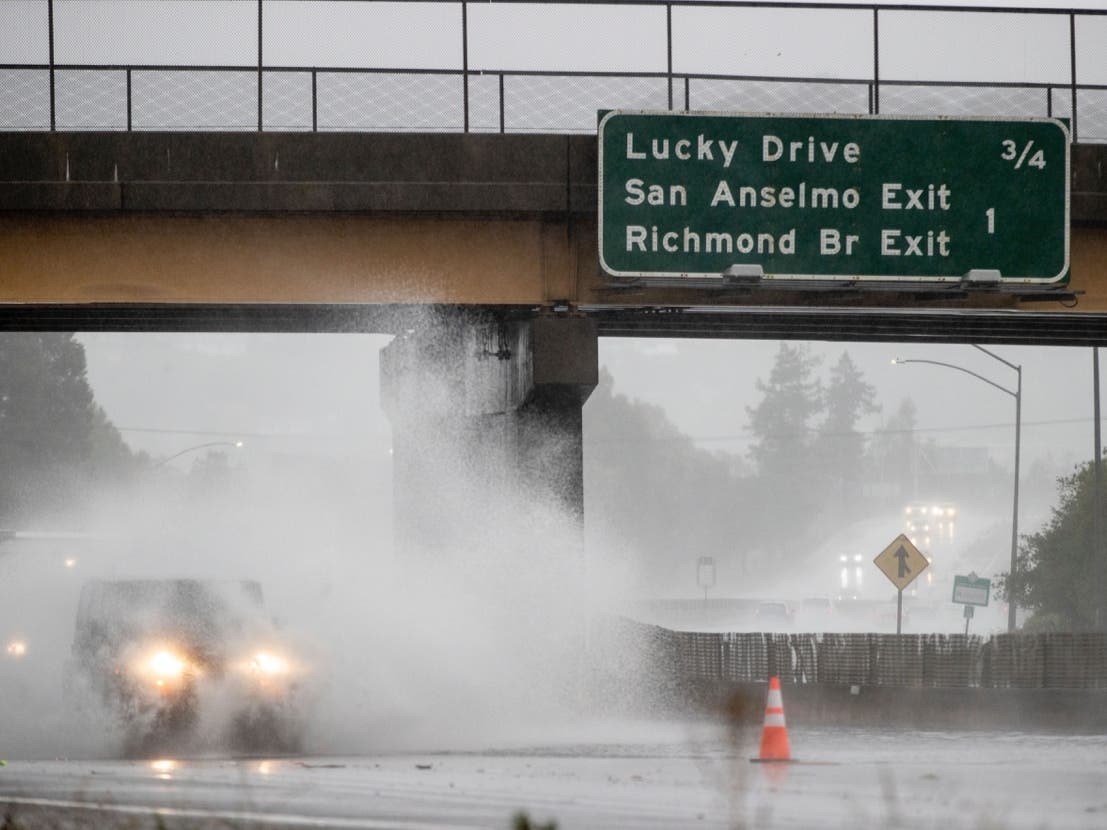
SAN FRANCISCO, CA — A powerful "bomb cyclone" storm toppled trees, flooded homes and busy thoroughfares on Sunday. The fast moving storm system also knocked out power for tens of thousands of residents in the Bay Area on Sunday.
Some 66,000 residents had lost power by 1 p.m., according to Pacific Gas & Electric. The utility warned ahead of the storm that the massive storm would likely bring torrential rain, heavy mountain snow and intense winds, which could cause widespread outages.
The weekend's extreme "atmospheric river" was forecast to effectively end another destructive wildfire season and quell some drought concerns in Northern California, but on Sunday it brought a slew of other dangers such as flooding and mudslide risks in fire-scarred California.
Find out what's happening in San Franciscofor free with the latest updates from Patch.
Also dubbed a "bomb cyclone," the powerful storm swirled violently over the state, and had a pressure equivalent to a Category 4 hurricane, according to U.S. StormWatch. The storm was expected to dump a foot of rain in some parts of Northern California and deliver 8 feet of snow over the mountains, USA Today reported.
As the storm barreled through the Bay Area Sunday, PG&E was also warning residents not to touch or get anywhere near downed wires. Downed wires can be reported by calling 911 and PG&E directly at 1-800-743-5002.
Find out what's happening in San Franciscofor free with the latest updates from Patch.
"Never touch downed wires: If you see one, assume it is energized and extremely dangerous," PG&E tweeted on Sunday. "Do not touch or try to move it — keep children and animals away."
The North Bay remains hardest hit and as of 11:30 a.m., power was out to 43,319 customers, mostly in Marin and Sonoma counties, PG&E spokesman J.D. Guidi told Bay City News.
About 16,439 customers are affected on the Peninsula; 2,430 in San Francisco, 2,258 in the East Bay, and 1,582 in the South Bay.
PG&E started staging crews on Saturday to deal with the storm, with more 3,000 workers available to respond to outages, Guidi said.
See PG&E's outage map here.
On Sunday, emergency crews responded to flooded roads, downed wires and toppled trees all over the Bay Area on Sunday.
"Water levels are on the rise in many of our creeks right now due to the storm," the Santa Rosa Fire Department wrote on Twitter. The department posted video of rushing waters of a rain-swollen waterway at Flat Rock Park, at the confluence of Brush and Santa Rosa creeks. The waterbed was mostly dry just a week ago.
"Please stay away from the edges of these fast-moving waterways," department officials tweeted.
Several homes were flooded in Santa Rosa on Sunday and authorities were urging residents not to attempt to drive through flooded streets in the city.
There is currently flooding on Tachevah Dr. and Neotomas Ave. with water flooding homes in the area. Crews are on scene to address the impacts. As a reminder, please do not attempt to drive through flooded out roadways. Please be safe out there! pic.twitter.com/PNtwb0uQ7o
— Santa Rosa Fire Department (@SantaRosaFire) October 24, 2021
Evacuation warnings were issued for Santa Cruz and San Mateo counties on Sunday. In San Francisco, the threat of a large tree leaning in the city's Forest Hills neighborhood prompted fire officials to order the evacuation of three homes on Sunday morning, the San Francisco Fire Department said on social media about 11:10 a.m. Residents in the 2176-2178-2184 block of Ninth Avenue were being evacuated.
National Weather Service officials said the rains would persist into the night and were encouraging residents to stay home on Sunday and to avoid travel.
"It's a great day to stay home! Heavy rain across the area will lead to roadway flooding today into tonight," NWS officials in Sacramento tweeted. "Tonight into tomorrow night, snow will impact mountain travel. If you do have to drive, take it slow and leave plenty of time get to your destination."
Flash flood warnings were issued to several reaches of Northern California on Sunday, including where the destructive Dixie Fire left a massive burn scar. Areas where fires impacted the topography become dangerous and ripe for "debris flows" during a storm such as this weekend's bomb cyclone, authorities warned.
Debris flows tend to manifest during copious rainfall, transforming topography into a treacherous river of mud, weather experts said. These mud rivers can flow rapidly, striking with little or no warning at avalanche speeds — faster than a person can run, according to Ready.gov, a website created by the U.S. government to help citizens cope with emergencies.
READ MORE: What Are Debris Flows And How Can NorCal Residents Cope?
Ahead of the treacherous storm, Northern Californians were urged to charge up cell phones and battery back ups, tie down outdoor furniture and trash cans. Emergency kits or "go bags" should also be prepared ahead of the story, officials said.
The storm also prompted community leaders to cancel the Alameda County Fair, one of the most popular Bay Area attractions. Danville's bustling Fallfest was also canceled on Sunday.
READ MORE:
- Alameda County Fair Canceled As 'Bomb Cyclone' Storm Hits
- Danville's Fallfest Canceled As Torrential Rains Arrive
We are getting reports of debris flows within the Dixie Burn Scar area especially impacting Highway 70 from Jarbo Gap to Greenville. #CAwx https://t.co/8yINGS46FH
— NWS Sacramento (@NWSSacramento) October 24, 2021
Californians celebrated when rain started falling earlier this week for the first time in any significant way since spring. The San Francisco International Airport set a record rainfall for Thursday, with 0.44 inches of rain tallied. The old record was 0.13 inches on the same day in 1970, the National Weather Service in the Bay Area tweeted.
Rain and snow will continue to drench central and Northern California before spreading into Southern California on Monday, although Southlanders woke up to a bit of drizzle on Saturday morning.
Incredible imagery of the bomb cyclone, with a pressure equivalent to a Category 4 hurricane (943 mb) driving an extreme atmospheric river into Northern California. #CAwx pic.twitter.com/UpN1DX34kh
— US StormWatch (@US_Stormwatch) October 24, 2021
The incoming heavy rainfall is welcome news in the Golden State, where exceptional drought conditions and another monstrous fire season has plagued residents and authorities working in treacherous burn zones.
"This rainfall is coming about a month ahead of average and will be very welcome in fighting the remaining fires, particularly in Northern California," according to Jon Porter, AccuWeather Chief Meteorologist. "Repeated storms delivering such copious rainfall will have a major effect on the wildfire season – effectively ending the wildfire season from Northern California northward."
Wildfires have ripped through 2.4 million acres in California this year, which have destroyed or damaged more than 3,600 structures and killed three people, Cal Fire reported.
READ MORE: NorCal Braces For 'Bomb Cyclone,' High Winds And Copious Rainfall
The Associated Press, Bay City News and Patch Editor Kat Schuster contributed to this report.
Get more local news delivered straight to your inbox. Sign up for free Patch newsletters and alerts.