Community Corner
Fire Chief Says '89 Quake Catalyst for Nationwide Improvements in Search, Rescue
The day Loma Prieta struck the Bay Area everything changed. [VIDEO]


By Bay City News Service:
The 1989 Loma Prieta earthquake that hit 25 years ago Friday was a catalyst for dramatically improved search and rescue operations nationwide, according to the chief of the Menlo Park Fire Protection District, who has helped create a national network for search and rescue specialists.
Chief Harold Schapelhouman was a firefighter with the department on Oct. 17, 1989. He was off-duty but working on a water rescue proposal at Menlo Park Fire Station 1 at 5:04 p.m. when the 6.9-magnitude earthquake struck in the Santa Cruz mountains.
Find out what's happening in San Anselmo-Fairfaxfor free with the latest updates from Patch.
Schapelhouman jumped under a desk, waited for the shaking to stop and then rushed downstairs to the dispatch center and spent the next six hours taking calls and sending first responders to the hundreds of calls coming in for emergency service, he said. Because of his work in emergency preparedness, he was selected in 1990 to work on a federal pilot program to develop a nationwide search and rescue model, meeting experts from departments nationwide and helping to bring the pilot to fruition.
Related: Recalling When Loma Prieta Interrupted the 1989 World Series ... and What Happened Next
Find out what's happening in San Anselmo-Fairfaxfor free with the latest updates from Patch.
Menlo Park today operates a 26,000-square-foot warehouse loaded with rescue equipment and is a central point of Bay Area rescue training and deployment. The department works to train and equip a team of 200 Bay Area rescue specialists. The team is sent all over the nation, most recently to Alaska for a national earthquake drill and to a devastating mudslide in Washington.
The Loma Prieta earthquake “was a catalyst for change in the rescue community,” Schapelhouman said. After he was chosen to work on the national pilot program in 1990, the Menlo Park Fire Protection District was selected as one of the national network of 28 rescue teams in 1991. The water rescue proposal he was working on the night of the earthquake was accepted and today the fire district operates a fleet of specialized watercraft that has conducted hundreds of successful water rescues.
A former Oakland fire battalion chief who now works closely with Schapelhouman as a division chief in the fire district also brought his experience from the 1989 quake and was a large part of Oakland becoming part of the same network of search and rescue specialists, according to Schapelhouman.
Related: 25 Years Since Loma Prieta: Are You Ready for the Next Big Earthquake?
Battalion Chief Manny Navarro returned to work while off-duty on the day of the Loma Prieta quake and worked for the next five days extricating people trapped in the collapse of the Cypress Viaduct of Interstate Highway 880 in Oakland. His team rescued a dozen people from the collapsed double-decker freeway. Navarro went on to become an assistant chief in Oakland overseeing another a National Urban Search and Rescue Task Force in 1991, Schapelhouman said.
Both Oakland’s and Menlo Park’s teams remain part of the 28-team network of search and rescue task forces operated by the Federal Emergency Management Agency today, ready to deploy nationwide in the case of a major disaster using the skills honed and developed in the last 25 years after the Loma Prieta earthquake.
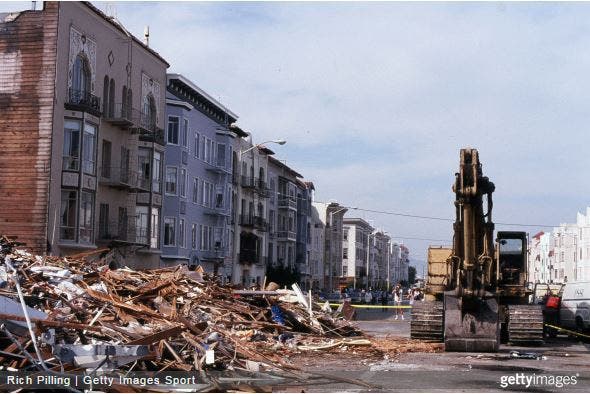
PHOTO: SAN FRANCISCO, CA - OCTOBER 18: A general view of a street in San Francisco after the Loma Prieta earthquake hit prior to World Series game three between the Oakland Athletics and San Francisco Giants on October 18, 1989 at Candlestick Park in San Francisco, California. The game was postponed for 10 days. (Photo by Rich Pilling/Getty Images)
Get more local news delivered straight to your inbox. Sign up for free Patch newsletters and alerts.