Schools
LIST: 2017 California College Rankings, According to U.S. News & World Report
How does the Golden State stack up with the rest of the nation? The much-anticipated annual college rankings were released Tuesday.


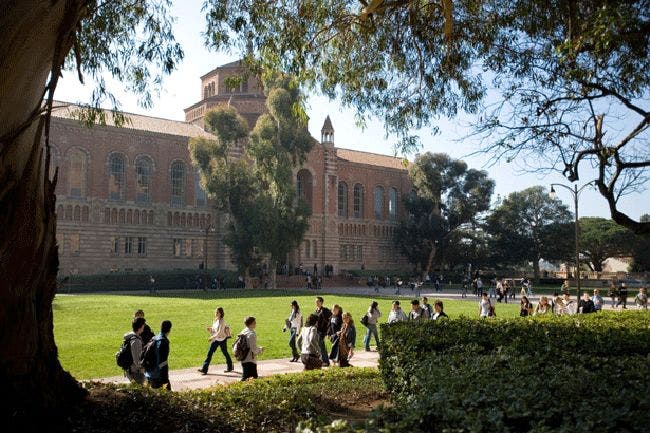
California is home to numerous high-quality colleges and universities. But who is the best?
That's a question the prestigious publication U.S. News & World Report seeks to help answer every year in its "Best Colleges" report. Starting in 1983, it began the arduous process of surveying higher education institutions nationwide. In 1988, the U.S. News Best Colleges report became an annual feature, and today it creates an esteemed list that parents and kids alike rely upon in the college-hunting process.
For the second year in a row, colleges located in California snagged more than 10 percent of the top 100 spots. Also a repeat: Stanford came in number one in the Golden State and seven of the state's top 12 schools were part of the UC system.
Find out what's happening in San Mateofor free with the latest updates from Patch.
Routinely, Stanford, Harvard, Yale and Princeton are among the top American universities, though their order often changes depending on the year and the specific methodology used. Also mainstays in the top grouping are usually Columbia, MIT and University of Chicago.
On Tuesday, the 2017 list was published, revealing the top 5 schools in the nation this year are:
Find out what's happening in San Mateofor free with the latest updates from Patch.
1. Princeton University
2. Harvard University
3. University of Chicago
4. Yale University
5. Columbia University (tie)
5. Stanford University (tie)
Here are this year's California-specific rankings, according to U.S. News:
- Stanford University, Stanford, CA #5 in National Universities (tie)
- California Institute of Technology, Pasadena, CA #12 in National Universities (tie)
- University of California--Berkeley, Berkeley, CA #20 in National Universities (tie)
- University of Southern California, Los Angeles, CA #23 in National Universities
- University of California--Los Angeles, Los Angeles, CA #24 in National Universities (tie)
- University of California--Santa Barbara, Santa Barbara, CA #37 in National Universities (tie)
- University of California--Irvine, Irvine, CA #39 in National Universities (tie)
- University of California--Davis, Davis, CA #44 in National Universities (tie)
- University of California--San Diego, La Jolla, CA #44 in National Universities (tie)
- Pepperdine University, Malibu, CA #50 in National Universities (tie)
- University of California--Santa Cruz, Santa Cruz, CA #79 in National Universities (tie)
- University of San Diego, San Diego, CA #86 in National Universities (tie)
- University of San Francisco, San Francisco, CA #107 in National Universities (tie)
- University of the Pacific, Stockton, CA #111 in National Universities (tie)
- University of California--Riverside, Riverside, CA #118 in National Universities (tie)
- San Diego State University, San Diego, CA #146 in National Universities (tie)
- University of California--Merced, Merced, CA #152 in National Universities (tie)
- University of La Verne, La Verne, CA #152 in National Universities (tie)
- Biola University, La Mirada, CA #164 in National Universities (tie)
- Azusa Pacific University, Azusa, CA #183 in National Universities (tie)
- California State University--Fullerton, Fullerton, CA #202 in National Universities (tie)
- California State University--Fresno, Fresno, CA #220 in National Universities (tie)
So, how are the rankings compiled?
U.S. News Chief Data Strategist Robert Morse told Patch that the publication considers objective factors such as graduation and retention rates.
More specifically, U.S. News uses five categories of data that are all weighted differently.
- Outcomes (30 percent): Hard student performance data such as retention, graduation rate performance and graduation rate.
- Expert opinion (22.5 percent): More subjective data that includes opinions of presidents, provosts, high school counselors and admissions deans.
- Faculty resources (20 percent): Class size, student-to-faculty ratio, proportion of full-time faculty, proportion of professors with the highest degrees in their field and faculty salary.
- Student excellence (12.5 percent): How incoming students are performing on measures such as ACT/SAT scores, proportion of first-year students in the top 10 percent of their high school graduating class and acceptance rate.
- Financial resources (10 percent): How much money the school spends on things such as instruction, research and student services. (Spending on dorms, food and sports don’t count.)
- Alumni giving (5 percent): What percentage of living alumni with a bachelor’s degree have given to their school that year.
Read the full methodology here.
“College is expensive,” Morse told Patch in an email. “In addition to considering factors like location, cost, course offerings and activities, families should pay close attention to graduation and retention rates.
“These are important indicators of how well a school supports its students academically and financially. The Best Colleges rankings measure academic excellence, and we believe that students and their families should strongly consider academic quality when choosing a college.”
Typically, the prestigious Ivy League schools have a stronghold on the top of U.S. News’ lists. Last year, for instance, Princeton University, Harvard University and Yale University took the first three slots on the national rankings.
That’s all well and good for the best of the best high school students, but what about the rest?
The rankings are broken out by state and by category. Students and parents can also look at the publication’s rankings of best value schools and best public schools and the best schools by discipline such as engineering and business.
They can also drill down and see how specific schools perform across several metrics.
“U.S. News believes that the more information that is available to students, the better,” Morse told Patch. “Rankings, done right, are a useful source of information for students. U.S. News rankings focus specifically on assessing academic quality of schools. If academic quality is a top priority, our rankings are an ideal place to start.”
– Patch Editor Marc Torrence contributed to this report.
(Image courtesy of UCLA/ used with permission)
Get more local news delivered straight to your inbox. Sign up for free Patch newsletters and alerts.