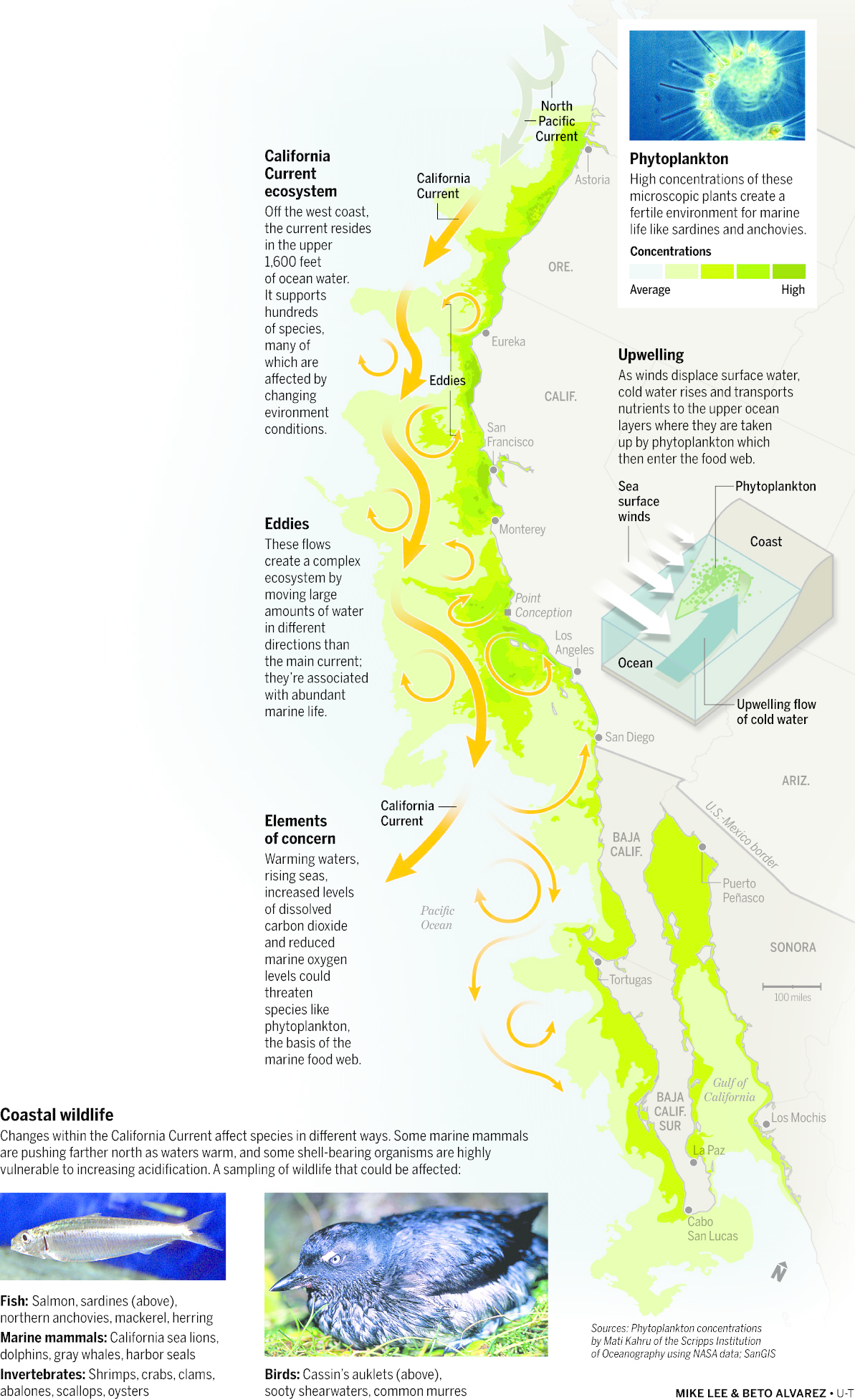
We know its spring when the cool blustery breeze blows across the San Francisco Bay, washing whitecaps onto our shorelines. Outside the Golden Gate, these same winds create a phenomenon important to our well being as coastal residents called upwelling. California is at the eastern edge of the Great Pacific gyre, a vast oceanic circulation that travels around the north Pacific west along the equator, north along Asia, curving eastwards over the top beneath the Bering Sea and finally running down the North American continent past our door.
In spring, the strong northwest winds combined with the effects of the earth’s rotation push the surface water offshore. Upwelling is the process where cool nutrient rich waters from the depths replace the water moved offshore. These deeper waters are rich in nutrients and create another phenomena that affects our daily lives known as a plankton bloom. Like adding Miracle Grow to a garden, tiny marine plants called phytoplankton suck up the phosphate and nitrate rich waters created by upwelling, and explode in to great blooms in the lengthening sunlight. Phytoplanktons are in turn consumed by zooplankton, small crustaceans that in turn feed the herring, sea lions, auklets and a host of other organisms right up the food chain. These periods of increased productivity makes the water soupy and brown during the spring months. This system called the California Coastal Upwelling Ecosystem is what makes California one of the richest marine ecosystems in the world, with fisheries worth hundreds of millions and the abundant and diverse life from herring to whales. The many wonderful seabirds and marine mammals in our Sanctuary are all here thanks to upwelling. This system and four other major upwelling regions in the world (also at the junction of a gyre's easterly edge and a continent in Africa, Chile and W. Australia,) have been cranking along for millions of years.
However, changes in circulation patterns believed to be associated with rising sea temperatures is raising alarm among scientists. Scripps Institute of Oceanography (SIO) has been monitoring ocean conditions in the California Current since 1949, coincident with the great sardine crash off Monterey. This study called California Cooperative Oceanic Fisheries Investigations, or CalCOFI has been measuring oxygen, nutrients, temperature and other physical and biological conditions off the California Coastline. One trend observed in this study is an average surface water temperature increased of about 3 degrees since 1950 at the Scripps Pier. SIO scientists report that a major shift in ocean dynamics is expected to reduce the upwelling of cold, nutrient-rich waters off our coast. This not only impacts the productivity, and the livelihood of seabirds, marine mammals and even we humans, it has other impacts. Warm waters near the surface are expected to heat up, expand and intrude higher onto land creating flooding and increased coastal erosion and damage in storms. The studies from CalCOFI also indicate that decreases in some zooplankton, mid-water fishes and seabirds along the state’s coast have been linked to global warming.
Other observations include that our coastal waters have become more stratified by temperature, limiting the movement of species vertically but also regionally.
Over the past 25 years, dissolved oxygen concentrations have decreased in parts of the southern California Current and low-oxygen or dead zones have blossomed along the Oregon coast.
Due to increased dissolved carbon dioxide; coastal waters are becoming more acidic threatening sensitive shellfish like abalone and oysters, but also the zooplankton that are a vital part of our marine ecosystem.
Climate change doesn’t just affect the weather of the planet. Climate change will impact the abundance and diversity of the marine animals we love right off our coastline. Residents of the Bay needs to think about climate change as happening right now and consider it in our daily lives in addition to planning and policy. Providing buffers to impacts such as increased wetland restoration, restoring important species of plants like eelgrass, and support expanding marine protected areas that can mitigate other stresses to our ocean and bay ecosystems.
Climate change isn’t just about reducing power plant emissions, it is also about thinking more of the impacts created in our daily lives, and the choices we can make to maintain the health and balance for our marine life and habitat, and the future of our oceans.