Business & Tech
Unscrambling Egg Labels
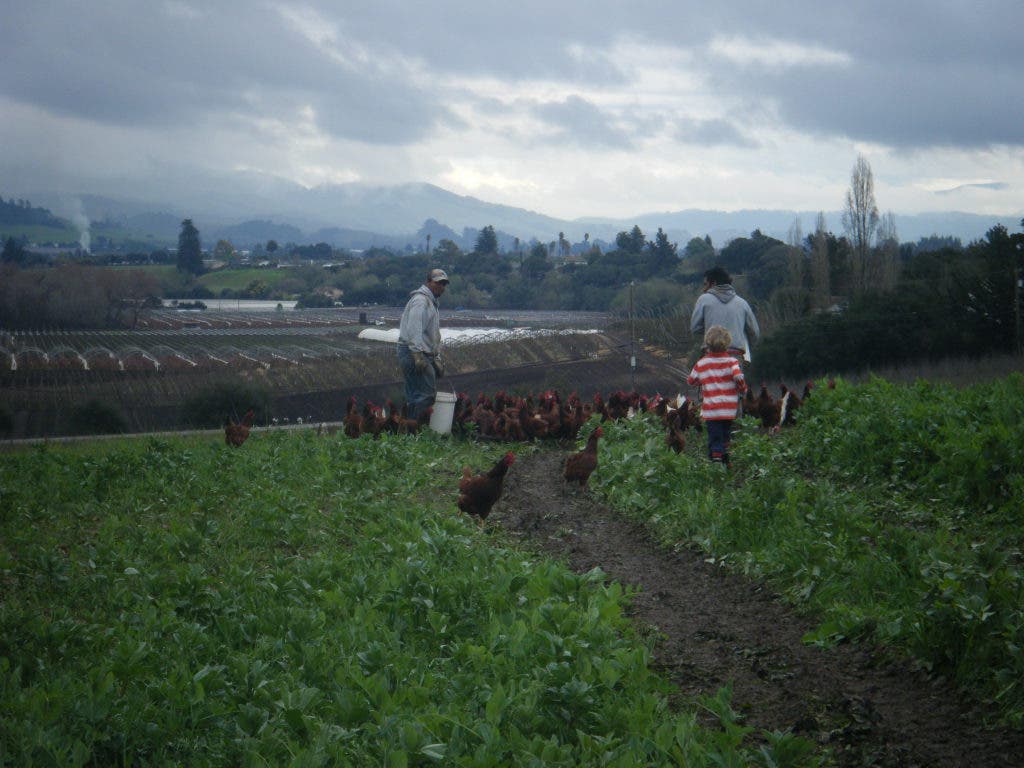
Vegetarians-turned-omnivores, Sarah and Aurelio Lopez, humanely raise and slaughter poultry for meat and eggs at Watsonville's Surfside Chickens.


Standing in front of the egg carton section of the grocery store can be like trying to read a foreign menu. What exactly is the best choice? What do all those labels, certifications and distinctions mean? What’s the difference between cage free and free range? Chicken and egg rearing terminology is confusing and can be misleading.
Pumping poultry with sodium, antibiotics and additives, beak cutting and forced molting via starvation are standard commercial poultry industry practices that even eggs with labels don’t guarantee against.
While buying free range, organic, cage free and certified humane may give purchasers a sense of fairness, labels don’t necessarily correlate to humane animal treatment or healthy eggs. Even if eggs look similar, the nutritional value can be disparate. According to the Mother Earth News egg testing project, pasture-raised eggs can have up to one-third less cholesterol, one-fourth less saturated fat, two-thirds more vitamin A, two times more omega-3 fatty acids, three times more vitamin E, and seven times more beta carotene than commercial eggs.
Find out what's happening in Watsonvillefor free with the latest updates from Patch.
Hoping to better inform consumers, Surfside Chickens’ owners Aurelio and Sarah Lopez discussed some of the dubiety present in egg purchasing. While state and federal regulating agencies have differing standards, poultry farmers must adhere to these definitions to obtain certification through the U.S. Department of Agriculture (USDA):
Organic
Find out what's happening in Watsonvillefor free with the latest updates from Patch.
According to Sarah, “certified organic eggs” mostly means the hens have been fed certified organic feed. The USDA organic seal can be placed on the packaging of eggs produced by certified organic poultry farmers. Organic feed doesn’t guarantee humane treatment of the birds.
Free Range
In order to label eggs free range or free roaming, the USDA requires that a producer “demonstrate that the poultry has been allowed access to the outdoors.” That access may only be available for a small amount of time each day, and no other criteria that ensure humane treatment is required. The range is not even required to have vegetation for the birds to feed.
Cage Free
Most U.S. egg-laying hens are confined in battery cages, leaving each bird the space of a piece of paper. California has banned the sale of eggs from out-of-state battery cages and phased out the use of the confining cages in state as of 2015.
While people may think that “cage free” chickens are completely unconfined, that is not the case. They are not raised in battery cages, but commercially raised cage free hens often do not have access to the outdoors. They may be kept in large warehouses or barns.
Pastured
Pastured is yet another term being used in the poultry industry, though not yet available as a certification. Pastured is more closely in line with what most people think “free range” indicates. In addition to eating grass and other greens on pasture, chickens eat bugs, rodents and frogs.
"It’s not a standard label as of yet, but it’s the most humane way to raise chickens," said Sarah.
A farmer who meets labeling standards must pay fees to become certified organic or free range. Thus, not all eligible farmers are certified.
While Surfside Chickens raises pastured chickens which are fed 100 percent organic feed, because of the expense of certification and the ambiguity inherent in labeling distinctions, the Lopez' have not become certified.
Surfside Chickens are raised in mobile, open-air housing, which is rotated regularly around the pasture. Constant access to fresh pasture allows for better nutrition and hygiene. Farming humanely is hard work and profit margins aren’t always large, but Sarah and Aurelio find great reward in it.
While Sarah appreciates the efficiency of large-scale farming, she also feels good about knowing everything on her plate comes from someone she knows. Having a “direct relationship with the people who eat what we grow and who grow what we eat, that feels good," she said.
Aurelio added that, “farming is a very hard occupation. Most people don’t want to work this hard. But, to be your own boss is something special and I always want to live this way.”