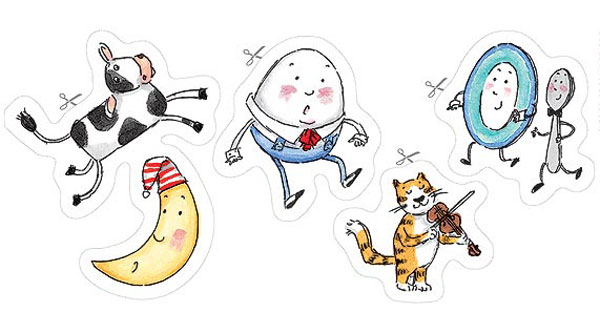
The old-fashioned nursery may be a relic of the past, but nursery rhymes are here to stay. They continue to be a regular part of our children’s lives through songs, finger plays and the reference to them in many stories of children’s literature. But, nursery rhymes are not just fun and games. Nursery rhymes are catchy and funny, yes, but they can also play a significant role in early literacy and they have historic roots that even the most distinguished scholar can appreciate. If you haven’t made the nursery rhyme part of your child’s life, it’s time to start!
There are many awesome and interesting facts about nursery rhymes, but here’s a few to inspire you to revisit your favorites.
1) Nursery rhymes are an ideal early literacy tool. Early literacy is not reading early, or forcing flashcards on kids. Early literacy is the introduction to words and literature concepts. Through centuries of honing, nursery rhymes deliver an early literacy product that would make a modern early childhood research lab proud. A combination of elements, including simple vocabulary, catchy rhymes, and use of alliteration, help to accelerate language and literacy development. They enrich vocabulary and increase phonemic awareness, and they effortlessly help children to internalize grammatical structure. Recent studies show that children who learn and memorize nursery rhymes become better readers.
Find out what's happening in Bethelfor free with the latest updates from Patch.
2) Nursery rhymes have a compelling history. The first important English rhyme dates back to the 14th century, at a time when most people were unable to read and write. Subversive messages were masked as child’s play in rhymes like “Baa, Baa Black Sheep” (about the wool tax) and “Mary, Mary Quite Contrary” (about Mary I and the reversal of the state religion). The Black Plague provided the origin for “Ring Around the Rosy” ending of course with “Ashes, ashes, we all fall down!”
3) Nursery rhymes exist in nearly every language and culture. Nursery rhymes create a context for children to understand their culture and the people, places and things that make up that culture. Children become immersed in the things that are important to those around them as these things are identified and repeated. References to food are a great example of how a nursery rhyme focuses on cultural fixtures. In Mexico, a favorite rhyme is “Tortillitas Para Mama.” The Italian “Tacci e taccin” is about making pasta, and England’s “Sing a Song of Sixpence” features the pie.
Find out what's happening in Bethelfor free with the latest updates from Patch.
4) Kids love nursery rhymes! Nursery rhymes are easy to love because they are fun. The history may be long forgotten, but the words, rhymes and stories remain compelling. With just a few short lines, nursery rhymes conjure vivid visual images; the words and images can be almost impossible to forget once they have been woven into the recesses of your memory. In fact, even if you have not recited a nursery rhyme in decades, odds are that you could rattle off “Jack and Jill,” “Jack Be Nimble,” “Humpty Dumpty” and many more without hesitation.
By sharing nursery rhymes, you will be having fun with your children, and so much more!
The Connecticut Early Childhood Alliance is a statewide advocacy organization working to ensure that all children are healthy, safe and ready for lifelong success. Visit us at earlychildhoodalliance.com, find us on Facebook at www.facebook.com/ctearlychildhoodalliance or follow us on Twitter at www.twitter.com/cteca. The Connecticut Early Childhood Alliance is supported by the William Caspar Graustein Memorial Fund, the Fairfield County Community Foundation and our member organizations.