Business & Tech
How Sweet It Is
Maple syrup production is in full swing in Connecticut and at local "sugar shacks."




The telltale blue plastic bags of a maple sugar operation start showing up more than a half-mile from Rick Walker’s home in a woodsy area of East Hampton.
Affixed to taps in about a dozen maple trees that line a short section of South Main Street the clear tap flowing into the bags will soon be harvested by Walker during a process he calls “the gathering.” He’ll then spend hours, sometimes 24 in a row, boiling the sap to make rich maple syrup and other maple products he sells at his business, “Rick’s Sugar Shack.”
This is the high season for maple sugaring in Connecticut and the South Main Street trees are among some 250 maples around town that Walker has tapped, with permission from their owners, as part of this year’s harvest.
Find out what's happening in East Hampton-Portlandfor free with the latest updates from Patch.
And after last year’s “devastating” maple season, when there were few really cold nights, Walker says he’s looking forward to a much stronger season this year.
The weather has mostly cooperated for this season to be a good one, he adds. The nights are still plenty cold, but daytime temperatures can shoot into the 40s and even 50s. Those are exactly the conditions needed for maple sap to flow. The trees “lock up,” during the night, Walker explains, but as they warm during the day they send their sap from the roots up into the trees to signal that spring is approaching.
Find out what's happening in East Hampton-Portlandfor free with the latest updates from Patch.
That’s the prime time for maple sugar producers like Walker to tap into maple trees.
These days there’s a flurry of activity at “Rick’s Sugar Shack” as Walker, his wife Jill and thier nephew Jason Porter, not only prepare their maple products but also get ready for an annual open house Walker and his family will host at his 69 Collie Brook Road home business this Saturday, from 9 a.m. to 3 p.m.
Throughout the day he and others in his family will give guided tours of his maple sugar operation, including the inner workings inside the “sugar shack,” to show how syrup is made.
Last year’s open house attracted hundreds of visitors, Walker says.
His is one of dozens of maple sugar operations in Connecticut that are gearing up right now for the season, including the Durham Sugarhouse, run by the Hassmann Family on Burwell Newton Drive in Durham, Bureau’s Sugarhouse in Old Lyme, which specializes in maple kettle corn, and the Brooksvale Park Sugar Shack in Hamden.
There’s also the much-anticipated Annual Hebron Maple Festival, which will be held March 12 and 13 this year. Visitors throughout both weekend days can take self-guided tours of several local sugarhouses, including Wenzel, Woody Acres, Winding Brook and Pierce, see maple syrup being made and enjoy maple-related treats.
Walker, who grew up in New Hampshire and worked for maple sugar producers there in his youth, has been making his own maple products from Connecticut sap for about 18 years. His sugar shack, located behind his home, started out as a small operation when he started making his own maple syrup. He later built a little shack to house the wood-fired stove and boiling equipment that he bought to bottle his own syrup.
Friends encouraged him to build a bigger shack to accommodate his ever-growing supply of maple products and today the shack is actually two small buildings – one that houses the wood-burning sap boiling apparatus, the other houses the production equipment to test and bottle the finished syrup. An attached structure holds the dozens of cord of wood needed each season to keep the woodstove going. Another small building nearby houses the retail store, open weekends from 10 a.m. to 3 p.m.
Over the next few weeks, after gathering sap during the day and into the night sometimes, Walker and his nephew stoke up the fire in the morning and get the sap boiling. It flows into the sugar house through a large storage container on the shack’s roof.
During the process sap, which looks like water, trickles from a pipe into a large metal container that sits atop the woodstove. It boils at about 213 degrees, evaporating out water and leaving behind an amberish liquid.
During the process steam flows through the small room, warming its interior and imbuing it with a soft, sugary smell.
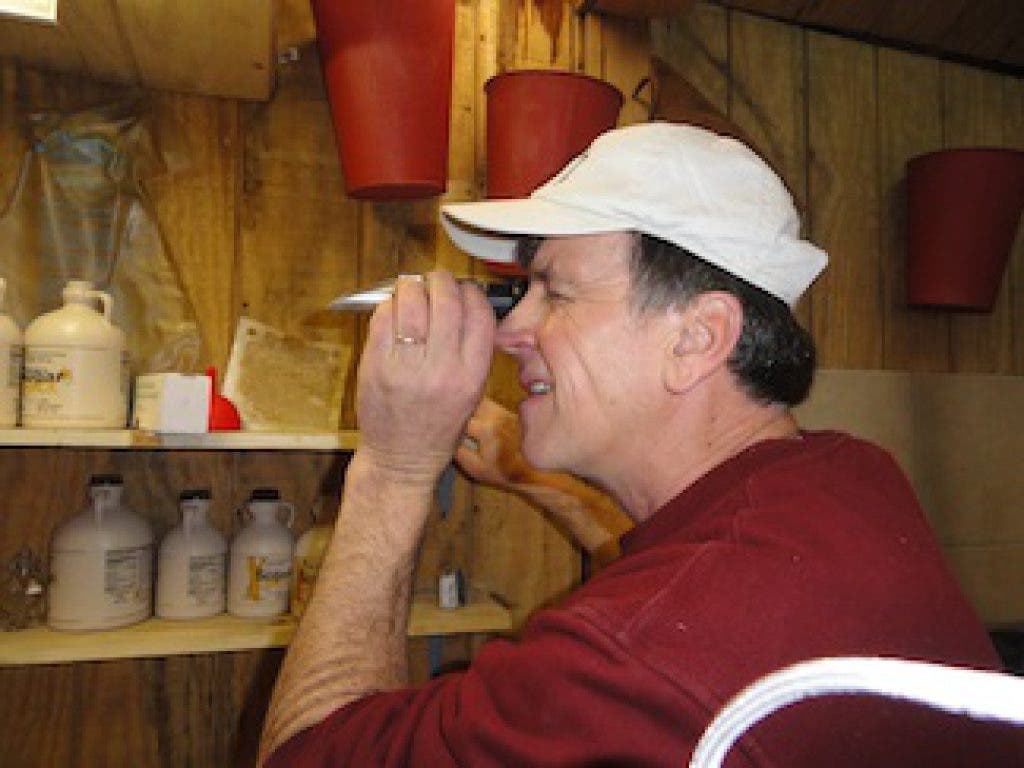
From there the sap product, which is not quite syrup yet, is drained out of the metal box, into a plastic bucket and brought into a room next door. There it’s poured into another metal container where it is boiled again for a time and then tested for the amount of rendered sugar.
Once the sugar level reaches a certain level, ideally 35-40 percent, syrup is achieved and the product is then sent through a filtration system and bottled.
The process is a lengthy, costly and exacting one, Walker says. It takes about 40 gallons of sap to make one gallon of syrup.
While this year’s cold weather is good for producing lots of sap, the heavy snowfalls have impeded the gathering process, he adds.
“There’s just way too much snow to get through,” he says.
Still, Walker’s hoping to produce between 150-188 gallons of syrup this year. Last winter, which was too warm for maple trees to make adequate sap, he produced less than 90 gallons.
“Everyone in Connecticut was devastated last year,” he says. “I’m hoping we’ll have a longer season this year.”
Like us on Facebook (facebook.com/KDMPatch) and follow us on Twitter (twitter.com/KillngwrthPatch)
Get more local news delivered straight to your inbox. Sign up for free Patch newsletters and alerts.