Politics & Government
Fairfield Candidates Clash On Contamination Crisis During Debate
First Selectman Mike Tetreau defended the steps he's taken amid the controversy, while challenger Brenda Kupchick went on the offensive.


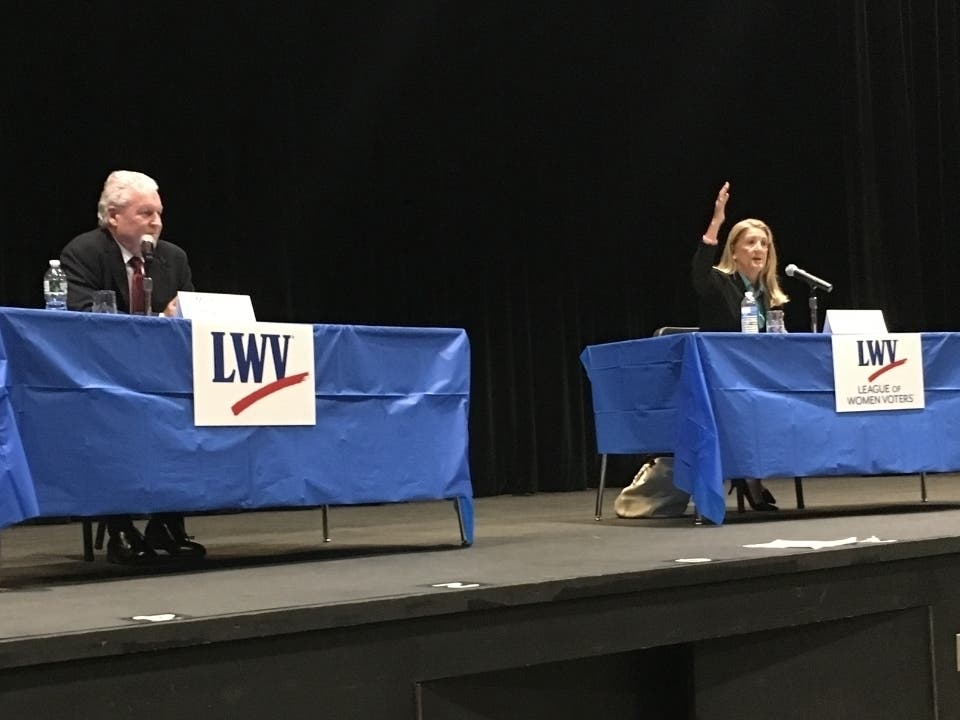
FAIRFIELD, CT — It was no surprise that Fairfield's first selectman debate began with a question about the topic that has dominated headlines, public meetings and conversations in town for months: The arrest of Fairfield employees charged with dumping at the public works yard and related discovery of contaminants in local schools and parks.
When asked what the community can learn from the contamination controversy, incumbent First Selectman Mike Tetreau, a Democrat, defended the steps he's taken amid the crisis, while challenger state Rep. Brenda Kupchick, a Republican representing District 132, went on the offensive.
"The charter was violated repeatedly," Kupchick said, arguing the town had the necessary controls in place to prevent the alleged abuses of power, but the proper processes weren't followed.
Find out what's happening in Fairfieldfor free with the latest updates from Patch.
A request for proposal from Julian Development — the contractor managing the fill pile at the public works yard when the dumping occurred — lacked details and numbers, she said, and was not brought before the Board of Selectmen. Julian filed four fraudulent bonds, according to Kupchick, and their validity went unchecked.
"These are simple things that need to be done and should have been done," she said.
Find out what's happening in Fairfieldfor free with the latest updates from Patch.
Town attorneys have confirmed Julian's request for proposal has standing as a contract, Tetreau said, and specifics in the Town Charter about contracts appearing before the Board of Selectmen have not been treated as protocol for decades.
Tetreau defended his response after charges were brought against the public works director, the public works superintendent and a Julian Companies owner. He referenced the recent creation of a whistleblower hotline and said he intends to ask the Ethics Commission to review Fairfield's ethics policy and address improving training for employees. The Board of Finance has set up an audit group related to the fill pile and the Representative Town Meeting has discussed hiring an independent consultant to review the matter, he said.
The debate was hosted Wednesday by the town's chapter of the League of Women Voters in front of an enthusiastic crowd at Fairfield Woods Middle School. A second debate between selectman candidates Republican Tom Flynn and Democrat Nancy Lefkowitz was not held after Flynn was unable to attend due to an injury.
Although Tetreau and Kupchick are running for first selectman, either could end up serving as a selectman. Whichever first selectman candidate gets fewer votes is then in the running to become a selectman, along with Flynn and Lefkowitz. Of those three candidates, the top two vote-getters are named selectmen. The election is Nov. 5. Outgoing Republican Selectmen Chris Tymniak and Ed Bateson are not seeking reelection.
Newport Academy and 8-30g
In response to a question Wednesday about how to prevent corporations from running for-profit enterprises in residential zones, the candidates were divided. The question was related to Newport Academy's effort to establish a live-in treatment facility for young adults in Greenfield Hill. A large trailer parked directly outside the debate location read, "No Newport Academy in Fairfield residential zones."
Tetreau said companies using a group home or medical clause in state statutes can override town regulations for building permits and noted that the Zoning Board of Appeals reviewed the permits granted to Newport Academy and ruled they were appropriate.
"I'm really upset that the state just can come in and let that happen," Tetreau said.
A group of Greenfield Hill residents have plans to take the Newport Academy permit issue to court and have argued the company applied for building permits as a group home when it actually intends to open a medical facility. The neighbors feel there is an important distinction between the two categories.
Kupchick said the state statute is unclear about the difference between group homes and medical facilities, and the zoning department shouldn't have granted the permits under the assumption Newport Academy would build a group home when that's not what the company is proposing.
When asked about zoning regulations and overdevelopment in Fairfield, Kupchick said the town's approach to building has not been strategic and the state law 8-30g has put Fairfield in a position where it is subject to predatory developers pursuing projects that are not in character with neighborhoods.
Under 8-30g, towns where less than 10 percent of housing stock meets state affordability criteria must approve certain residential developments unless it is proven a project warrants zoning denial because it poses a threat to public health, welfare and safety that outweighs Fairfield's need for affordable housing.
"We do have an issue in terms of providing for affordable housing," Tetreau said, adding the town must be welcoming but integrate developments properly, putting them near mass transit and in walkable areas.
During closing statements, Kupchick discussed her time as a member of the Representative Town Meeting, the Board of Education and the General Assembly, as well as her roots in Fairfield and experience as a business owner.
Tetreau offered statistics about the town by way of his credentials, noting Fairfield has a 90 percent commercial occupancy rate and despite cuts to state aid, town schools are fully funded, with 65 cents of every tax dollar going to education.
Get more local news delivered straight to your inbox. Sign up for free Patch newsletters and alerts.