Neighbor News
He Rewrote Thanksgiving. Now He's Reframing the Revolution.
Passamaquoddy author Christopher Newell returned to Stanley-Whitman House with his new Scholastic book and brought a fuller story.

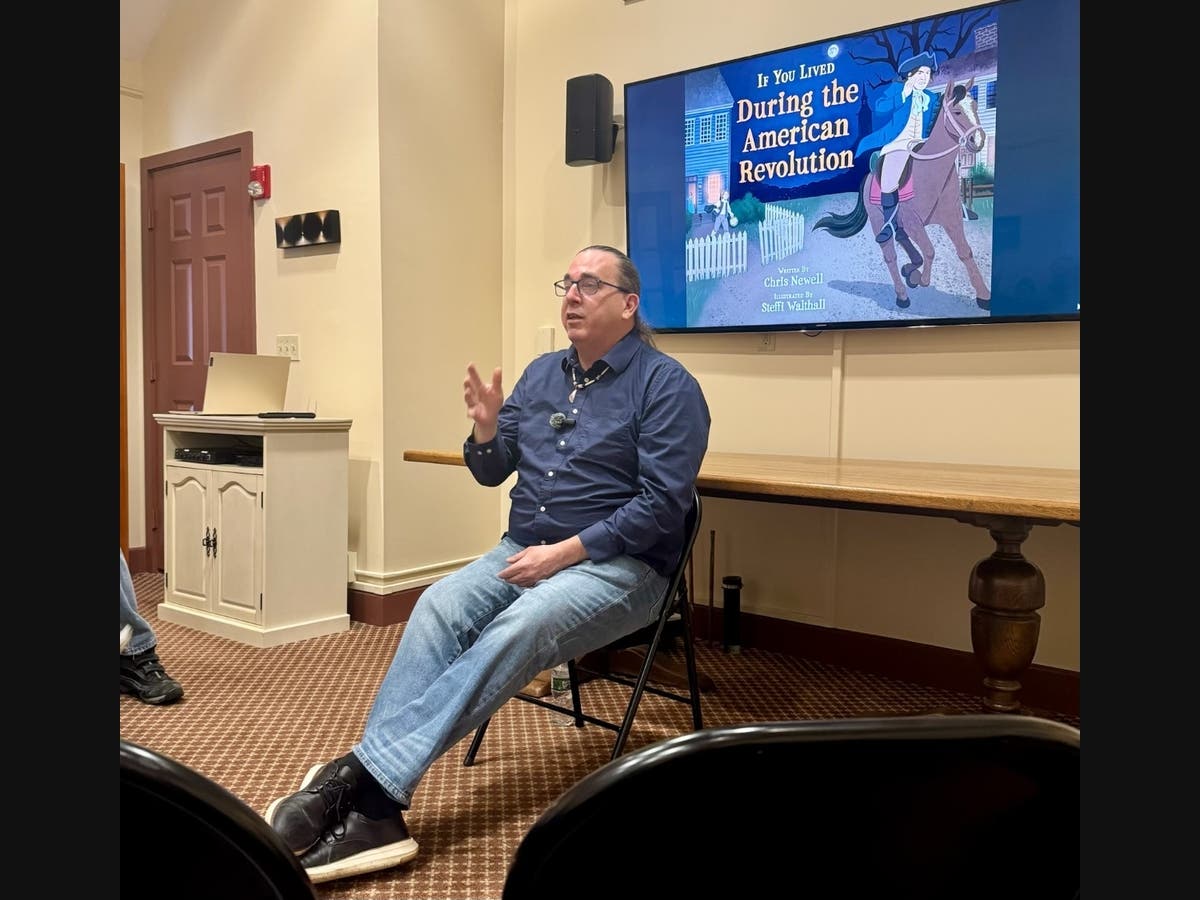

A nor'easter was gathering outside when Christopher Newell began to speak, and the crowd that had come to Stanley-Whitman House on that February afternoon stayed anyway. That is worth noting. Not because bad weather is unusual in Connecticut in February, but because what Newell had come to say was the kind of thing people drive through storms for, when they sense, even before it begins, that they are going to leave thinking differently than when they arrived. By the time the Q&A wound down ninety minutes later, that sense had been confirmed. The room was quieter than it had been at the start, the particular quiet of people turning something over.
Newell is a citizen of the Passamaquoddy Tribe, director of the Native American Culture Program at the University of Connecticut, co-founder of Akomawt Educational Initiative, and the first Wabanaki executive director of the Abbe Museum, Maine's only Smithsonian affiliate. He holds faculty and graduate faculty appointments at UConn despite having only a bachelor's degree. "They do recognize my indigenous knowledge," he told the audience, without apology or particular emphasis. It was the first of many moments in the afternoon where the contrast between institutional credentialing and the authority that comes from living inside a history made itself quietly felt.
He was here to present his new Scholastic book, If You Lived During the Time of the American Revolution, the second in what has become a meaningful and ongoing relationship between Newell and the If You Lived series, and the second time Stanley-Whitman House has been the first museum to host a public program for one of his books. The first, If You Lived During the Plimoth Thanksgiving, earned starred reviews from both School Library Journal and Kirkus Reviews, both of which called it "essential," along with the endorsement of the National Indian Education Association. That book is now regularly assigned in college classrooms. This one, aimed at second through fifth graders, is likely to travel a similar distance.
Find out what's happening in Farmingtonfor free with the latest updates from Patch.
A Kitchen Table in Indian Township, Maine
Before Newell opened the book, he opened something else: the story of where his understanding of history actually comes from. He was born in 1974 at Indian Township, Maine, one of two Passamaquoddy communities in the state, located in what the tribe calls Downeast Maine, close to the Canadian border, the easternmost tribe in the United States. That was the same year his family moved into a house with electricity and running water. His father, Wayne Newell, had grown up in tar paper shacks, learned Passamaquoddy before he learned English, and inserted himself into the Catholic school on the reservation at age ten because he understood, even then, that literacy in English was going to be necessary for survival in the world the colonizers had built around him.
Find out what's happening in Farmingtonfor free with the latest updates from Patch.
"My generation is the first generation to grow up speaking English language first," Newell said. His father spent much of his life working to reverse that, building tools for language preservation, trying to ensure that Passamaquoddy children would grow up with their language again. At the kitchen table, he told history the way a Passamaquoddy citizen tells it, from the inside, looking out at the forces that had shaped his people's lives, not from the outside looking in at a textbook version of events.
That upbringing is not incidental to Newell's work. It is the work. When he says he approaches history from a perspective that is "a tiny bit more objective," he does not mean disengaged. He means that he was raised to see himself as a Passamaquoddy citizen first and a United States citizen second, a distinction that is not rhetorical but historical. US citizenship for Native peoples did not arrive until 1924. His grandmother was not born with it. She was given it later, without being asked.
Where the Revolution Actually Begins
Most tellings of the American Revolution begin with the Stamp Act, or the Boston Tea Party, or the shot heard round the world. Newell begins with the Seven Years War, the global conflict that ended in 1763, left Britain deeply in debt, and fundamentally changed how the Crown treated its American colonies in the decade that followed. He credits historian Ned Blackhawk's The Rediscovery of America, a National Book Award winner, for crystallizing that framing, and he brings it into language a ten-year-old can follow.
The logic is straightforward once someone says it plainly. Britain's war debt drove the new taxation policies. The Proclamation Line of 1763, which barred colonial expansion beyond the Appalachian Mountains, was designed to prevent another costly conflict with Native nations to the west. And that barrier, that interruption of the colonists' plans for westward expansion onto Native land, was among the genuine grievances that drove the rebellion. "You cannot understand why the colonists went to war without understanding what the British were stopping them from doing," Newell said. "And what they were being stopped from doing was taking Native land."
This is the kind of reframing that sounds simple once someone says it plainly, and that you then cannot unhear. The Revolution was not only a principled stand for liberty. It was also, in part, a land-grab war, with the British as the obstacle.
The Bones of the Revolution and What Surrounds Them
The If You Lived series has been published by Scholastic since the 1970s, structured as a question-and-answer resource, a table of contents made of questions, each answered in a short passage, designed to be dipped into rather than read front to back. Newell was the first author invited to rewrite one of the original volumes. His editor was so embarrassed by the 1970s version she would not even send him a copy as reference. He was contracted for 8,500 words. His first draft came in at 15,000. They edited together until they had an 88-page book that Newell describes not as a narrative to be read through but as a resource to be reached for, the kind of book a child picks up when they have a question, not when they have been told what to think.
What that book contains is the familiar architecture of the Revolution, and then the rooms most textbooks seal off. The Sugar Act is in there. So is the Stamp Act, the Boston Massacre, and Paul Revere's ride, the last of which Newell originally left out of his draft entirely, only to have Scholastic ask him to add it back. "He made it onto the cover," Newell said with a wry smile. "That wasn't my choice either." His editor at Scholastic, Katie Hite, has been, in his words, "a soldier" for ensuring his perspective survives the editing process intact. They don't say no to him. That matters, because what Newell puts in the unsealed rooms is not comfortable.
Crispus Attucks, the first person killed in the Boston Massacre, is a name many people know. What fewer know is that he was a mixed-race man, the child of an enslaved father and a Native Praying Indian mother. And Paul Revere's famous engraving of the event was deliberate propaganda: colonists depicted as defenseless gentlemen, British soldiers as brutal aggressors. "It was a rallying cry," Newell said. "And it worked. But it was not a neutral account."
On enslaved people, he discussed Lord Dunmore's 1775 Proclamation, in which the last royal British governor of Virginia offered freedom to enslaved and indentured people willing to bear arms for the Crown, an act of military desperation, but one that recruited Black soldiers by the hundreds. Meanwhile, as many as 5,000 Black Patriots fought for the Continental Army. Some remained enslaved after the war ended. "Both sides continued to enslave people who would not fight," he said. "Freedom was conditional, and it was not guaranteed even for those who earned it."
On Native nations, he read aloud from a letter George Washington sent to Passamaquoddy chiefs in December 1776, a warning that tribes who refused to help the American cause would be treated as enemies, with the destruction already visited upon the Cherokee offered as evidence of what that meant. "For those who did help," Newell said, "all promises, including payments, were broken by the United States government and its first president." He paused. "Spicy," he added. The room laughed, and then went quiet again.
The Town Destroyer
The Q&A extended the conversation into territory the book touches but the afternoon had not yet reached. Someone asked about George Washington's relationship with Ohio River Valley tribes. Newell's answer landed with audible weight. Washington had adopted his grandfather's name among those nations, The Town Destroyer, and personally led raids to depopulate Native-occupied territories west of the Appalachians. "He announced himself to the tribes by that name," Newell said. "That is not in most history books."
It is in this one. That is the point of this one.
A teacher in the audience noted she works in a high school and wondered about the reach of a book aimed at second through fifth graders. Newell reminded the room that his Plimoth Thanksgiving book is now regularly assigned to college students. "For a lot of people," he said, "the information in my book is the first time they're reading it, even as adults. That's not their fault. The system was made to erase Native peoples out of history."
Language as the Ownership Manual
One of the afternoon's most unexpected passages came when Newell discussed the relationship between the English language and the English conception of land. In Passamaquoddy, he explained, the word for soil, dupuan, translates roughly as "the molecules of our ancestors." There is no real equivalent in English. In English, "dirty" is an insult. The word carries a negative weight that simply does not exist in Passamaquoddy, where what the English call dirt is understood as the substance of the life cycle, the material that connects the living to those who came before.
When he was writing the Plimoth Thanksgiving book, a copy editor pushed back on his claim that American life today more closely resembles England than it does the cultures that preceded colonization. The argument went back and forth in editorial comments until Newell ended it with a question: "What language do we speak?" The copy editor had no response. "We speak a foreign language in this country," Newell told the Farmington audience. "Algonquin languages, the languages of this coastline, those are the ownership manual of how this land should be stewarded. The concepts of land as commodity, of stripping resources without thought for the future: those came over with English."
Beyond the Books
When someone in the audience asked what Newell was working on next, he laughed and said he was looking forward to taking a breath. The American Revolution book had taken years to get where he wanted it. But the breath, it turned out, would be relative. He spent the past year co-curating a performance with cellist Yo-Yo Ma, a collaboration that moved between Indigenous music and classical repertoire. He works full-time at UConn. And he is helping lead what could be the most consequential development in Native higher education in this region in generations.
UConn is working to convert its Avery Point campus into a Native-serving institution, the first of its kind in the Northeast. There are no tribal colleges east of the Mississippi. The gap is not incidental; it is a direct consequence of the same history Newell spent the afternoon describing, the displacement, the broken promises, the systematic removal of Native peoples from the institutions that shape a society. "UConn of all places," Newell said, and the pleasure in his voice at the institutional irony was unmistakable. "But there's a lot of positive things happening there right now."
He has been part of Connecticut's Native community since the mid-1990s, when he came south from Maine to sing with the Mystic River Singers, based at Mashantucket, and ended up married, with children, and rooted. He knows this landscape the way the afternoon's conversation suggests he knows all landscapes, as a place with a history that did not begin when the English arrived, and has not ended yet.
A Relationship, Not a Booking
This was not Christopher Newell's first program with Stanley-Whitman House. In November 2021, still in the shadow of the pandemic, he joined the museum's Conversation Club virtually to present If You Lived During the Plimoth Thanksgiving, the first public museum event for that book. He returned in February 2026 in person, with If You Lived During the Time of the American Revolution, to a room full of people who had driven through a nor'easter to be there. The difference between those two programs says something about how much has changed, and the fact that he keeps coming back says something about why it matters.
Stanley-Whitman House's Farmington250 initiative uses the Semiquincentennial as exactly that kind of inquiry. Over the coming months, the museum will continue to explore the Revolutionary era through programs that refuse the simplified version, not to diminish what was built in 1776, but to reckon honestly with who built it, who was excluded from it, and what work remains.
Newell ended the afternoon with his book's conclusion, which holds the contradiction without resolving it falsely. "We can accept the truth that this country was built on great things like the ideas of liberty and freedom, but also relied on an abomination such as the forced labor of enslaved peoples and the conquering of land occupied by indigenous peoples. The United States continues to grow and improve. We are not a perfect union. However, we can continue to strive to be more perfect, the promise the United States was built on."
Outside, the nor'easter had arrived in earnest. Inside, people were still asking questions.
Watch the full program: https://youtu.be/gvMAwDqirw0
Copies of If You Lived During the Time of the American Revolution and If You Lived During the Plimoth Thanksgiving are available at the Stanley-Whitman House museum shop at 37 High Street, Farmington.
Stanley-Whitman House is a National Historic Landmark at 37 High Street in Farmington, CT. For upcoming Farmington250 programs and events, visit s-wh.org.