Neighbor News
Music, Memoir, and a Message: Gaelynn Lea Returns to the Stanley-Whitman House
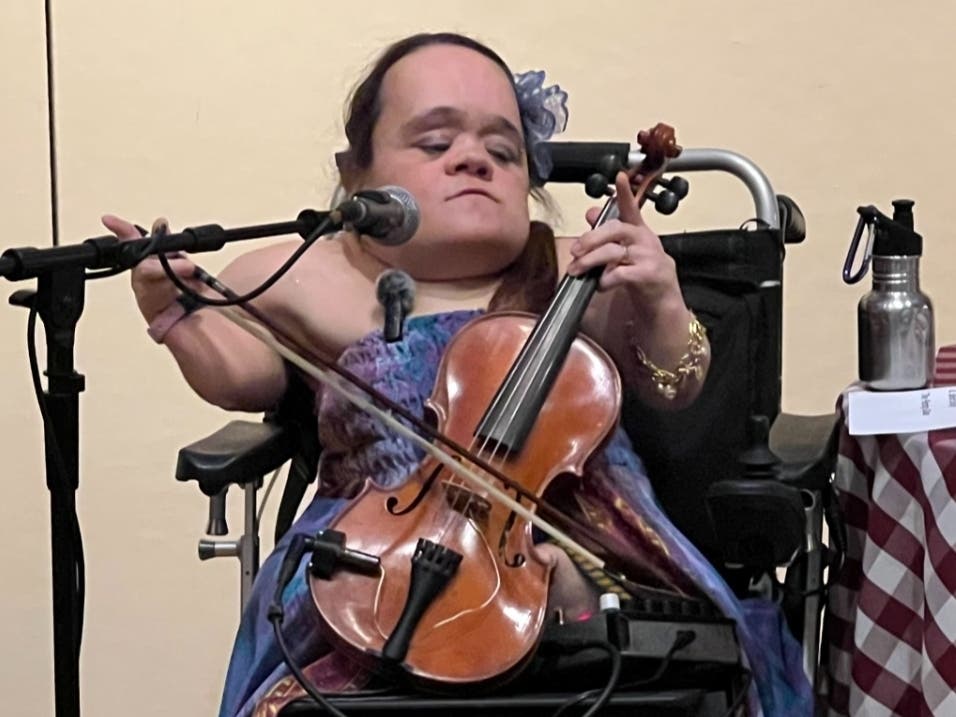
Violinist and disability rights advocate Gaelynn Lea celebrated her debut memoir at Farmington's historic Stanley-Whitman House on April 19.

By the Stanley-Whitman House|April 19, 2026
On the evening of April 19, violinist and songwriter Gaelynn Lea returned to the Stanley-Whitman House in Farmington for the third time, and this time she came with a book. Her debut memoir, It Wasn’t Meant to Be Perfect, published by Algonquin Books on April 14, 2026, had arrived in the world just five days earlier, days after a feature in People magazine on her thirteen-year interabled marriage and the disability stereotypes her life quietly dismantles. The Whitman Tavern in the museum’s history center provided an intimate and resonant setting for an evening that wove together conversation, advocacy, and live music. The full program is available to watch online.
Watch the full program: https://youtu.be/cQ6YCs1fjwo
Find out what's happening in Farmingtonfor free with the latest updates from Patch.
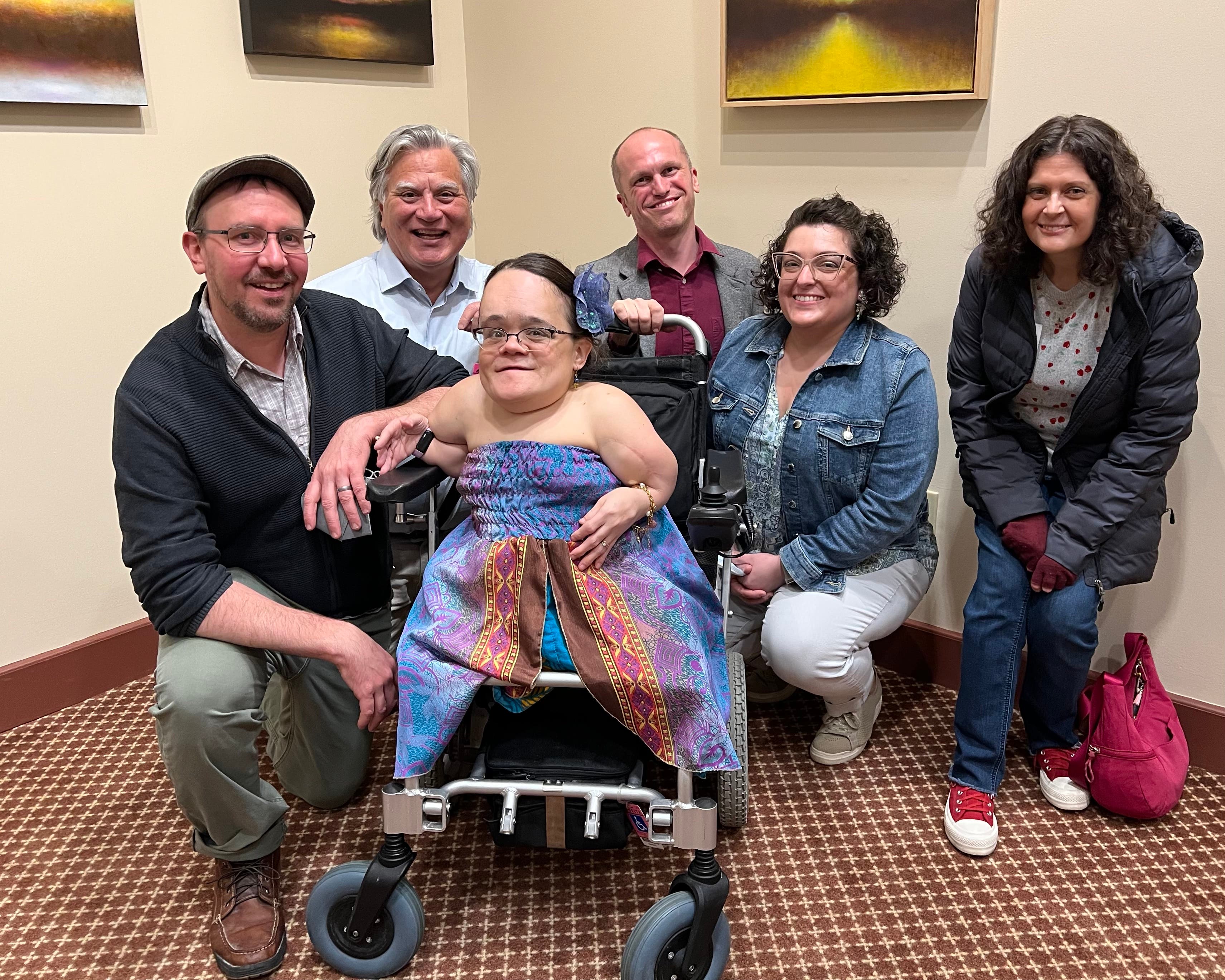
Gaelynn Lea first performed at Stanley-Whitman House in 2018, returned in 2019 when she mentioned she was at work on a memoir, and came back in 2026 with that book finally in hand. The evening was made possible in part by the generosity of Helen and Catherine Michanczyk, life members of the museum. Gaelynn Lea was joined in conversation by Andres Verzosa, Executive Director and Curator of the Stanley-Whitman House, who has programmed all three of her visits as part of the Music in the Tavern Series.
Things started, characteristically, in motion. Gaelynn Lea arrived in her travel wheelchair, which she uses for flying, and it had other ideas. "This is what makes live music live," Verzosa said as she sorted herself out. "Right," she agreed. "Everything goes wrong." It was a fitting opening for an evening whose central argument is that imperfection, handled with honesty, is exactly the point.
Find out what's happening in Farmingtonfor free with the latest updates from Patch.
A Duluth, Minnesota-based musician who rose to national attention after winning NPR’s Tiny Desk Contest in 2016, Gaelynn Lea has become known not only for her looping-pedal violin performances and songwriting, but for her unflinching advocacy on behalf of people with disabilities. Born with osteogenesis imperfecta, a condition sometimes described as brittle bone disease, she plays the violin in an unconventional position and performs from a wheelchair, and has hearing loss in her left ear that she manages with a hearing aid. She has composed the original score for Sam Gold’s 2022 Broadway production of Macbeth, with the album Music From Macbeth released in May 2025; collaborated with Michael Stipe on "Give Me A Hand," a 2023 Earth Day release for Brian Eno’s EarthPercent charity that features on the emerging body of Stipe’s solo work; co-founded RAMPD, the Recording Artists and Music Professionals with Disabilities organization; and in 2024 was named a Disability Futures Fellow by the Ford and Mellon Foundations. That evening she was accompanied by her husband Paul, her constant touring partner and personal care attendant, and by ASL interpreter Joy Valenti, a detail Gaelynn Lea noted with visible appreciation.
The Pandemic Years: Innovation Under Pressure
The book’s long gestation runs directly through the pandemic years. Gaelynn Lea had expected to finish the memoir by 2022; it arrived in 2026. She described those years as a time of contradiction, stressful and generative at once. Disabled people were disproportionately impacted by COVID-19, and she worked hard to secure a mask mandate in her hometown. At the same time, she ran an online concert series for 18 months, every Sunday, with a different guest each week, including Jeff Tweedy of Wilco performing from his living room. She scored Macbeth remotely with a careful engineer before traveling to New York under heavy COVID protocols. She took cooking classes online with her parents through the New Orleans Culinary and Hospitality Institute, 50 people gathered in their own kitchens in Zoom boxes. And she finally began writing the book in earnest. "You are holding beauty and pain in the same moment," she said of the period. "That is a big part of what the pandemic feels like."
A Memoir as a Disability "Sneak Attack"
Gaelynn Lea described the memoir’s strategy with characteristic directness: she wanted it to be a "disability sneak attack." The idea was simple. Invite readers in through music, and let them absorb something larger along the way. "I did not want the memoir to only be read by people who already cared about disability," she said. "We have done ourselves a real disservice in America by not teaching about disability in schools."
The book opens with the Tiny Desk win, then moves back to childhood before sweeping forward again, organized not by strict chronology but by theme: access, adaptation, creativity, and what it means to move through the world in a body the world was not designed for. It also covers her songwriting origin story. Gaelynn Lea did not begin writing her own songs until 17 years into her musical life. A substantial portion of the book traces the long arc of learning to use a looping pedal not as a workaround for her disability, but as a genuine extension of her artistic voice.
One passage drew an unexpected personal response from Verzosa: a section about how Gaelynn Lea’s father would call out melodic phrases in the car when she was three or four years old, asking her to sing them back, each one harder than the last, the two of them trying to stump each other. "I did that too," Verzosa said. "My dad was a person who sang a lot." Gaelynn Lea turned the question back on him immediately: "Wait, how did you resonate with that piece?" It was a small moment, but characteristic of how the evening moved, less interview than genuine exchange.
Standing on the Shoulders of Judy Heumann
One of the evening’s most moving passages came when Gaelynn Lea spoke about disability rights activist Judy Heumann, who died in 2023. Heumann is widely credited as a foundational figure in the American disability rights movement, and the tribute Gaelynn Lea offered was both personal and historical.
"I did not learn about the 504 sit-in until I was in my 30s," Gaelynn Lea said. "I graduated college and never heard about it." The 1977 Section 504 protest, in which roughly 150 disabled activists occupied a San Francisco federal building for 24 days to force the signing of civil rights protections, is widely considered the birth of the modern disability rights movement and a direct precursor to the Americans with Disabilities Act. Gaelynn Lea urged the audience to watch the documentary Crip Camp, noting that the story of solidarity it tells, with the Black Panthers supplying food and labor unions and LGBTQ organizations lending support, is one every American deserves to know.
Gaelynn Lea described meeting Heumann at the State Department in 2017 or 2018, sharing lunch and talking about how far the culture had shifted and how far it still had to go. After Macbeth opened on Broadway, Heumann called Gaelynn Lea from the cab ride home simply to say she had loved it. Gaelynn Lea reflected that theater, not disability advocacy, had been Heumann’s true passion, and that a more accessible world might have taken her life in an entirely different direction. Heumann’s practical counsel was clear: do not refuse to play anywhere that is not perfectly accessible, but never stop fighting for better. "She was extremely firm," Gaelynn Lea said, "but she never treated people without humanity."
A Timely Urgency: Medicaid and Independent Living
Before performing her song "I Wait," written during an earlier Congressional debate over Medicaid cuts and still urgently relevant, Gaelynn Lea addressed what she called a returning crisis. She was unambiguous: proposed federal Medicaid reductions will cause real harm to real people, and the harm is not abstract.
"It is not just doctor’s appointments and wheelchairs and surgeries," she said. "It is personal care attendance. It is the difference between living in your home and living in an institution." She asked the audience directly to contact their state legislators, noting that with federal funding cuts the pressure will increasingly fall on states to preserve Medicaid, and that what is at stake is not healthcare in a narrow sense, but independence, creativity, and the basic capacity to participate in civic life. "Someone like me," she said quietly, "without someone like Paul or family, would need to live in an institution."
It Wasn’t Meant to Be Perfect
The memoir’s title is also its thesis. Gaelynn Lea recounted a formative moment after the Tiny Desk win, when Bob Boilen, co-creator of NPR’s Tiny Desk Concerts, longtime host of All Songs Considered, and now retired after 35 years at NPR, watched her push through a mistake onstage rather than stop and restart, then gently suggested she consider the alternative. A live show where something goes wrong, he told her, can be more memorable than a perfect one.
For a classically trained musician who had absorbed years of pressure toward flawless execution, it was a revelation that still requires daily practice. "You always have to keep bringing yourself back into the present," she said. "It is like a meditation. You just keep recentering and recentering." The goal, she argued, is not the abandonment of standards but the replacement of perfection with integrity as the compass: something more durable, more honest, and more forgiving of the inevitable stumbles that make a life, and a performance, genuinely human.
Responsibility to the Audience
Gaelynn Lea spoke directly about what she owes her audiences. In 2018 she made a firm decision to stop accepting bookings at inaccessible venues, a long time coming after hundreds of shows where she could not get in or move freely. When her booking agent continued placing her in inaccessible spaces, she eventually took control of her own bookings and began seeking out welcoming venues herself. She also named ASL interpretation as a goal at every event, not just selected ones. "I do not know if anyone is using it tonight," she said of Joy Valenti’s presence, "but it means a lot to me."
The other dimension of her responsibility, she said, is simply to get out of the way of the music. "You are kind of just a conduit for it," she said. "You can have what feels like a terrible show and somebody says, ‘I really needed to hear that.’ The music is just bigger than us."
Trusting the Ripple
Gaelynn Lea closed the conversation reflecting on what she calls "trusting the ripple," the final chapter of her memoir. Back at the Stanley-Whitman House for a third time, book finally in hand, she offered something simple: the relationships built with integrity last, and there are friends everywhere in the world waiting to be found. Her book tour team had suggested Farmington was out of the way. She had insisted on coming anyway.
The concert that followed featured songs from across her catalog, including the Tiny Desk-winning "Someday We'll Linger in the Sun," music from her Macbeth score, a rousing audience singalong on "Bird Song," written with Alan Sparhawk of the band Low, and a closing rendition of "The Parting Blast," a traditional Scottish and Irish tune she described as a song for the end of things: funerals, celebrations, the close of a long evening. She noted with satisfaction that Connecticut, unlike North Dakota, is a state that sings along. Later this fall, Gaelynn Lea will tour with Wheelchair Sports Camp, a hip-hop artist with the same disability, a collaboration she described with evident excitement.
It Wasn’t Meant to Be Perfect is available now from Algonquin Books. For Gaelynn Lea’s music, tour dates, and resources on disability advocacy, visit violinscratches.com.
Watch the recording of the conversation and concert:
The Stanley-Whitman House is a National Historic Landmark and living-history museum at 37 High Street in Farmington, CT, dedicated to collecting, preserving, and interpreting the history and culture of 17th- through 19th-century Farmington. For upcoming programs and events, visit s-wh.org.