Neighbor News
What a Glorious Crash They Made: Connecticut's Revolutionary Music at Stanley-Whitman House
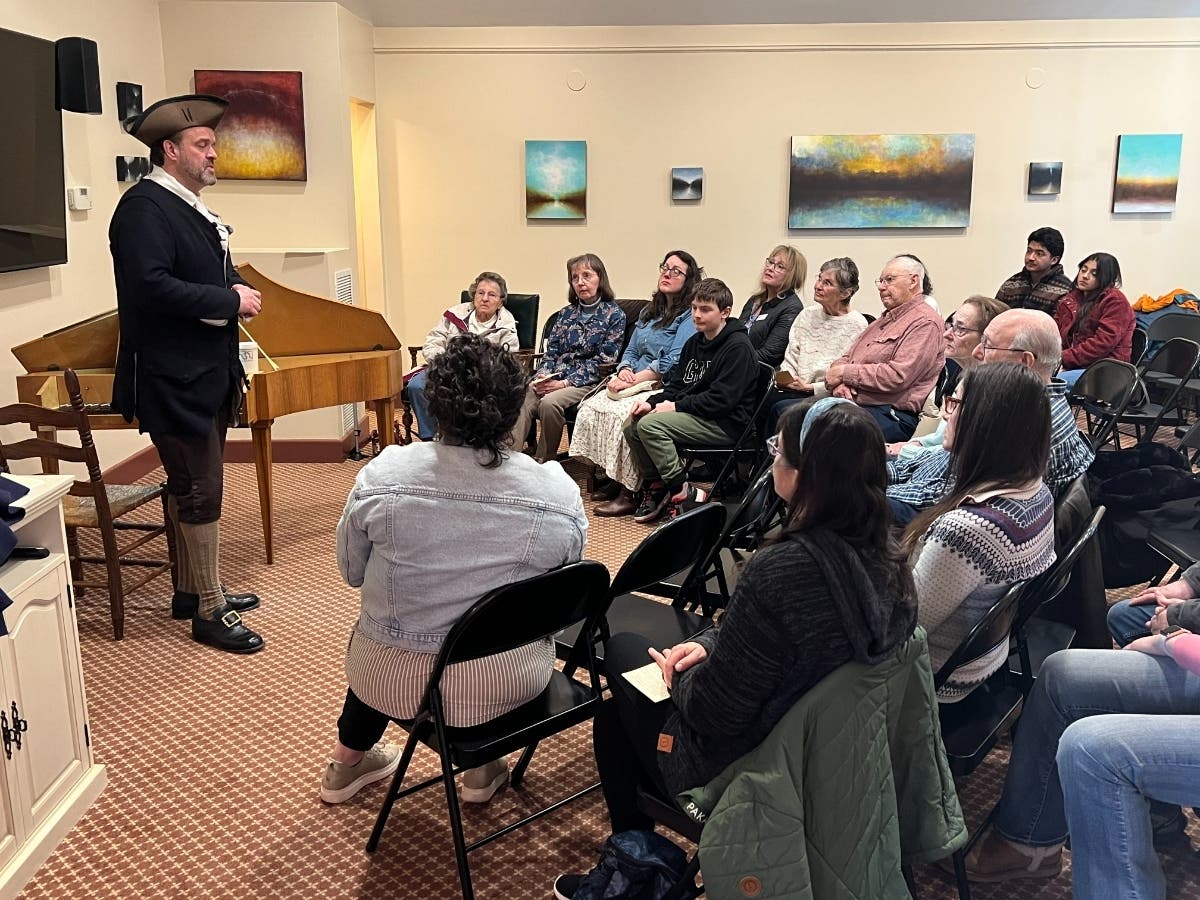
Historian and tenor Richard Franklin Donohue performed songs composed and sung in Connecticut during the Revolution on harpsichord, March 29


Connecticut's Revolutionary Music Comes Home to Stanley-Whitman House
Stanley-Whitman House | Farmington, CT | March 29, 2026
You know the tunes. That is the first surprise. You are sitting in a house built sometime between 1709 and 1720, listening to a man sing songs from the age of revolution on a harpsichord, and something keeps pulling at you from inside the music. A melody you half recognize. A rhythm that feels like it belongs somewhere in your body already. You cannot quite place it, and then you can. A hymn your grandmother might have known. A march you have heard in a film about redcoats. A drinking song that could have come from any pub in any century. Richard Franklin Donohue has been watching this happen to audiences all year, and he knows exactly why it happens. "We didn't have a unique culture," he told the room, "because we were separate little colonies. We were living off the culture from Europe." These were Englishmen. English subjects who had grown up singing English songs, praying with English hymns, marching to English tunes. And when they needed to argue, to grieve, to rally, to mock their enemies and hearten their friends, they reached for what they knew. They kept the old melodies and wrote new words. And in doing so, song by song, they made something that was neither quite English nor quite American yet, but was in the process of becoming. That becoming is what Donohue brought into Stanley-Whitman House on the afternoon of March 29, 2026, for his program What a Glorious Crash They Made: Musick of Connecticut's Revolution.
As the nation marks the 250th anniversary of American independence, programs like this one are rare and essential. It is easy, in a year of commemoration, to reach for the familiar stories: Boston, Philadelphia, Lexington and Concord, the Virginia planters who wrote the documents and the New York merchants who argued about them. What Donohue offers is something different. He offers Connecticut. And as he makes clear from the first song to the last, Connecticut has been hiding a remarkable story in plain sight, printed week after week in the columns of its own newspapers, waiting for someone to go looking. "Connecticut tends to be overlooked when we start talking about the revolution," he said, "because all that great stuff happened in Boston and then a bunch of great stuff happened in New York, but there was plenty that happened here as well." Donohue is the person who went looking, and what he found is a ninety-minute program that has earned roughly forty bookings this year across the region. Once you have heard it, that number makes complete sense.
Find out what's happening in Farmingtonfor free with the latest updates from Patch.
Donohue calls himself a historical musician, and the title is exactly right. He is a tenor and harpsichordist, a music teacher, the president of the Cromwell Historical Society, and that town's historian. He studied early music at UConn and came to understand, he told the audience during the Q&A, something that shapes everything about how he performs this material. "When you listen to music, you cannot listen to it outside of its history without it sounding different. If you think of how '70s music sounds to us today, and you have to understand the '70s to really understand '70s music. Well, the same goes with the 1770s." The harpsichord sitting at the front of the room was not an affectation. It was a statement. Its strings are plucked rather than struck, producing a sound that is bright and percussive and crystalline, a sound that does not linger the way a piano note does but speaks and then releases. There is something almost declarative about it, which turns out to be entirely fitting for music that was itself declarative, written to say something urgent, to make a case in a colony that was arguing about everything.
The engine of that argument was what Donohue calls the new song phenomenon. "They published new words either in a newspaper or just put a poster up on the wall in the tavern saying these are new words about this very important subject that we're all very much aware of, set to a very popular tune." He made it immediate: "If I have written new words about, I don't know, Donald Trump and Elon Musk, right? Everyone in this room has an opinion. And I said, let's sing this song to the tune of Happy Birthday. That's how similar this phenomenon was." The Connecticut Courant, Hartford's Patriot newspaper founded in 1764 and the direct ancestor of today's Hartford Courant, the oldest continuously published newspaper in the country, published song after song throughout the revolutionary years. Words only, no notation, because everyone already knew the melodies. The argument was in the new words.
Find out what's happening in Farmingtonfor free with the latest updates from Patch.
The program opened with The Liberty Song, and Donohue handed each person in the room a facsimile of the song as it appeared in the Connecticut Gazette in New London in 1768. You held a reproduction of an eighteenth-century broadside in your hands while he sang. The song was written by John Dickinson, a member of the Continental Congress, whom Donohue described as "the reluctant revolutionary. He wanted to remain British like many people did. We were British citizens after all." The tune was jaunty. The argument was careful. And then came the refrain: not as slaves, but as free men our money will give. Donohue paused there and said plainly what anyone paying attention was already thinking. "That's one of the great discrepancies, ironies of the Declaration of Independence. The Declaration of Independence didn't give everyone freedom. It gave women no rights. It did not free the slaves. It didn't mention anything about natives. And so we have been perfecting it for 250 years, but it certainly set something in motion 250 years ago that we are still working on today." He said it without editorializing and moved on. It was the right weight for the moment, honest without being heavy, present without being preachy, and it set the interpretive tone for everything that followed.
What followed was a revelation for anyone who thought Connecticut watched the Revolution from the sidelines. Studying Patriots versus Tories in this state, Donohue said, is "sort of like Yankees-Red Sox. On one side of the state, we were very Patriot. As we get to the other side, we're very Tory." The Connecticut Courant was a Patriot paper, but Tory newspapers existed too and published response songs, sometimes six or seven exchanges on a single melody, the same tune carrying opposite arguments back and forth across a divided colony. The revolution was not a unanimous chorus. It was a fight, and the music carries that complexity in every verse. And the fight was local, specific, rooted in these towns. A Presbyterian minister from Norwich named Nathaniel Niles wrote fifteen verses about Bunker Hill. "It's a very serious song," Donohue said, "should be sung by a hundred or so choral singers with big bellowing sounds, and I have a harpsichord and one voice, so I will give you my rendition of it." Oliver Arnold of Norwich, Benedict's uncle and a staunch Patriot, rewrote a Scottish love song called The Banks of the Dee to taunt the British army. A poet in New Haven rewrote God Save the King itself into encouragement for the besieged people of Boston, with rhyme schemes so poor that a nineteenth-century newspaper man later apologized for them in his memoirs. Donohue sang it anyway, with evident delight. Amos Bull, a traveling singing master who moved from town to town for weeks or months at a time teaching congregations their hymns, composed his Middletown resurrection hymn while he was in Middletown. William Billings, the Boston singing master who published the first volume of hymns composed entirely by a native-born American, delayed publication for two years so he could use untaxed American paper, and his Chester was printed in Connecticut in 1781 in Simeon Jocelyn's Chorister's Companion out of New Haven. These are not songs about the Revolution in the abstract. They are songs from these specific places, written by these specific people, in specific weeks, for specific reasons. They are ours.
The emotional range of the program is part of what makes it so sophisticated and so satisfying. This is not ninety minutes of martial enthusiasm. The music moves between grief and defiance, between the intimate and the enormous, between the sacred and the ribald. The Middletown hymn is quiet and private, the sound of faith persisting through war. The Bunker Hill ode reaches for something vast. The drinking songs repurposed as Patriot broadsides have the energy of a Saturday night that has turned serious. The True Soldier, published in the Connecticut Courant in June of 1778 as Washington was becoming a mythic figure, has a steady driving quality that sounds like someone who has made a final decision. And the songs marking Burgoyne's surrender at Saratoga and Cornwallis at Yorktown carry something almost giddy, the sound of people who had survived something they were not sure they would survive. The program closed with John Adams writing to Abigail from Paris in 1780, words Donohue read aloud: "I must study politics and war that my sons may have the liberty to study mathematics and philosophy. My sons ought to study mathematics and philosophy, geography, history, naval architecture, navigation, commerce, and agriculture in order to give their children a right to study painting, poetry, music." Then Donohue lifted his eyes from the page. "250 years ago, a group of people got together, took hands simply because they didn't like the way their government was treating them. Here we are 250 years later, still working to perfect the idea that they put forward, but they did put it forward." The room was quiet for a moment.
Part of what lingers after the program is the strange familiarity of all of it. Not just the tunes, though the tunes do it too. The arguments. By uniting we stand, by dividing we fall. The wretch that would enslave you. Not as slaves but as free men. We have been perfecting it for 250 years. You have heard these ideas before, in different words, in different centuries, in newspapers and speeches and arguments around dinner tables. That is because they did not end in 1783. The Revolution was the beginning of a conversation this country has never stopped having, about liberty and who gets it, about loyalty and what it costs, about what you owe the place that made you and what you owe the people it left out. The songs carry all of that. They are partisan documents from a partisan moment, because the Revolution was exactly that, a political fight that divided families and towns and colonies right down the middle, with songs on both sides. Hearing them now, in a year when the nation is asking again what the founding meant and who it was for, they do not feel like history. They feel like something closer. That is not a comfortable feeling, but it is an honest one, and it is precisely what good historical interpretation is supposed to produce.
Hearing this program in Stanley-Whitman House adds a dimension that cannot quite be replicated elsewhere. As museum Executive Director and Curator Andy Verzosa said in his introduction, "This is a house that was already a century old when the revolution began. That's worth sitting with for a minute. The people who lived within these walls during the 1760s and 1770s were not figures in a textbook. They were neighbors, congregants, farmers, and tradespeople. People who heard the same arguments, sang the same hymns, and faced the same impossible questions that were reshaping the world around them. Music was part of how they made sense of it all." Sacred music, psalm singing, the kind of music Amos Bull traveled the colony to teach, was already part of life in a household of the Whitmans' standing. A keyboard instrument in a colonial parlor was not unusual. When Donohue sat down at his harpsichord and began to play, he was almost certainly doing something that had been done in these rooms before in the 1770s, when the songs he performed were new. Not a recreation. A continuation. History is not only preserved in objects and documents, it is preserved in song, in performance, in the act of listening together. On March 29, in a room in Farmington, in a house that has stood for more than three hundred years, those things were the same.
Richard Franklin Donohue returns to Stanley-Whitman House in December for his annual winter solstice program. If March 29 is any measure, the room will be full, and you will leave with tunes in your head that you will not quite be able to place, and will not quite want to.
The full program was recorded and is available to watch on YouTube: https://youtu.be/Vd1qjTJtAZk
Stanley-Whitman House is located at 37 High Street, Farmington, CT. For information about upcoming programs, visit s-wh.org.