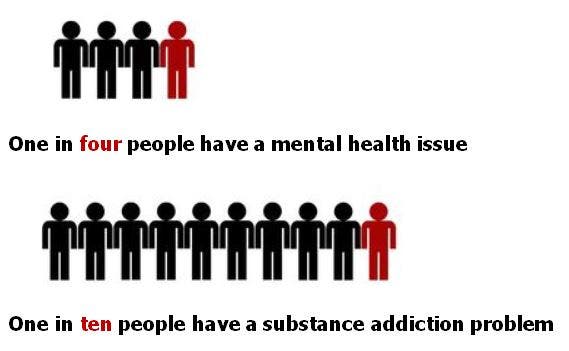
Despite great strides in the area of mental health treatment, in many cases mental illness still remains the “silent epidemic”.
Mental Health and Substance Abuse
Mental health and substance abuse crosses all race, cultural, and social economic lines; ranging from CEOs to celebrities, to children to seniors.
Find out what's happening in Greenwichfor free with the latest updates from Patch.
Mental health disorders are the leading cause of disability in our country.
For too long insurance companies imposed limits on access to help for many people, as a result of:
Find out what's happening in Greenwichfor free with the latest updates from Patch.
1. Limiting the number of visits for mental health therapy
2. Reimbursing for mental health treatment costs at lower levels than for other medical claims
2. Placing a yearly and lifetime dollar limit on the amount of allowable mental health treatment
3. Requiring a higher co-payment for mental health services
4. Excluding certain diagnoses – such as post-traumatic stress disorder (PTSD)
These restrictions often forced people to remain undiagnosed and untreated, and to suffer in silence.
The Affordable Care Act (ACA) and Mental Health Services
We’ve been listening to debates whether the ACA a good thing for America.
Regardless of where you stand in this debate, one thing is clear – as of Jan 1, 2014 the Affordable Care Act (ACA) expands access to mental health and substance abuse treatment for Americans, as part of the 10 “essential health benefits”
What does this mean?
1. Children under 19 years of age cannot be denied insurance coverage
2. Children up to 26 years of age may remain on a parent’s insurance policy
3. Mental health services (including substance abuse treatment) are now included as part of the “10 essential health benefits” package offered through State Exchanges
4. A person can no longer be denied coverage based on a “pre-existing” condition such as depression, post-traumatic stress disorder or substance abuse
The ACA now offers a “preexisting condition insurance plan” for citizens and legal immigrants who have been uninsured for at least 6 months
5. Your insurance coverage can’t be dropped, just because you get sick
6. The former yearly and lifetime dollar limits once imposed on some medical conditions such as mental health and substance abuse treatment are no longer allowed
7. Insurance premiums can no longer be rated based on your health status; although higher premiums may be based on your age, tobacco use, and where you live
8. States are now required to cover treatment for all those newly eligible for Medicaid
9. Plans that include mental health and substance abuse treatment must now pay these claims at the same dollar rate as it does for medical conditions
10. Healthcare professionals are now encouraged to discuss and screen all patients for mental health and substance abuse issues. These screenings and referrals are now classified as a Preventive Services and are available without a co-pay.
Case Management
Another key component of the ACA is the integration of treatment into a patient’s overall care plan; which is the focus of the work of The Caregiver Resource Center.
Case management functions such as planning, assessing, care transitions and care coordination are now recognized as a key component in improving the quality and efficiency of health care, preventing chronic disease, and improving public health.
A strong emphasis is now placed on the development of Care Plans for every patient, which is a written agreement, mapping out how care will be provided for an individual, utilizing available resources to meet that person’s unique and often complex needs.
The goals of Care Planning
- Optimize Health, Function and overall Quality of Life
- Help prevent or delay disability, frailty, and displacement from home and community
- Help Preserve Assets
Mental Health and Substance Abuse Resources
“Remember help is just a phone call away!”
CT Department of Mental Health and Addictions Services
410 Capitol Avenue
Hartford, CT 06106
780 Summer Street
Stamford, CT 06905
For general information: 203-388-1600
Crisis services: 203-358-8500
Connecticut Suicide Hotline
Serving Southwestern CT
Greater Bridgeport Community Mental Health Center
8am - 8pm
(203) 551-7507
CT Info-line
Dial 211
The information in this article is provided as an information resource only, and is not to be used or relied on for any diagnostic or treatment purposes. This information is not intended to be patient education, does not create any patient provider relationship, and should not be used as a substitute for professional diagnosis and treatment.
Please consult your health care provider for an appointment, before making any healthcare decisions or for guidance about a specific medical condition.
_________________________________________________________________________________________________________________________
Linda Ziac is the owner and founder of The Caregiver Resource Center. Linda founded her company in October 1990, and provides concierge case management and advocacy services for seniors, people with special needs and families.
Linda’s professional career spans 40 years in the health and mental health field as a CT Licensed Professional Counselor, CT Licensed Alcohol and Drug Counselor, Board Certified Case Manager, and Board Certified Dementia Practitioner.
Linda’s role is to work with the client, their family and healthcare professionals to help assess, plan for and implement ways to allow for their greatest degree of health, safety, independence, and quality of life. We are often asked to help when a person is taken to the ER, is in the hospital, or there is a need to help assess and implement a plan to address a person’s day to day needs.
This process involves identifying a client’s abilities and needs, and helping to design a care plan (road map) that is composed of a spectrum of services, that best meets the unique needs of that particular client. A client and their family select the services that they want, and they only pay for those services.