Community Corner
Ellis Tibere's Mom Testifies In Crisis Intervention Bill Hearing
State senator, filmmaker and mom of man accused of attempted murder working to ensure cops are trained in mental health crisis intervention.


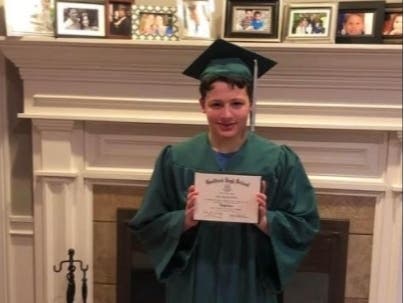
GUILFORD, CT — He went from a soon-to-graduate, well-liked and "kind" high school student to being accused of attempted murder in less than 24 hours.
The mother of Ellis Tibere, a mentally ill imprisoned 19-year-old charged with violent felonies including attempted murder, is prepared to testify Thursday before the Connecticut General Assembly’s Public Safety and Security Committee in support of a proposed bill calling for a study of crisis intervention training currently required by the State Police Academy and the Police Officer Standards and Training Council. Such training is to "ensure that police officers have the tools they need regarding mental health awareness and crisis intervention," said the bill's sponsor, Guilford state Sen. Christine Cohen.
There is no mandate that police departments have crisis intervention teams in the state.
Find out what's happening in Guilfordfor free with the latest updates from Patch.
Ellis Tibere's mother, Denise Paley, maintains that what her son is accused of — a seemingly random attack where he’s alleged to have violently stabbed and seriously wounded a 33-year-old woman in a Westport beauty salon parking lot a year ago — might have been prevented if police believed, understood and then acted based on the Tibere family’s claim that the then-18-year-old’s actions were due to his serious mental illness that had him in a psychotic state.
The Jan. 6, 2020, attack, which his parents neither defend nor deny, was preceded by the teen's daylong disappearance — an extreme deviation from his typical behavior, his parents said — that occurred while he was in a psychotic state, a condition where a person has lost touch with reality and is experiencing delusions and hallucinations.
Find out what's happening in Guilfordfor free with the latest updates from Patch.
Read the full Patch story here.
Through the Freedom of Information Act, Patch requested all the relevant Guilford Police Department documentation around the 24 hours the Guilford High School student was reported missing to police by his parents, and the last call they had with Guilford officers when they say they were told, “Didn’t you know, he’s in Westport;” held by police for the Jan. 5, 2020 assault.
Guilford Police Chief Warren "Butch" Hyatt said Monday the full release of all requested documents, recordings and video to Patch is imminent. (Check back with Patch for a follow-up story on what those records show.)
Hyatt agreed that crisis intervention training for law enforcement officers is important and is training he wants his officers to undergo.
In her slated testimony Thursday, Paley is expected to tell lawmakers that her son, then a senior in high school, was supposed to be at the library working on a school project with classmates on Jan. 5, 2020, but never arrived. She and her husband, Eric Tibere, “knew something was wrong” when their son did not return home and could not be found by family or friends, so she went to police to report him missing.
“As developments unfolded throughout the evening, we became certain he was experiencing a mental health crisis. We were terrified he would harm himself,” Paley will testify.
She told a Guilford police officer repeatedly about her concerns, an officer who she maintains “lacked the training to put the evidence together and make this determination for himself. Whose predetermined narrative did not consider Ellis’ mental state. An officer who, despite my pleas to act, told me that our crisis was ‘a family matter and not a police matter.’”
Ellis Tibere is imprisoned on $2.5 million bail. The court and department of corrections, agreeing he is mentally ill, sent him to Whiting Forensic Hospital, the state's maximum-security psychiatric hospital where he remained for several months. The Tibere family has yet to receive a specific mental health diagnosis for their son who, as a child, was diagnosed with obsessive compulsive disorder and attention deficit disorder. The department of corrections and the court have determined he is mentally ill, though fit to stand trial. He’s being held at Manson Youth Institution in Cheshire.
The purpose of Cohen’s proposed legislation is to “recognize that incidences related to mental health are on the rise and to provide law enforcement officers with the tools they need for mental health awareness and crisis intervention.”
“What we know is that a tremendous amount of cases for which the police are contacted are mental health-related,” Cohen told Patch. “Crisis intervention teams can help diffuse situations and get the appropriate assistance and care for people in need of mental health intervention. But we have to provide our law enforcement officers with those tools, as well as ways to collaborate with local mental health organizations.”
Cohen’s bill would “take a dive into our crisis intervention training for law enforcement and plan to have an upcoming information session for legislators.” Cohen has been working with Paley and has brought another Guilford woman into the conversation.
Jenifer McShane produced and directed the award-winning documentary “Ernie & Joe: Crisis Cops.”
McShane’s film follows two San Antonio, Texas, police officers who engage with “people in crisis” using their “innovative approach to policing that takes mental health into account and is having a dramatic effect on the way police respond to these challenges.”
McShane did three years worth of research for the film, including “observing during ride-alongs and talking to mental health officers.”
In response to a question by Patch about how feasible it is to institute a policy, the training and then actual crisis intervention team in smaller police departments, she said, “Just start.”
“Start where you are. Every community has different resources, but any community can start by getting educated and talking about it honestly,” McShane said. “I think the will to start is so important.”
But she pointed out that it’s “not just a policing issue — it is a community issue.”
“Mental health challenges impact all communities whether urban, suburban or rural," she said. "We are facing a national crisis, and it takes a collaborative community response. Police and first responder training is just one piece of the puzzle.”
McShane added that crisis intervention training “is as important, if not more important, for small- and medium-size police departments.”
“Large cities often have more resources and support, but people in crisis are everywhere — not just large cities,” she said. “The biggest misconception is that the problem is out there, not ‘here.’ We all need to be better versed in mental health awareness.”
Cohen said that the information session planned for legislators will include “law enforcement officers to help us really understand what they’re faced with on calls and how this training helps them.” The session also will include a portion of McShane’s documentary as well as the two police officers in the film as guest speakers.
“I really think this will raise awareness and assist in the passage of the bill,” Cohen said.
'Crisis intervention works'
McShane believes that, “at a minimum,” an eight-hour mental health first aid course is a good place to start to be able to “spot and understand the signs of mental health challenges ….”
Guilford Police Chief Hyatt said he gave a letter of support to BHCare for a grant that would cover the mental health first aid training course, not just for police and first responders but the community at large, he said.
But McShane said that beyond the first-step mental health first aid course, "it works” when police departments have the "will" to institute dedicated crisis intervention teams.
“San Antonio didn't have funds and they started small. Their police department's mental health unit started with two officers as a pilot program which grew to four, six and ultimately 20 officers. Their police commissioner made the decision to train 100 percent of officers,” she said. “In the process, they realized a beautiful fact: Once officers actually used crisis intervention team training on the job, they realized deescalation and crisis intervention training works. Private and public hospitals, law enforcement, and mental health agencies in San Antonio meet monthly to tackle the issues together. Collaboration is the secret sauce.”
Hyatt said the Guilford Police Department is looking to add more crisis intervention-trained officers and has often used social workers and other community resources for situations involving someone in crisis, although it does not have a dedicated crisis intervention team.
"When the call comes in and the police respond, a social worker or people trained is very, very helpful, and that's why one of the policies being looked at as part of the police accountability study is the feasibility to have social workers with police for just those situations," Hyatt said. "You'll find across the board from bigger cities like New Haven to towns like Guilford, police are going to agree that's a great concept. We are very lucky to have good local resources like BHCare, social services and Guilford Youth and Family services, but social workers are not always available at 2 a.m., so having people trained is very important."
McShane said she's making her film available at no charge to all law enforcement agencies across the country. And she hopes it will be used at the Connecticut police training academy. Hyatt told Patch he has spoken to McShane and hopes to screen the film for his officers, as he's committed to crisis intervention training, even at the "minimum level" to start.
In her testimony Paley is prepared to say that “Crisis intervention training is more than quelling a volatile situation. It’s also about preventing one.”
“I’m grateful that the police Ellis encountered in Westport do have this training. It may have saved his life,” she said. “I can’t help but wonder, if our town had a crisis intervention team, how this whole story could have unfolded much differently.”
A portion of McShane's film will be screened by NAMI Elm City and NAMI Shoreline with a panel discussion to follow March 29 from 7 to 9 p.m. Check back with Patch for the link to register.
Check back with Patch for story updates.
Get more local news delivered straight to your inbox. Sign up for free Patch newsletters and alerts.