Neighbor News
Statewide Survey Reveals Gaps in Developmental Screening, Parenting Supports for Families with Young Children
CTData Collaborative Authors 2nd in Series of Connecticut RAPID Survey Reports, Providing Data, Analysis and Recommendations for Policy

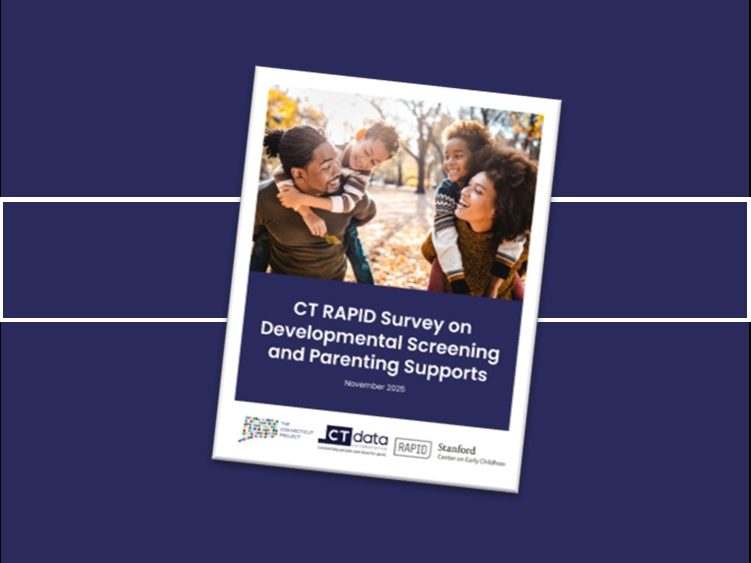
The Connecticut RAPID survey on Developmental Screening and Parenting Supports received responses from 2,207 primary caregivers of children under 6 years old from 152 towns across Connecticut, revealing substantial disparities in access to early childhood developmental services and parenting supports, particularly for children in lower income families, children with disabilities, and parents for whom English is not their primary language.
The results provide insights into areas of strength as well as inequities and gaps that should be addressed with policies and programs that are responsive to families’ and children’s needs.
The statewide survey focused on:
Find out what's happening in Greater Hartfordfor free with the latest updates from Patch.
- Developmental screening and connection to services, including whether and how children were screened for developmental delays, and parents’ experiences getting connected with and accessing services for their children.
- Parenting supports, including whether and how parents were accessing parenting supports and resources, what additional supports parents would find useful, and how confident and connected respondents are feeling as parents.
Findings from this survey can inform policy and programmatic changes in Connecticut to ensure that all children are receiving timely developmental screenings, families are being connected to services that meet their children’s needs, and all caregivers of young children in Connecticut have access to parenting supports that can build their confidence as parents.
Parents or other caregivers of children under 6 years old living in Connecticut were eligible to participate. A total of 17 community-based organizations in towns and cities across Connecticut invited parents to complete the survey. This approach was designed to elevate the voices of lower-income families who are often under-represented in statewide surveys. A majority of respondents were low-income, relative to the state median income.
Find out what's happening in Greater Hartfordfor free with the latest updates from Patch.
The Connecticut RAPID Survey was distributed to parents of young children across Connecticut; it is the second of eight surveys planned in Connecticut as part of an initiative that includes The Stanford Center on Early Childhood, The Connecticut Project, and CTData Collaborative (CTData). The first report, on Child Care Access and Affordability, was released in May; this second report in November.
“These are actionable findings that reflect the real-life experiences of Connecticut children and families all across the state,” pointed out Michelle Riordan-Nold, Executive Director of CTData. “The collaboration to gather this data brings together a range of expertise and local connections with families that provide insight into where Connecticut policy makers can act to improve the lives and well-being of young children.”
The CTData Collaborative provides data and data support so that nonprofits, state agencies, businesses, and the public can make decisions and work toward equity – all informed by data.
The Connecticut RAPID Survey is part of the RAPID Survey Project led by Dr. Philip Fisher and Cristi Carman at the Stanford Center on Early Childhood. The Connecticut RAPID Survey project is directed by Courtney Parkerson at The Connecticut Project. This report was authored by Chase Wilson and Cynthia Willner at CTData.
This work was funded by The Connecticut Project. The Connecticut Project is a philanthropic, advocacy, and mobilizing organization that brings together people, ideas, and resources to build opportunity for working class people throughout the state of Connecticut.
"The RAPID surveys continue to show something many parents already know: it's almost impossible for working class and middle-class parents to find and afford the early childhood services and resources that their children need,” said Courtney Parkerson, Director with The Connecticut Project. “We remain committed to lifting up working class parents' voices to advocate for an affordable, accessible, quality early childhood education system that meets the needs of all children."
Findings: Developmental Screening and Access to Services
- One in five children ages 1 to 5 years had not received a developmental screening from any source – including pediatricians, childcare providers, and caregivers at home – within the past year.
- Two in five children ages 1 to 3.5 years had not received a developmental screening from a pediatrician in the past year, as recommended by the American Academy of Pediatrics.
- Concerns raised by a professional resulted in a referral for evaluation more often than when a parent raised a concern with a professional (63% of concerns raised by a professional vs. 44% of concerns raised by a parent).
- Three in five parents were satisfied with the support they received getting connected to services for developmental concerns and three in four reported that these services met their children’s needs.
- Higher-income and White parents were more likely to report that it was easy to access services for their children and that these services met their children’s needs.
Parenting Supports
- Among parents who speak a language other than English in the home, roughly one in four said that they do not have access to parenting resources in a language they feel comfortable speaking.
- Three in four parents – and 82% of parents of a child with a disability – reported that they could benefit from additional parenting resources and supports.
- Many parents expressed a preference for receiving additional parentings resources via newsletters, texts, or parenting apps.
- Parents were particularly interested in additional resources related to child behavior management and promoting a healthy parent-child relationship
- More than four in five parents reported feeling confident about their parenting skills, but nearly half (48%) reported feeling overwhelmed by their parenting responsibilities. Among parents of children with disabilities, more than half (57%) reported feeling overwhelmed.
Recommendations
These findings suggest that policy and programmatic changes are needed to:
- Ensure that all young children receive developmental screenings as recommended by the American Academy of Pediatrics.
- Assess the frequency with which valid concerns from parents about their children’s development are not acted on by pediatricians and other early childhood professionals.
- Promote equitable access to services to address developmental concerns for families of different income levels and racial and ethnic identities.
- Increase the provision of parenting resources – particularly on behavior management and promoting a healthy parent-child relationship – in easy-to-access formats such as digital newsletters, and in a greater variety of languages.
- Provide more parenting resources and supports specifically for parents of children with disabilities.
Planned future survey topics, analysis, and recommendations will focus on Financial Security & Material Hardship, Early Literacy & Relational Health, Housing and Access to Health Care, Child Care Enrollment & Navigation, and Parent & Child Well-Being and Material Hardship. Results will be released throughout 2026.
“Data has a story to tell, and when we listen to what it’s saying, we can construct policy that truly meets the needs of our families,” said Rep. Robin Comey (D-Branford), Vice-Chair of the Human Services Committee. “I want to thank CTData Collaborative and their partners for their research, which sets the foundation for actionable policy that makes a real difference in people’s lives.”
“As the Senate Chair of the Committee on Children, my primary focus is ensuring and improving the safety of our youngest residents,” said Sen. Ceci Maher, (D-Wilton), Deputy Senate President Pro Tempore. “This report makes it clear that children and families in our communities are not receiving the care and aid they need. This is a problem now and poses a lifelong disadvantage for many children if not fixed. The good news is this report tells us exactly where we can focus our efforts – better connecting parents to the resources they need to ensure children receive the care they deserve.”
The 17 CT RAPID Community Partners include: The Bridge Family Center, West Hartford; Bridgeport Prospers Cradle to Career, Bridgeport; Bristol Early Childhood Alliance, Bristol (has since merged into United Way of Central and Northeastern CT); Building One Community, Stamford; Capital Region Education Council, Hartford; Child & Family Agency of Southeastern CT, New London; Early Childhood Collaborative of Southington, Southington; EdAdvance, Litchfield; Enfield KITE, Enfield; Hamden's Partnership for Young Children, Hamden; Madonna Place, Norwich; New Haven Early Childhood Council, New Haven; Northeast Early Childhood Council, Windham County; Safe Futures, New London; Stamford Cradle to Career, Stamford; United Way of Coastal and Western Connecticut, Danbury; and Waterbury Bridge to Success, Waterbury.
The project team acknowledges the parents who responded to the survey, the 17 CT RAPID Community Partners who brought the survey to parents of young children across Connecticut, the CT RAPID Advisory Committee, and Stanford’s CT RAPID Project Team for their contributions to this work.